Winding Key House: The Withered Task of the Piano Tuner
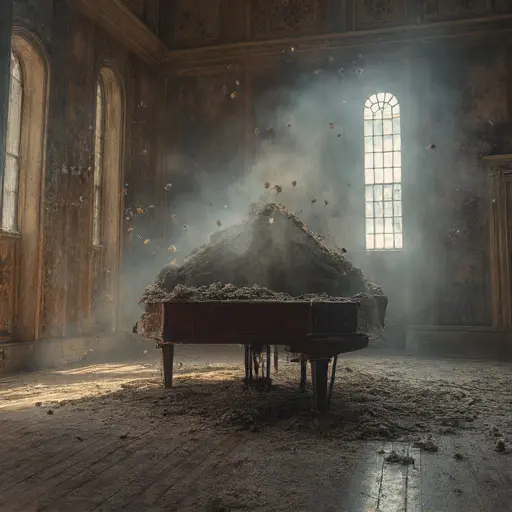
Winding Key House, named for its spiral staircase and musical patronage, served as both residence and workshop for Mr. Silas Thorne, a Piano Technician who worked for the family from 1865 until 1885. Silas was responsible for the maintenance and tuning of the manor’s collection of musical instruments, a vital role in an era where music was central to domestic life. His professional sphere was small and precise: a low-ceilinged back parlor that smelled faintly of shellac and fine sawdust. Here, the remnants of his trade were carefully arranged: jars holding tiny screws and wire coils, specialized leather pads, and small bottles of lubricants, all now coated in a thick, undisturbed patina of dust. On a small, sturdy workbench, a series of specialized hammers and tuning forks lay perfectly preserved, a toolkit abandoned mid-task. The pervasive atmosphere spoke of quiet diligence, a routine that suddenly ran to a Withered stop, leaving his entire workshop intact.
The Technician’s Logbook
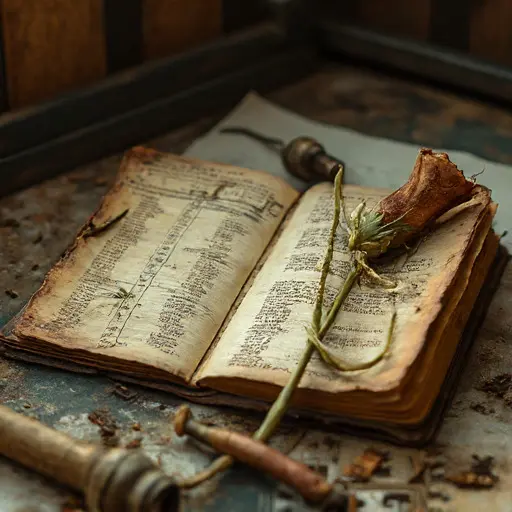
Silas Thorne’s maintenance logbook, recovered from the workbench, was an archive of the manor’s musical life. It detailed decades of tunings, string replacements, and repairs, charting the rise and fall of various instruments. However, the last few months of entries in 1885 showed a troubling shift. Silas began logging not just technical details, but personal observations, almost exclusively focused on the health and moods of Theodore, the youngest son of the manor, who was a prodigious pianist. The entries grew increasingly worried, citing Theodore’s “shaking hands” and “unnatural fevers.” The logbook abruptly terminated in September 1885, following a final, cryptic note written diagonally across a full page: “The melody is Withered. The tension cannot be held. I leave before the final chord.”
An Unfinished Repair

The mystery of Silas Thorne’s sudden vanishing was only deepened by the state of a small, upright piano in the back parlor. The front panel had been carefully removed, and several specialized tuning tools were still wedged amongst the strings and hammer rails. This was not the act of a man leaving his job; it was the abandonment of a job mid-completion. Tucked into the bottom of the exposed piano cavity, in a space where small tools were often stored, was a plain, unmarked envelope. Inside were five letters addressed to various regional newspapers, all identical, dated the day after his last log entry. They detailed, with professional precision, the symptoms and likely cause of Theodore’s ‘fevers’ as being not natural illness, but a slow, continuous poisoning, citing a specific, lead-based tonic prescribed by the family’s rural physician. The letters, though signed by Silas, were never mailed, remaining there, the Withered truth preserved within the silent shell of the unfinished piano.
Would you like me to generate the Next article following the strict guidelines?
