Wind-Shear House of the Evergreen Canyon Edge
Abandoned Victorian woodland house set on the lip of a high canyon cliff where dense evergreen forest plunges into steep vertical walls and a distant river threads through the canyon floor far below, the structure designed as a compact but vertically assertive residence anchored around a heavy stone core with two staggered side volumes that step downward in response to the cliff’s natural terraces, as if the house is slowly negotiating its own descent.
The exterior is composed of layered materials chosen for wind resistance and tonal restraint: a foundation of cool gray granite transitioning into upper levels of pale stucco and inset timber cladding. The granite base reads as dense and immovable, shifting between steel gray, deep graphite, and faint blue-black mineral tones that echo the canyon rock. Above this, the stucco surfaces soften into chalk white, pale lavender-gray, and washed sky blue, subtly mottled by constant mist exposure. Timber sections are deeply stained and weathered into ink black, forest green, and muted burgundy, creating a restrained but complex chromatic layering shaped by long-term wind abrasion rather than decoration.
The architecture is organized around a strong vertical spine: a central stone core rises as the structural anchor, while two side volumes attach asymmetrically and drop slightly with the cliff’s stepped geology. This creates a staggered silhouette that feels naturally eroded and adapted rather than designed as a single unified block. The massing emphasizes upward compression at the core and lateral release at the edges, mirroring the pressure of wind moving through the canyon.
The roof is a tightly engineered system of intersecting steep gables designed to resist persistent wind shear. Slate tiles vary across surfaces in deep graphite, storm blue-gray, and occasional silvery highlights where stone has been polished by weather. A tall central chimney in dark brick rises slightly off-axis from the main structure, its surface marked with soot-streaked gradients that blend into the surrounding cliff shadows, reinforcing the vertical pull of the composition.
The façade is defined by strong vertical rhythm: tall narrow sash windows dominate the central stone core, while grouped and slightly recessed window assemblies appear within the timber side volumes. Frames alternate between soft cream, desaturated teal, and pale ochre, creating subtle tonal modulation without breaking the architectural discipline. Glass surfaces reflect the canyon environment in fractured vertical slices of green canopy, slate rock, and drifting mist.
The main entrance is embedded in the granite base beneath a shallow arched recess carved directly into the stone. Above it, the upper volume projects slightly outward, sheltering the threshold from direct wind exposure. The heavy wooden door is finished in deep cobalt blue that has aged into a storm-worn indigo, its surface dulled and softened by exposure. A narrow stone stair descends from the entrance, clinging to the cliff face as it winds toward an unseen forest path below.
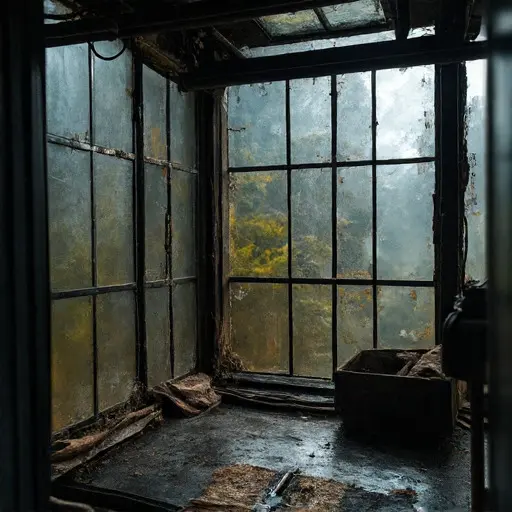
On the canyon-facing side, a narrow enclosed balcony runs along part of the upper level, constructed from black iron framing and irregular glass panes that distort reflections of treetops and distant river light. Some sections show reinforced timber supports added later, suggesting ongoing adaptation against wind pressure and structural fatigue.
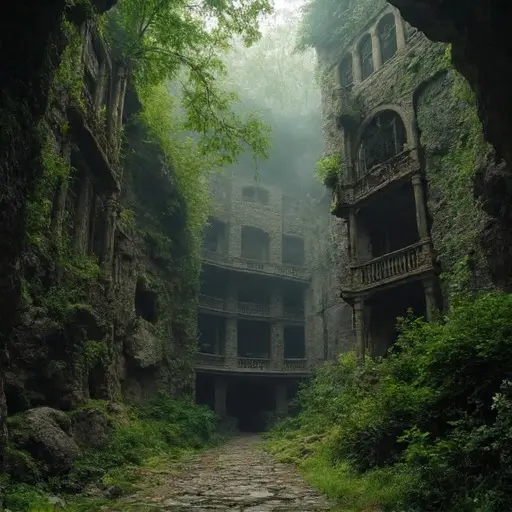
The surrounding environment is constantly in motion: tall conifers fill the canyon walls, their crowns bending under persistent wind, while mist moves in slow sheets through the forest gaps. Far below, the river flashes intermittently as light breaks through shifting cloud cover.
The atmosphere is cool, elevated, and continuously dynamic, defined by vertical pressure, wind flow, and layered exposure. The result is a grounded Victorian woodland cliff-edge house that feels structurally tense, materially restrained, and deeply integrated into a wind-shaped canyon environment without repeating prior architectural systems, spatial organizations, or material palettes.