Whispers of the Coastal Grove Palace
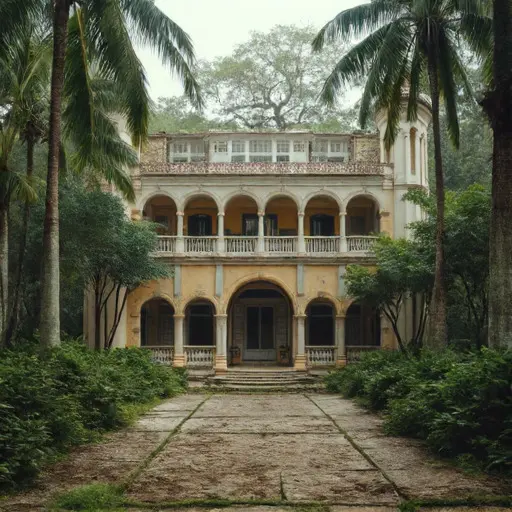
An abandoned Moorish Revival coastal palace rests within a subtropical forest grove, as if the sea once shaped its language before the land quietly reclaimed it. The structure rises 3–4 stories in a layered composition of horseshoe arches, interlaced geometric façade patterns, and pale stucco surfaces warmed by aged ochre tilework. Despite its decay, the palace retains a precise ornamental logic—every arch, tile band, and carved surface still aligned in rhythmic repetition, now softened by time and vegetation.
Slender corner towers rise at the edges of the composition, echoing minaret forms but reinterpreted through Moorish Revival restraint. Their green-glazed ceramic domes remain intact, though dulled into deeper oceanic tones under years of exposure. Across the façade, carved wooden mashrabiya balconies once provided shade and privacy; many have partially collapsed, their latticework broken and draped in climbing vines that blur the boundary between architecture and forest.
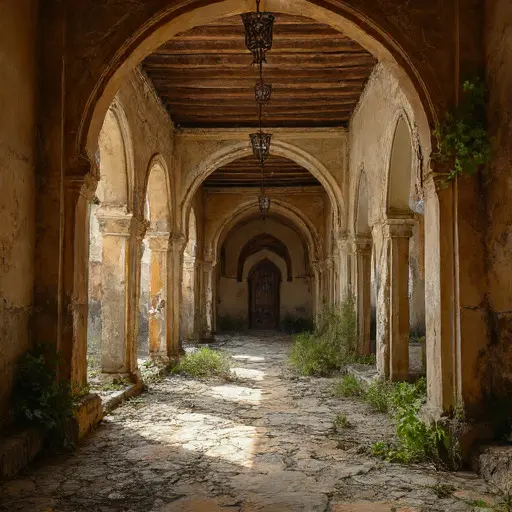
The central courtyard façade opens directly into the surrounding grove, dissolving the boundary between interior and exterior space. A series of repeating arch colonnades lines the courtyard perimeter, forming long shadowed passages that lead into completely unlit interior voids. No artificial illumination survives inside the palace; instead, daylight filters through arches and broken latticework, casting soft patterned shadows across stone surfaces.
Terraced stone pools occupy the courtyard’s lower levels, once reflective and ceremonial but now dry and fractured. Vegetation pushes through cracked channels where water once flowed, creating irregular green veins across geometric stone basins. The original symmetry of the water gardens remains legible, though interrupted by organic growth and structural collapse.
The surrounding landscape is densely layered with palms and broadleaf trees that press close against the palace perimeter. Their forms echo the repeating verticality of arches and towers, creating a visual dialogue between natural and constructed rhythms. Broken mosaic fountain fragments and overgrown patterned tile pathways fill the foreground, their once-vivid designs now softened into earthy abstractions beneath leaves and soil.
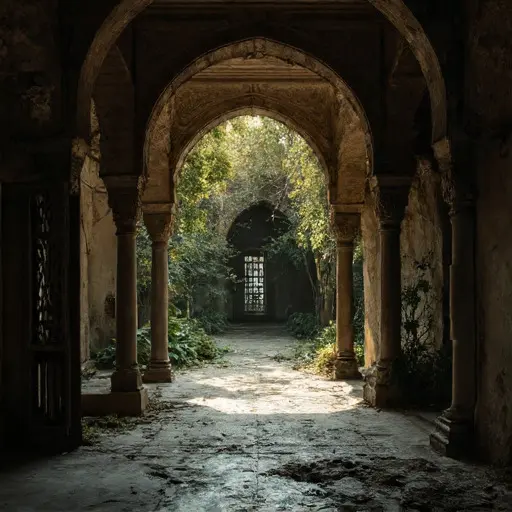
From a low-angle ultra-wide perspective, the palace’s ornamental density becomes overwhelming yet coherent, with every surface contributing to a unified architectural language. The horseshoe arches create a continuous rhythm across the façade, while geometric tilework binds the composition in layered patterns that wrap around corners and recesses. The minaret-like towers anchor the structure vertically, contrasting with the horizontal spread of arches and courtyards.
The atmosphere is calm and evenly lit under soft neutral daylight, with a clear sky filtering light evenly through the forest canopy. There is no mist or dramatic weather—only the quiet tension of ornamented stone gradually yielding to tropical vegetation. The result is a cinematic architectural study of a forgotten coastal palace, where Moorish Revival craftsmanship persists beneath a slow, inevitable return to nature.