When the Timber Began to Disappear into Shade
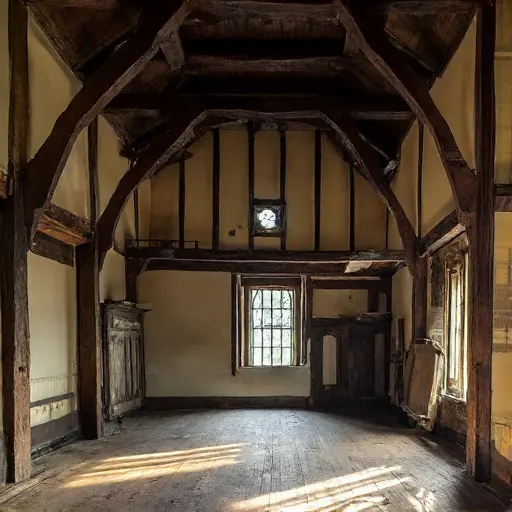
The Wycliffe Ridge House was constructed in the final decades of the nineteenth century, during a period when Tudor Revival architecture was increasingly favored for rural estates situated along forested valley edges. Designed as a family residence for a timber merchant lineage, the house was deliberately positioned on a sloping ridge where pine forest and open valley terrain meet. Its asymmetrical composition, defined by intersecting steep gables and a dominant central cross-gable, was intended to reflect both stability and complexity—an architectural expression of layered prosperity rooted in woodland resources.
The ground level, built in rich umber brick, provided thermal mass and permanence, while the upper cream stucco and dark oak half-timbering created a visually articulated structure that blended into the vertical rhythm of surrounding trees.
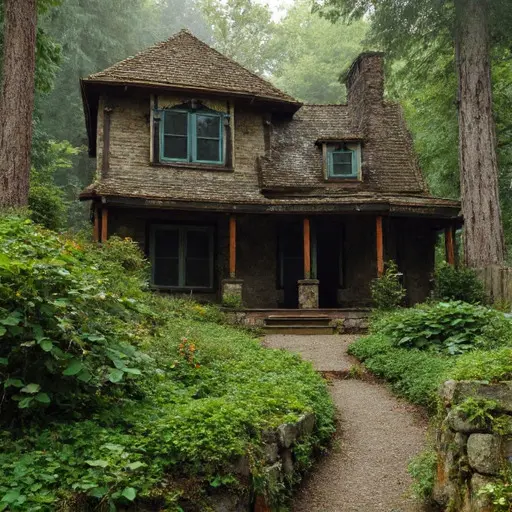
By the early 1920s, the Wycliffe Ridge House entered a gradual phase of decline following the reduction of its original family’s rural operations and their eventual relocation to urban centers. Maintenance became increasingly intermittent, particularly in roof care and timber preservation, where steep gables and intersecting joints required regular attention to prevent moisture intrusion. The slate-gray shingles continued to shed rain effectively for some time, but minor failures at ridge intersections allowed slow water penetration into upper framing. Interior spaces were progressively vacated, with upper-level rooms closed first, followed by secondary living areas that became impractical to heat and maintain during colder seasons.
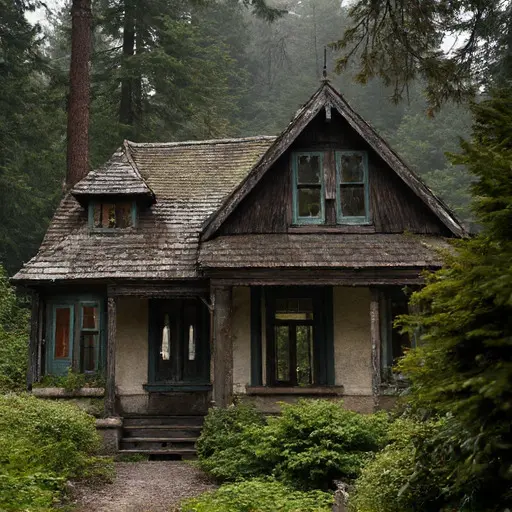
By the early 1930s, the Wycliffe Ridge House was fully abandoned and never reoccupied. No restoration efforts were undertaken due to its remote valley location and the steady progression of natural weathering. Official records eventually ceased referencing the property beyond its status as inactive rural residence. The house remains intact in its Tudor Revival form, its layered materials still legible beneath forest encroachment, standing quietly at the threshold between cultivated history and returning wilderness.