Vox-Natura: The Ornithologist’s Final Call
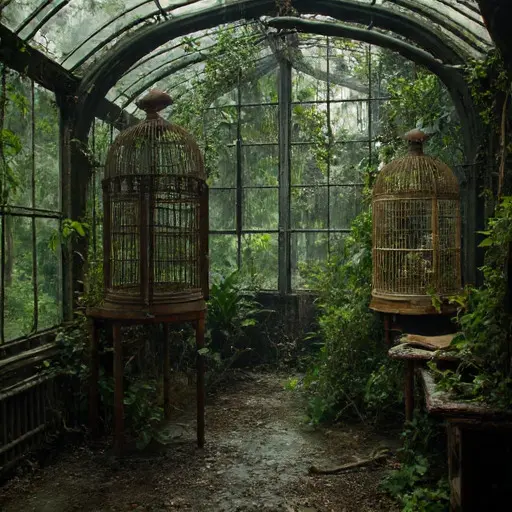
The moment the heavy, rotting wooden door to Vox-Natura swung inward, the air was immediately cold, humid, and held a distinct, unsettling blend of wet earth, decaying moss, and the faint, high-pitched sweetness of exotic bird food, long spoiled. The name, roughly translating to “Nature’s Voice,” was a haunting irony given the house’s profound silence. This abandoned Victorian house was structured not just for living, but for listening—its architecture featuring numerous acoustic funnels and high, open areas designed to capture and amplify sound, now serving only to emphasize the absolute quiet.
The final inhabitant was Professor Horatio Finch, a brilliant, but intensely reclusive ornithologist and bio-acoustician of the late 19th century. Professor Finch’s profession was the meticulous study and classification of avian life, focusing especially on the complex patterns of bird vocalizations. His singular obsession, however, was the creation of a ‘Universal Avian Language Translator’—a code that would unlock the meaning behind all bird calls, believing that the chorus of the natural world held the ultimate, objective truth. After the death of his exotic, prized singing canary, he retreated to the manor. He dedicated his final years to resolving this single, terrifying goal. His personality was intensely patient, sensitive to sound, and utterly consumed by the pursuit of unadulterated, primal communication.
The Sound Laboratory
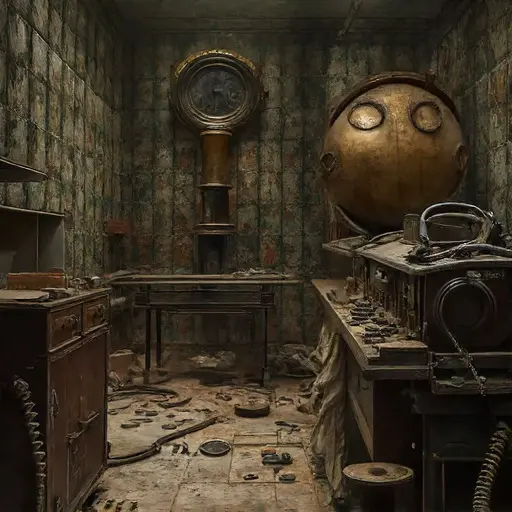
Professor Finch’s mania culminated in the Sound Laboratory. This secure, padded room was where he spent his final days, recording and analyzing the patterns of sound. His journals, written in a precise hand that gradually deteriorated into frantic, wave-like diagrams, were found pinned beneath the brass horn of his recording machine. He stopped trying to decode the language and began trying to speak it, testing his vocal cords against the complexities of the most ancient bird calls. “The Pattern is not in the syntax, it is in the frequency,” he wrote. “To hear the final truth, I must emit the perfect, primal note.”
The house preserves his anxiety structurally. Many interior walls have small, almost invisible tubes and speaking pipes running through them, remnants of a complex internal intercom system he used to instantly amplify and test acoustic properties throughout the entire manor.
The Final Feather in the Abandoned Victorian House

Professor Horatio Finch was last heard in his aviary, not speaking, but emitting a series of high-pitched, complex whistles and clicking sounds, followed by a sudden, jarring snap of glass. The house was found entirely locked from the inside. No body was found, and the aviary glass was cracked in a single, circular pattern.
The ultimate chilling clue is the single, perfect, black feather found in his cabinet. It belongs to no known species of bird. This abandoned Victorian house, with its silent aviary and soundproofed walls, stands as a cold, imposing testament to the ornithologist who sought the perfect voice of nature, and who, in the end, may have finally achieved the primal, unadulterated communication he desired, vanishing into the silent truth of the final call.
