Vertical Terraces of a Quiet Hillside Manor
An abandoned Victorian vertical terrace house sits embedded into a dense forest hillside under soft overcast daylight, where evenly diffused light flattens harsh contrast and emphasizes muted, natural tones. The structure is fully intact and lightly weathered, built from pale stone and white timber, arranged not as a conventional home but as a carefully stacked vertical residence that follows the slope of the terrain with engineered precision.
From the forest approach, the house appears modest—only two stories visible above the hillside. From the downhill side, however, the full four-tier structure is revealed, cascading downward in a controlled architectural descent. Each tier steps into the next with subtle offsets, creating a staggered but coherent vertical composition that feels intentional and structurally resolved rather than improvised.
The highest tier carries a simple dark slate roof with a clean ridge line and a single chimney. Below it, each level forms its own distinct horizontal band, with flat or gently sloped roof extensions doubling as terraces for the tier above. The overall effect is a layered architectural stack embedded directly into the land, as if the house and hillside were designed together as one system.
Exterior staircases run along the side of the structure, forming a continuous vertical circulation path between all four levels. The stair system is uniform and intact, though one intermediate landing is slightly offset, introducing a subtle lateral shift before the descent continues. This small irregularity is visible but does not disrupt the overall structural logic.
Windows are evenly spaced across all tiers—tall sash windows with clear glass, lightly dusted but undamaged. Curtains vary subtly from level to level, some drawn, others open, revealing simple interior rooms that mirror the exterior stacking pattern.
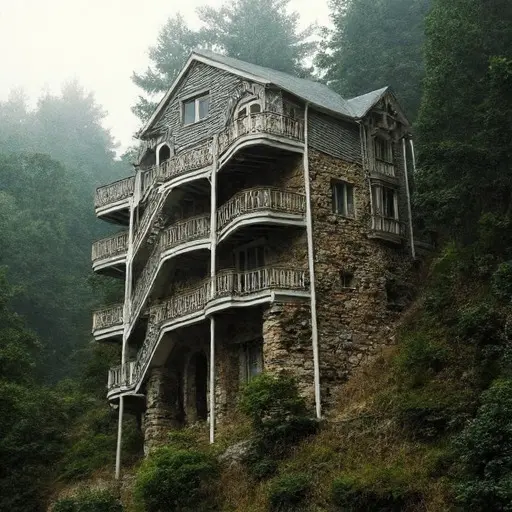
Inside, each tier functions as an independent living unit arranged in compact rectangular layouts. Rooms are simple and orderly—living spaces, small kitchens, and bedrooms organized consistently within each level. Doorways align cleanly within each tier but do not connect vertically except via the exterior staircase system, reinforcing the layered separation of living spaces.
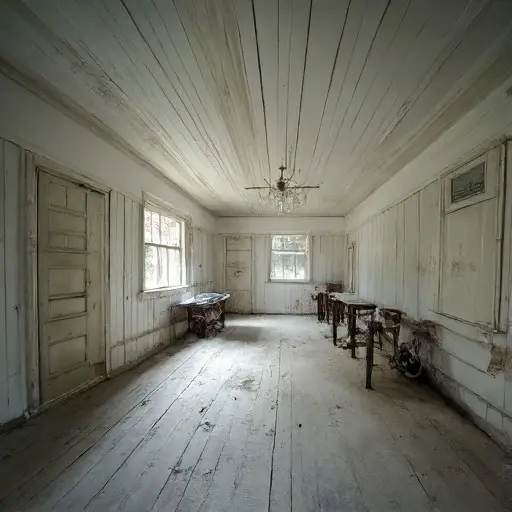
The middle tiers feel slightly more open due to their forward shift in alignment, allowing angled views between levels and enhancing the sense of stacked geometry. Light filters evenly through all floors, maintaining visual continuity despite structural segmentation.
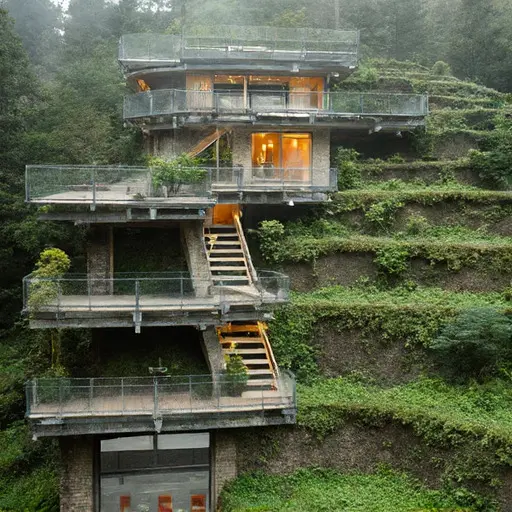
The surrounding forest climbs densely up the hillside but respects a clear boundary around the structure. Grass and small plants grow between stone retaining walls, and tree trunks stand close without encroaching. The house remains isolated yet integrated, shaped by terrain rather than consumed by it.
No decay, no collapse, no surreal distortion—only a quiet, engineered vertical residence preserved in balanced stillness under a gray sky, where architecture and hillside share a single, measured rhythm.