Unforgiving Calm in the House the Coral Conservator Never Evacuated
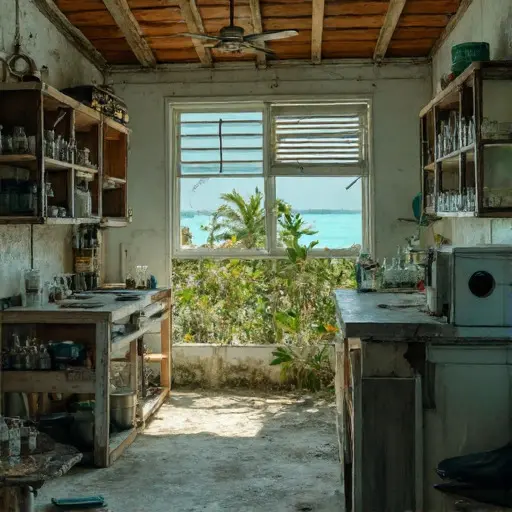
The water tanks still hum faintly.
Not from machines still running—but from residual vibration in glass, pipes, and salt-stained metal that seems to echo the sea outside.
Inside the shallow lab, coral fragments sit suspended in jars that once circulated carefully balanced seawater.
Some have turned bone-white.
Others remain faintly pink, as if refusing to fully give up color.
This house belonged to Dr. Naila.
She worked as a reef microbiologist and coral conservator, studying reef recovery, microbial balance, and coral bleaching resilience in shallow coastal ecosystems.
The laboratory was never large.
Just precise.
Every surface served observation.
Every container served time.
The house itself sat almost directly above tidal reefs visible through clear morning water.
Field boots by the door.
Salt charts pinned to cork boards.
And long seawater logs stacked in uneven columns beside the sink.
Inside the Salinity Drift Table
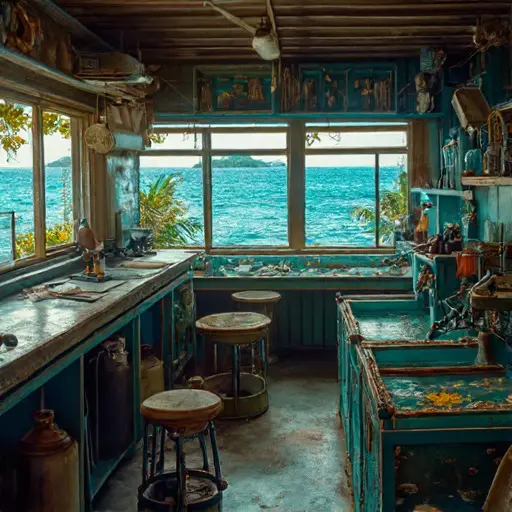
Dr. Naila worked most often at the Salinity Drift Table.
The stainless steel bench held aquariums, pipettes, microbial cultures, and coral samples arranged by reef origin and temperature exposure.
Her partner assisted with diving logistics before leaving years earlier.
After that, she stayed alone.
For years the work carried urgency.
Reef systems were still recoverable in measured cycles, and conservation teams depended on localized microbial studies to understand bleaching resistance and recovery pathways.
Then the oceans shifted faster than the models.
Heat anomalies increased beyond historical expectation, and coral mortality events began arriving in clustered, unpredictable waves across entire reef systems. Field interventions became slower than the damage.
Funding followed urgency elsewhere.
Projects closed.
Teams dissolved.
Dr. Naila remained.
Not officially.
Just physically.
She continued sampling, documenting, and attempting microbial transplant experiments long after institutional support ended.
Then the bleaching season broke record thresholds.
Multiple consecutive thermal stress cycles pushed surrounding reef systems beyond recovery, altering microbial baselines so drastically that comparative conservation work became nearly impossible.
The reefs still existed.
They no longer behaved predictably.
Already suffering from advanced decompression illness complications after years of intensive diving, she reduced fieldwork and spent more time inside the lab observing tanks rather than open water.
One extended heatwave season brought coral collapse even within her controlled systems.
She stayed inside the lab through several nights, recording final microbial shifts as oxygen levels in multiple tanks began to destabilize simultaneously.
No rescue attempt reached her in time during a delayed supply run interruption caused by regional storm activity.
The lab was found quiet.
No alarms.
No movement.
The sea outside unchanged.
The funeral gathered marine technicians, former diving partners, and coastal researchers who still referenced her early reef mapping studies.
The house was never reassigned.
The salinity charts remain pinned.
The tanks still hold fragments of reef memory.
And at the Salinity Drift Table, Dr. Naila’s unfinished conservation record continues waiting in silence—holding the last living trace of coral she never returned to release back into the sea.