Umbra-Locus: The Geologist’s Final Layer
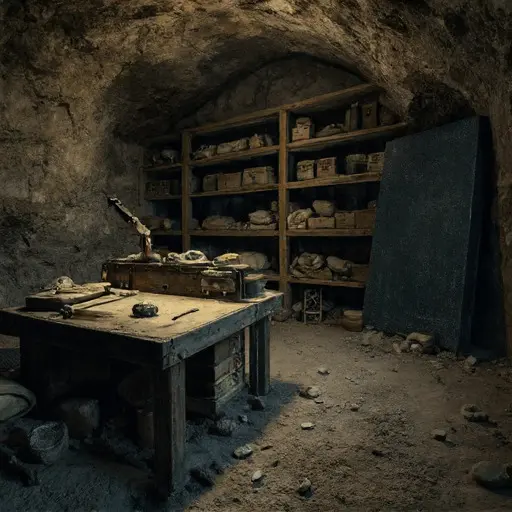
The entrance to Umbra-Locus was misleadingly grand. Once inside, however, the house felt immediately heavy, its atmosphere thick with the cold, sterile smell of pulverized stone and cold, inert metal. The name, roughly translating to “Shadow Place,” perfectly captured the manor’s oppressive, earthbound quiet. This abandoned Victorian house was built not merely on the ground, but designed to burrow into it, a deliberate descent from light into shadow, reflecting its owner’s singular obsession.
The final inhabitant was Dr. Quentin Hallow, a wealthy and intensely reclusive mineralogist and field geologist of the late 19th century. Dr. Hallow’s profession was the study of the Earth’s composition, the patient cataloging of rock layers, and the search for perfect crystalline structures. His dedication bordered on the religious; he believed that the secrets to timeless truth were locked in the immutable logic of stone. He built Umbra-Locus to be the perfect intersection of his living space and his massive, personal laboratory, perpetually seeking the final, foundational layer of the Earth. His personality was rigorous, exacting, and increasingly detached from human interaction, finding solace only in the cold, dependable permanence of geology.
The Borehole Chamber
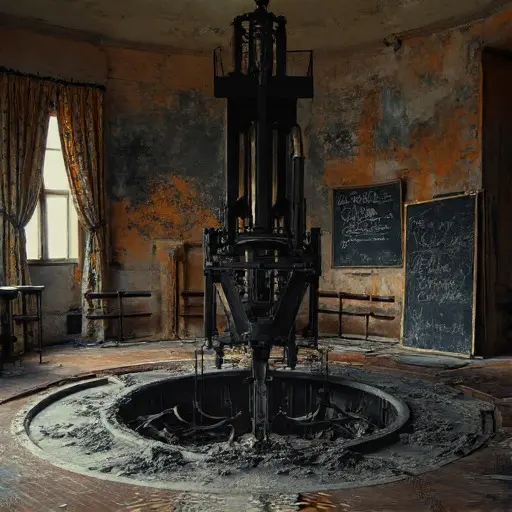
Dr. Hallow’s final, desperate phase centered on the “Borehole Chamber”—a once-elegant sitting room where he had a specialized drilling rig installed, punching a shaft straight down through the foundations of the house. His journals, found water-damaged and brittle near the base of the rig, charted his increasing geological mania. He no longer cared about surface samples; he was determined to reach the Earth’s core. “The final layer yields no light, no warmth, only a profound, crystalline truth. I must join the foundations,” read his final legible entry, the handwriting fractured by dust and exhaustion.
The house preserves his intense, physical labor. The main staircase groans not with age, but with the subtle, permanent shift in the manor’s foundation caused by the unauthorized boring of the deep shaft in the center of the main floor.
The Final Specimen in the Abandoned Victorian House
Dr. Hallow’s end was a quiet echo of his drilling. The workers he had hired to assist him eventually abandoned the project, citing his dangerous instability. When authorities entered, the house was empty, the bore hole rig standing silent and cold. No body was found, only a discarded miner’s helmet near the shaft’s edge.
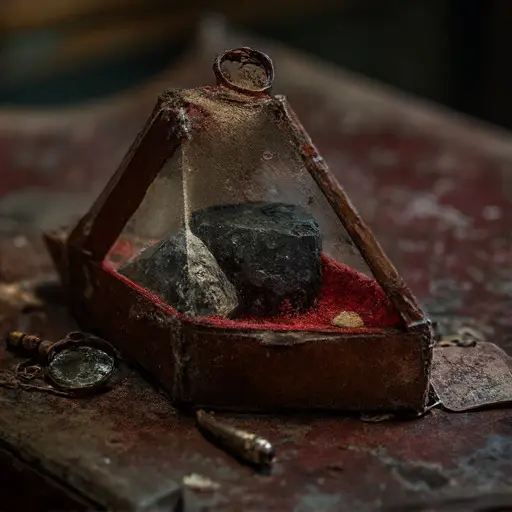
The chilling, final clue is the small, sealed triangular case. It contains a single piece of black, featureless rock, marked simply as ‘BASE.’ This abandoned Victorian house, with its disturbed earth and heavy stone walls, stands as a cold, imposing testament to the man who drove himself mad in his quest to find the ultimate, unyielding truth—the truth of the final, cold stone that anchors the world.
