The Zahire Moorish Alcázar Left in Forest Stillness
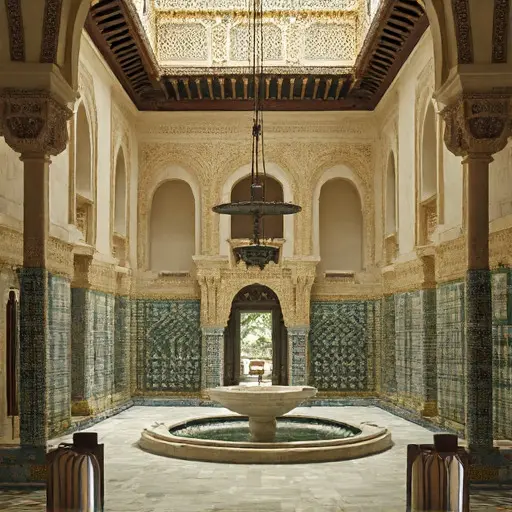
The Zahire Alcázar was constructed at the edge of a dense forest basin in the early 1900s by a cosmopolitan noble family with trade connections spanning Mediterranean and inland caravan routes. Designed in Moorish Revival style, the estate emphasized rhythmic geometry, water-centered planning, and ornamental unity across interconnected courtyards and domed pavilions. The household included multiple generations supported by clerks and stewards responsible for managing agricultural terraces, forest resources, and long-distance trade documentation.
Early operations were highly organized, with administrative functions centered around the courtyard fountain, where correspondence and financial records were reviewed in a controlled ceremonial environment. The estate maintained stability through diversified trade income, allowing its intricate tilework, stucco ornamentation, and garden systems to be preserved in pristine condition.
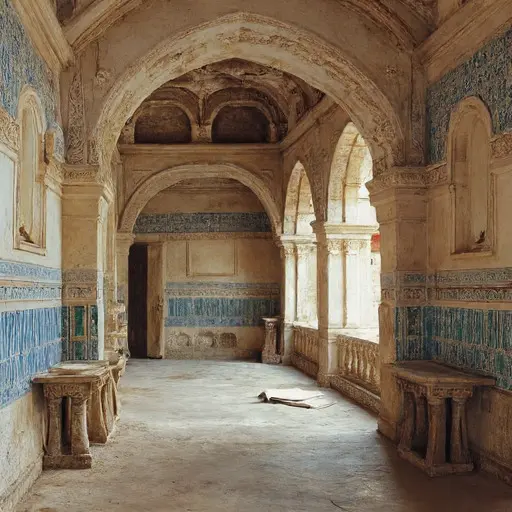
By the late 1920s, the Zahire estate began to experience financial strain as caravan trade routes declined and regional commercial networks shifted toward rail and coastal shipping systems. The complexity of maintaining its ornamental Moorish architecture required constant specialized upkeep, which became increasingly difficult under reduced revenue. Portions of the estate were closed off to conserve resources, resulting in uneven occupation across the interconnected pavilions. Administrative correspondence accumulated without timely response, particularly regarding trade settlements and land taxation obligations. Moisture from the surrounding forest began infiltrating stucco surfaces and tile joints, subtly eroding the crisp contrast of ivory, lapis, and emerald materials. The once unified system of courtyard-centered governance gradually fragmented into delayed and incomplete cycles of oversight.
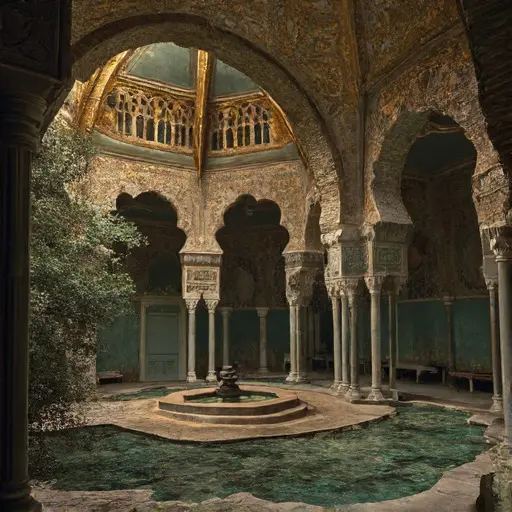
By the early 1940s, following prolonged financial collapse and unresolved inheritance fragmentation, the Zahire Alcázar was fully abandoned. No restoration efforts were undertaken, and legal disputes prevented any unified stewardship or redevelopment of the estate. The structure remained enclosed within its forest perimeter but gradually deteriorated under seasonal weathering, vegetation encroachment, and water infiltration from surrounding terrain. Interior spaces were left in their final operational states, preserving furnishings and records beneath layers of dust and humidity. Over time, the once highly ordered Moorish Revival system dissolved into silent decay, leaving the alcázar as an uninhabited architectural relic slowly reclaimed by forest growth, time, and water.