The Wrenford Marsh House and the Record of Submerged Rooms
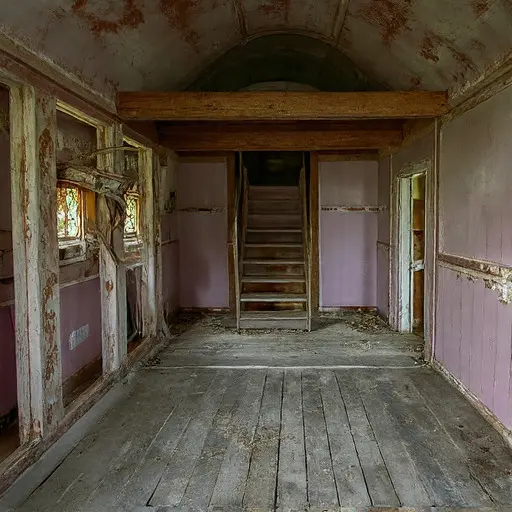
Wrenford Marsh House was built in 1892 by Silas Corbett Wrenford, born 1848 in Norfolk, a drainage engineer and land reclamation surveyor employed by private agricultural firms attempting to convert marshland into arable pasture. His work involved designing stilt systems, water diversion channels, and elevation mapping for unstable wetland terrain across coastal lowlands.
He constructed the farmhouse as both residence and operational base, intending it to serve as a long-term observation point for marsh stabilization experiments and seasonal waterline tracking.
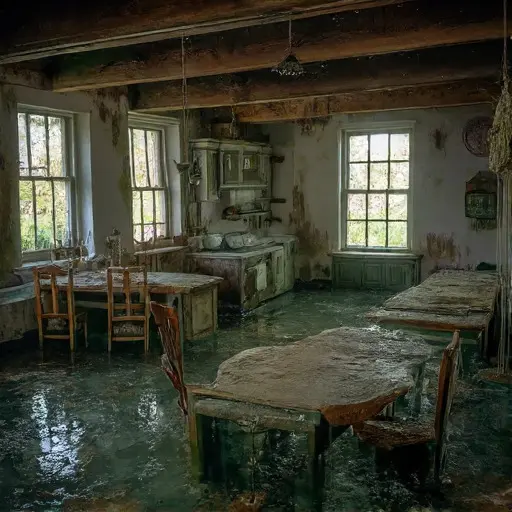
By 1900, Corbett’s field notes began documenting irregularities in recorded waterline elevation compared to fixed stilt markers installed beneath the house. The measurements showed that internal reference points within the structure did not align consistently with external marsh markers placed only meters apart.
Letters to his contracting agency describe “localized sinking that does not propagate uniformly through the foundation,” though no structural failure was observed in adjacent buildings constructed using identical plans.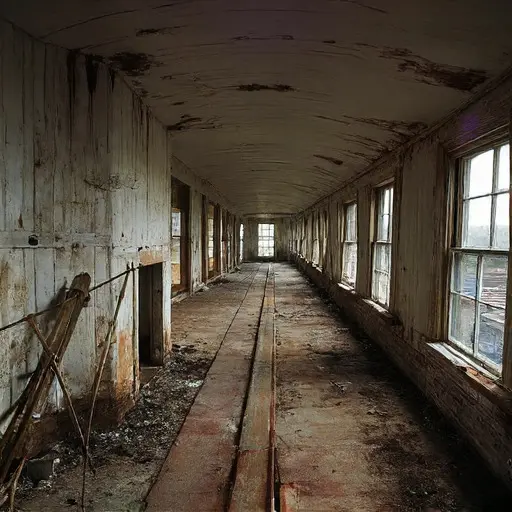
By 1908, household entries ceased to distinguish between “upper house” and “lower submerged levels,” instead referencing rooms by function rather than location, as if vertical order had become unreliable.
The Wrenford Marsh House was formally abandoned in 1910 after repeated seasonal floods made access routes unstable. No record indicates a full dismantling. The structure remains standing in the marsh, slowly sinking at uneven rates, its submerged rooms still intact beneath the waterline while upper sections continue to lean into the blackwater pool without ever fully collapsing.