The Wrenfield Botanical Conservatory Mansion Left in Quiet Bloom
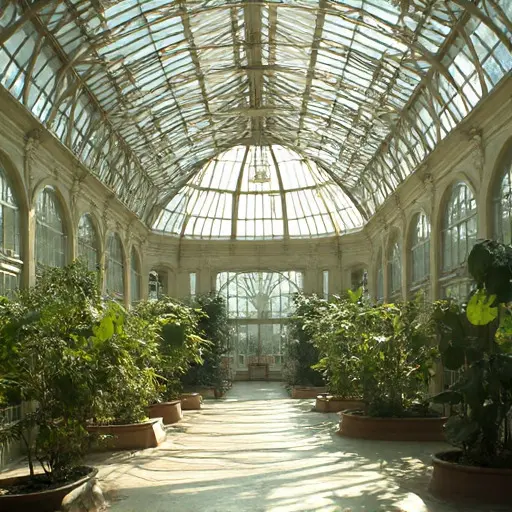
The Wrenfield Conservatory Mansion was established in 1886 by the Halbrook botanical estate as both a private residence and a controlled horticultural environment designed to integrate living space with scientific cultivation The original structure began as a central domed greenhouse hall, later expanded into asymmetrical residential wings that radiated outward like layered petals around the botanical core Over several decades, additional glass corridors and pavilion rooms were added, each designed to maintain visual continuity with the conservatory while introducing private living quarters for the Halbrook family and visiting horticultural researchers The result was a harmonious but gently irregular estate where architecture and plant life were intended to coexist within a shared luminous environment
For many years the mansion functioned as a seasonal research residence, with the conservatory maintained at the center of daily activity Botanical collections were curated with precision, and plant labeling systems were carefully preserved across all interior sections The white-painted iron framework required regular maintenance due to humidity exposure, but the overall structure remained stable and visually coherent Sunlight passed through layered glass surfaces, creating shifting patterns across stone floors and pastel-painted trim, reinforcing the sense of a living, breathing scientific residence rather than a static building
Early Soft Withdrawal from Daily Use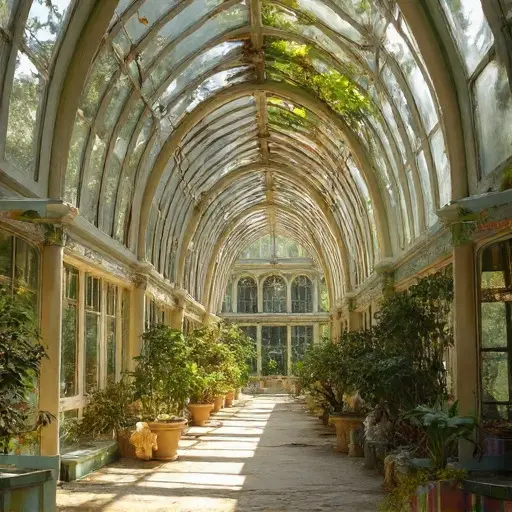
By the early 1930s, the Halbrook family’s direct involvement in the estate began to decline as successive generations relocated to urban centers for academic and professional pursuits The conservatory transitioned from a fully active research environment into a partially maintained heritage property, with certain wings used only during specific seasons The central dome remained functional, but peripheral pavilions saw reduced activity, and botanical collections were no longer expanded or refreshed at previous rates Maintenance shifted from active cultivation to preservation, focusing primarily on preventing structural deterioration rather than sustaining living collections
Despite this reduction in use, the mansion retained its architectural and botanical clarity Glass corridors remained intact, and interior light conditions continued to produce the characteristic soft diffusion across stone and iron surfaces However, subtle signs of neglect accumulated gradually, including dust films on glass panels and the slow fading of botanical documentation The estate remained peaceful and visually coherent, with no abrupt abandonment, only a steady withdrawal of daily human presence
Final Preservation Without Return
<img src=”https://beyondvisit.
com/wp-content/imagecontent/uploads/abandoned victorian house 35600838.webp” alt=”” />
By 1940 the remaining Halbrook heirs had permanently withdrawn from active management of the Wrenfield Conservatory Mansion as institutional responsibilities and wartime priorities redirected their attention elsewhere No single caretaker assumed full responsibility for the estate, and while no formal destruction or sale occurred, the property effectively entered a state of passive preservation Occasional inspections ensured structural safety, but botanical activity ceased entirely, leaving the conservatory’s interior systems in a static condition
In the following decade, the mansion remained intact and visually luminous despite the absence of active cultivation Glass surfaces retained their clarity under natural light, and iron frameworks continued to support the expansive domed structure without significant deformation The surrounding gardens softened slightly in structure but did not overgrow the architecture, maintaining the estate’s balance between cultivated order and natural encroachment
By 1950 the Wrenfield Conservatory Mansion remained standing in quiet completeness, its glass dome still catching the afternoon sun and its interior halls filled with preserved botanical memory No restoration was undertaken, no new cultivation began, and no occupants returned The mansion remained an abandoned yet radiant conservatory estate, suspended in time with its gardens dried but intact, its structure unchanged, and its silence uninterrupted