The Wraithlinmere House Journals and the Embered Desk
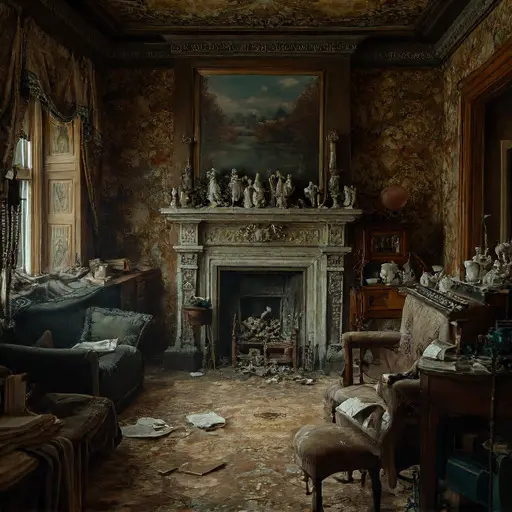
The parlour at Wraithlinmere House feels less entered than rediscovered, pressed inward by the thick scent of rotted damask and the faint metallic tang of old coal soot. Each object seems to have sunk slightly under its own weight. Nothing speaks of haste; instead, the room bears the softened contours of routines abandoned gradually, without any witness.
The Reserved Life of Edgar Rowan Wraithlin
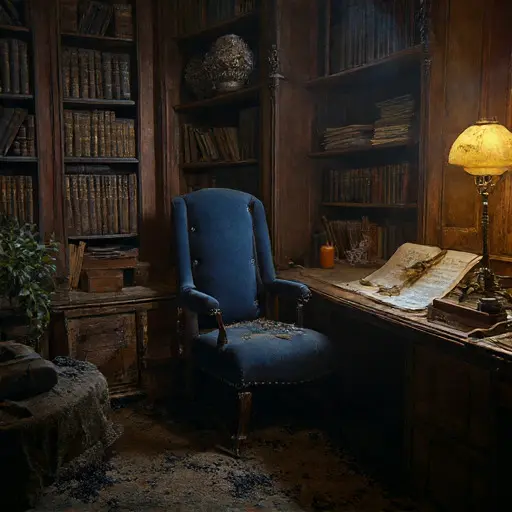
Edgar Rowan Wraithlin, civil registry clerk and meticulous recorder of household life, inhabited this house with his wife, Frances, and their twin daughters, Ada and Lisbeth. Edgar was a man of restrained habit—steady-handed, soft-spoken, fond of chronology and categorization. His journals, stacked unevenly across a writing desk in the Study, reveal a temperament shaped by consistency: each entry timed, each margin aligned, each correction made in careful red ink.
Frances ran the household with similar precision. Her handwritten recipe cards still lie tucked inside a kitchen drawer; her pressed flowers remain flattened within thick almanacs; and her half-mended garments populate the upper rooms in various stages of completion. The twins’ presence lingers in smudged slates, discarded hair ribbons, and water-stained sketchbooks left upon a trunk near the landing.
But Edgar’s world constricted under the weight of changes to his department—revised procedures, reduced staff, expanding duties. His journal entries shift subtly: older ones measured and even, later ones crowded with compact script and ink-blotted hesitations. Frances’s illness accelerated this shift. As she weakened, household rhythms loosened. After her passing, the twins left to stay with relatives, and Edgar, swallowed by work and hollowed by grief, let the house fall into a slow, unintentional decline. He moved room by room less frequently, leaving tasks uncompleted and correspondence unopened. Eventually he departed as well, not in haste but exhaustion, leaving Wraithlinmere House intact, unaltered, unclaimed.
The Corridor of Quiet Withdrawing
The upper corridor reflects the family’s steady retreat. Its runner is rucked into soft humps where footsteps once avoided loosened floorboards. A hall table displays a careless stack of handkerchiefs and collar studs, a broken clasp from a child’s locket, and an appointment book whose pages stopped mid-month. Wallpaper bears pale rectangles where framed portraits had been removed and never replaced.
The Abandoned Mending in the Attic Workroom
In the Attic Workroom, Frances’s presence lingers most clearly. A treadle machine holds a garment frozen beneath its presser foot, thread still looped through the needle. A basket of fabric scraps—gingham, muslin, twill—sits beside a pair of shears whose blades have seized shut. Spools of thread lie scattered across the table like small, toppled towers. It is a room waiting for hands that never returned.
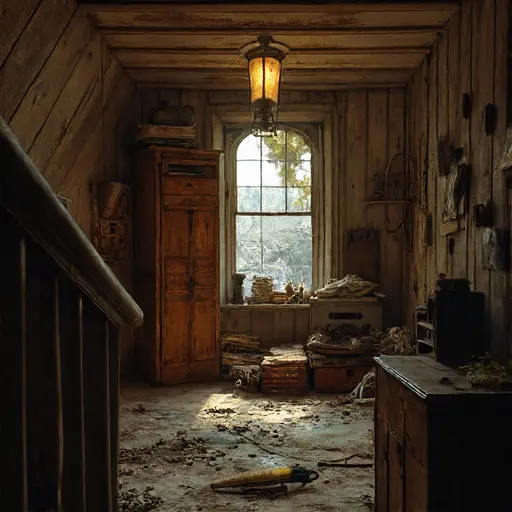
Behind one crate lies a scrap of paper in Edgar’s careful script: “Tasks for tomorrow—finish letters, repair lamp, sort linens.” No dates, no confirmations. Just intention suspended. And so Wraithlinmere House remains, its rooms steeped in quiet abandonment, waiting for a tomorrow that never arrived.
