The Wraithenden House Folios and the Abandoned Glassblower’s Bench
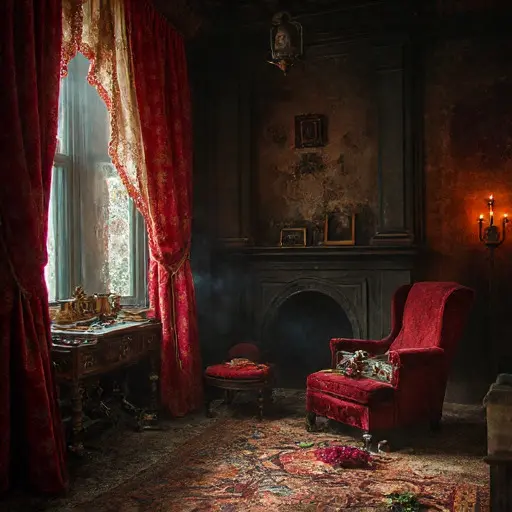
The Tender, Disciplined Life of Silan Corbett Wraithenden
Silan Corbett Wraithenden, a Victorian glassblower specializing in scientific vessels and colored ornaments, lived here with his cousin Edeya and her daughter, Linne. Silan’s notebooks brim with sketches—curved flasks, bead forms, ornate necks for laboratory tubes—each diagram annotated with heat timings and pressure notes. He worked with gentle intensity, often humming softly as he shaped molten glass into delicate forms.
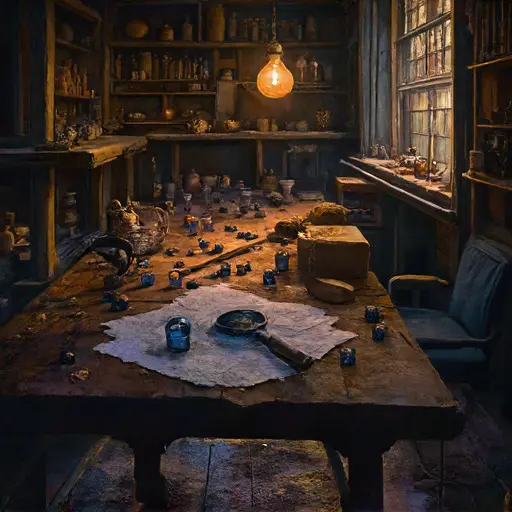
In the Glassblower’s Workshop, rods of glass sit bundled by hue; blowpipes lie in tidy pairs; paddles rest in ash-coated trays; and paper patterns curl in loose stacks. Edeya shaped the home with methodical warmth—folded linens aligned by size, herbal tinctures labeled neatly, and mending arranged with care. Linne’s presence lingers in scattered traces: a wooden toy vase carved in imitation of Silan’s work, chalk numbers dusting a slate, and a folded drawing of a bright blue bottle with “For Mama” written beneath.
As commissions increased, Silan’s notes grew tighter and more strained. Diagrams layered atop corrections. Pressure marks crossed earlier attempts. Failed shards gathered in corners. When Edeya fell ill, order in the home softened. After her passing, Linne was taken in by distant family. Silan remained briefly, but his final sketches show trembling lines, unfinished contours, and heat-timing notes cut short mid-word. One day, he stepped away from the bench and never returned. Wraithenden House has remained untouched since.
A Corridor Slumped Under Quiet Withdrawal
Upstairs, the corridor carries the softened imprint of a fading household. The runner rug lies in tired folds, its once-rich floral pattern faded into shadowy beiges. A hall table holds a broken spectacles hinge, a chipped shard of colored glass, and a personal note whose final line ends mid-curve. Pale rectangular outlines on the wallpaper reveal where vessel sketches once hung before being removed with slow, resigned care.
A Sewing Room Stilled in Its Final Gesture
In the Sewing Room, Edeya’s gentleness endures. A partially hemmed child’s dress sits pinned beneath the treadle machine’s presser foot. Thread spools toppled from their arrangement have faded into chalky pastels. Pincushions hardened with age bristle with rusted needles. Folded muslin stiffened along its edges waits in silence for hands that will never return.
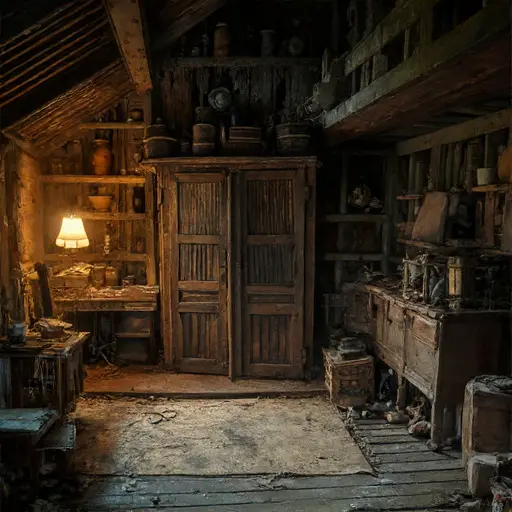
Behind the smallest crate lies a slip in Silan’s thinning script: “Finish blue bottle — tomorrow.” Tomorrow never reached Wraithenden House.
