The Wisteria Quiet of the Mansard Garden House
Wide rear-garden perspective of an abandoned Victorian Second Empire townhouse, three-and-a-half stories tall with a steep mansard roof clad in weathered slate-blue shingles, ornate dormer windows punctuating the upper silhouette, and a tall central pavilion rising from a tightly ordered symmetrical façade. The exterior is rendered in weathered slate-blue clapboard siding, deep oxblood red window frames, aged moss-green metal roof edging, and muted ivory stone lintels, all softened by time into a subdued but cohesive palette under a heavy overcast sky.
The rear garden unfolds as a layered domestic memory held in suspension. A narrow brick patio stretches from the back doors, now fractured and softened by creeping moss, while climbing wisteria in pale lavender and deep indigo cascades over trellises and railings in dense floral curtains. At the garden’s center, a marble statue of two figures leaning toward one another beneath a shared cloak stands partially enveloped in ivy, its contours softened by moisture and lichen.
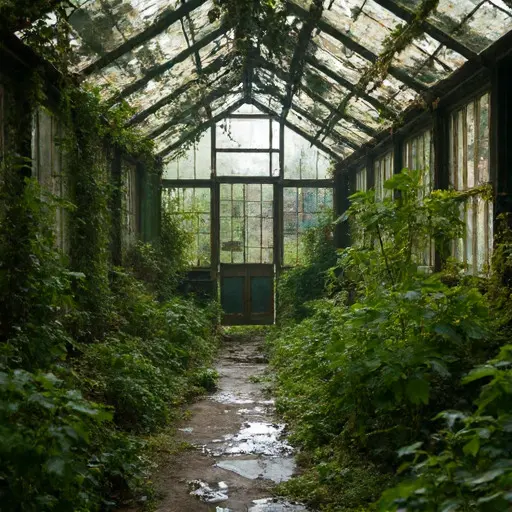
Beyond it, a long wooden trellis still carries tangled grapevines heavy with fruit, bending under their own weight. A tilted greenhouse with fractured glass panes shelters overgrown tomatoes, basil, and wild herbs, while a faded stone bench sits beside a shallow pond scattered with fallen petals and drifting leaves, reflecting the muted sky like a slow, unfinished thought.