The White Brick Queen Anne Lost Among the Maples
At the edge of a peaceful residential street where dense woodland slowly overtakes forgotten gardens, an abandoned Queen Anne Victorian family house stands as a delicate monument to another era. Built from bright white-painted brick and softened by years of weather, the three-story residence remains a striking presence beneath the canopy of towering maples and spruce trees. Its elegant Victorian details have faded but endured, creating a quiet portrait of architectural beauty slowly being reclaimed by nature.
The exterior is defined by a luminous white brick façade accented with soft coral-red sandstone bands that trace the structure’s architectural divisions. Muted sage-green trim surrounds the windows, porch elements, and decorative details, providing a restrained natural palette that blends beautifully with the surrounding woodland.
Above the home, a deep charcoal slate roof spreads across sweeping cross gables, its weathered surface darkened by moss and decades of exposure.
The tall circular turret remains the defining feature of the residence, rising above the front corner with a graceful vertical presence. Once perfectly aligned, the tower now leans slightly off-plumb after years of gradual settling, giving the silhouette a subtle handcrafted irregularity. Its curved walls and narrow windows create a gentle contrast against the sharper angles of the surrounding gables.

The home’s Queen Anne character is revealed through its abundance of decorative craftsmanship. Stained-glass bay windows project outward from the façade, their colored panes softened by age but still catching the diffused grey daylight. Intricate spindlework wraps around the porch, while carved brackets and decorative cresting remain attached beneath the roof edges, preserving the elaborate artistry of the Victorian period.
Time has gently altered the structure without destroying its identity. The exterior walls have developed subtle convex curves, creating a softened appearance where once-sharp lines now flow naturally. Uneven dormers interrupt the roofline, each sitting at slightly different angles as the house continues to settle into the landscape. Even the chimney has developed an almost imperceptible bend, adding to the home’s distinctive aged character.
The wraparound porch remains one of the most inviting elements of the abandoned property. Flowing gracefully around a rounded corner, the porch creates a continuous transition between the house and the overgrown garden. Weathered wooden posts support faded railings, while climbing ivy weaves through sections of the structure, slowly blending architecture with vegetation.
Cracked stone steps lead toward the entrance, their surfaces softened by moss and fallen leaves. Faded paint reveals layers of earlier colors beneath the sage-green trim, while small details such as worn brackets and decorative woodwork continue to show the exceptional craftsmanship that defined the original home.
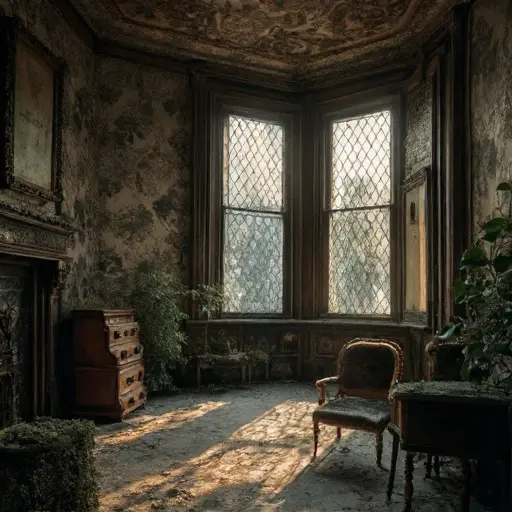
The surrounding landscape has transformed the property into a quiet woodland sanctuary. Old stone garden walls disappear beneath moss and creeping plants, while ferns, foxgloves, and tall grasses fill the abandoned grounds. The once-maintained garden now exists as a natural extension of the nearby forest, with wild vegetation growing around the foundation and along forgotten pathways.
Beneath the curved porch rests a weathered wooden rocking chair, frozen in place as if waiting for a former resident to return. Its faded surface carries the marks of countless seasons, positioned beneath peeling trim and surrounded by the quiet sounds of the forest.
Near the entrance, a rusted old bicycle leans against the white brick wall, partially covered by vines and surrounded by fallen leaves. Beside it, a partially open picket gate hangs loosely, offering a final glimpse into the overgrown yard beyond.
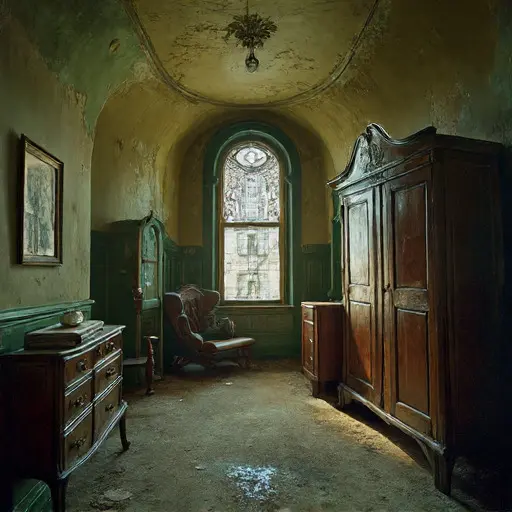
Despite its abandonment, the house retains an undeniable elegance. Every curved wall, weathered sandstone band, leaning turret, and moss-covered roof ridge reflects decades of slow transformation rather than sudden decay. The architecture has adapted to its surroundings, becoming a living piece of history surrounded by woodland and time.
The White Brick Queen Anne Lost Among the Maples remains a graceful Victorian relic, where craftsmanship, nature, and quiet abandonment exist together. Its faded colors, softened geometry, and surviving ornamental details tell the story of a family home that continues to stand proudly beneath the trees.