The Westrow Terrace House Left Quiet After Neighbouring Moves Ended
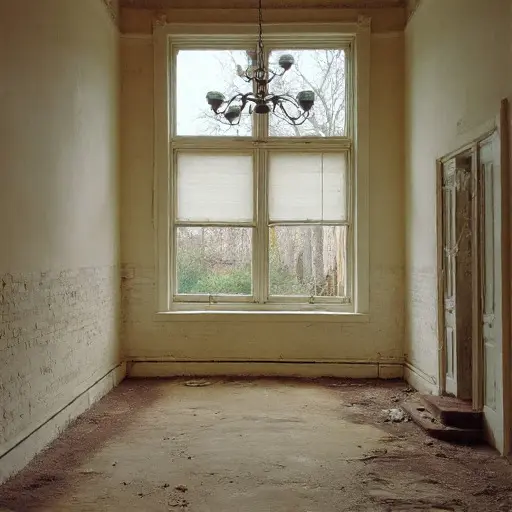
The Westrow Terrace House was constructed in 1886 as part of a continuous row of Victorian workers’ housing on the outer edge of a growing industrial town transitioning toward rural woodland boundary expansion The building formed one unit within a tightly packed terrace, sharing load-bearing walls with identical neighboring structures on both sides The house was a compact two-story residence designed for small families, with a narrow footprint, a modest rear kitchen extension, and a front façade that followed the strict rhythm of the terrace while still developing subtle individual irregularities over time The most notable deviation was a slightly protruding bay window that extended marginally beyond the uniform alignment of adjacent houses, a feature that later emphasized the building’s gradual structural drift under shared-wall pressure
For most of its active life, the Bramwell family occupied the house, maintaining a stable but modest domestic existence shaped by industrial employment and the constraints of terrace living The structure evolved slowly through incremental repairs, including patched slate roof sections, minor chimney realignment due to long-term settling, and repeated plaster restoration along the façade The red-brown brick chimney developed soot and moisture staining consistent with extended coal heating, while iron railings at the front steps accumulated a light rust patina from constant exposure to damp air The street itself remained active through much of this period, forming a dense residential corridor where daily life was closely interconnected between neighboring homes
Early Decline of Urban Edge Stability and Household Dispersal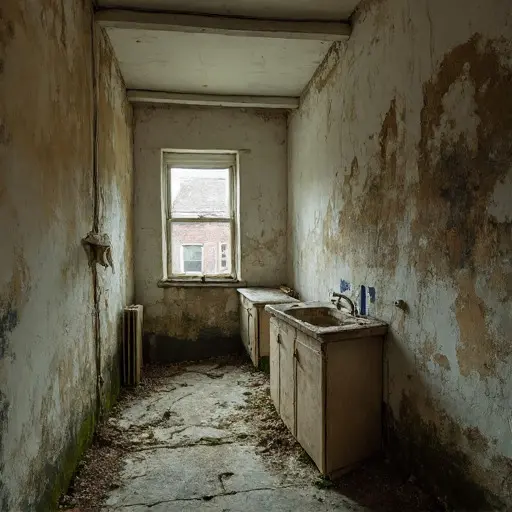
By the early 1930s, the Bramwell family began to disperse as economic conditions shifted and industrial employment patterns changed, leading to reduced necessity for dense terrace housing occupation The house transitioned from full-time residence to intermittent occupancy, with longer periods of vacancy between stays Maintenance declined gradually but did not cease entirely, resulting in slow accumulation of plaster cracking, window fogging, and minor structural distortion along shared walls where pressure from adjacent buildings remained constant despite reduced human presence
As neighboring houses also began to empty, the terrace gradually lost its continuous residential rhythm, leaving gaps in occupancy that altered the acoustic and visual density of the street The rear kitchen extension remained structurally sound but increasingly isolated, while the front façade began to show more pronounced weathering at ground level due to reduced foot traffic and maintenance The street outside transitioned into a quiet boundary zone between remaining urban structures and encroaching vegetation from the nearby forest edge
Final Stillness in the Terrace Row
<img src=”https://beyondvisit.
com/wp-content/imagecontent/uploads/abandoned victorian house 46679966.webp” alt=”” />
By 1940 the remaining Bramwell descendants had fully vacated the Westrow Terrace House as industrial decline and suburban relocation made continued occupancy impractical The house remained physically stable due to the structural support of the terrace system, but no further maintenance was performed and no new occupants were assigned despite its intact condition The neighboring houses also entered varying states of vacancy, gradually dissolving the once-continuous residential rhythm of the street
In the following decades the structure aged slowly under uniform overcast conditions The shared walls continued to support the building’s integrity, preventing collapse even as plaster layers peeled and roof patches aged unevenly No demolition occurred, and no restoration was initiated
By 1950 the Westrow Terrace House remained standing in quiet abandonment, fully intact within its row but functionally empty No return was recorded, no redevelopment was undertaken, and no structural failure occurred The house persisted in calm overcast silence, held between its neighboring shells, a Victorian terrace unit left behind at the edge of a fading street