The Westraven House Left Empty After Trade Collapse
The Westraven House was first occupied in 1901 by the De Vries family, prosperous merchants involved in regional textile and ceramics trade who sought to express their success through a structured Dutch Renaissance Revival residence. The manor was designed as a compact palace-like home, where strict symmetry and patterned masonry reflected discipline and prosperity. Early life within the house revolved around trade correspondence, estate management, and carefully maintained domestic order under steady economic conditions.
<img src=”https://beyondvisit.com/wp-content/imagecontent/uploads/abandoned victorian house 63422758.
webp” alt=”” />
Within the central reception chamber, the De Vries family hosted business partners and maintained detailed records of trade shipments and financial accounts. Light filtered through stained glass medallions, casting ruby and jade tones across carved oak furniture and tiled flooring. The atmosphere emphasized structured elegance, where every surface reinforced stability and measured success in the early years of the twentieth century.
Early decline begins
By the late 1910s, shifting international trade routes and rising economic instability began to strain the family’s business holdings. Maintenance of the manor slowed, with repairs to Delft ceramic tiles and slate roofing delayed indefinitely. Portions of the arcaded gallery were closed off to conserve heating, and dust began to accumulate along stepped gables and carved stone edges.
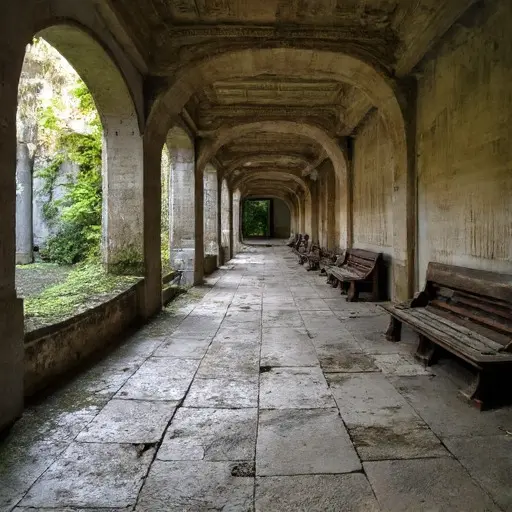
Following the 1930 global financial downturn, the estate entered rapid contraction. The conservatory wing was abandoned after structural glass damage, and the square tower rooms were sealed off due to rising maintenance costs. The household consolidated into a limited number of rooms while inheritance disputes delayed any possibility of restoration or sale.
Final abandonment phase
By the mid-1940s, the Westraven House was fully vacated after prolonged insolvency proceedings and unresolved ownership claims. Doors were locked with furnishings left in place, and gardens ceased to be maintained. The once-rigid geometry of the estate softened as vegetation crept through tiled pathways and broken fountain basins, dissolving the architectural order into natural overgrowth.
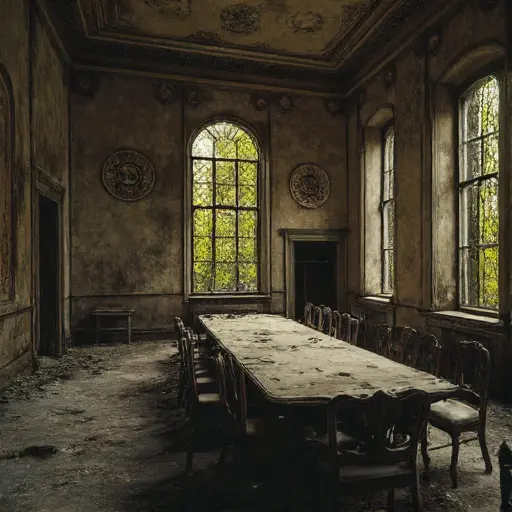
The Westraven House remains abandoned with no record of restoration or reoccupation after its final evacuation. Ownership disputes were never resolved, leaving the estate legally inactive. It continues to stand in the forest clearing, slowly deteriorating as its patterned stone and ceramic surfaces are reclaimed by time and surrounding woodland.