The Wasted House Below the Tea Ridge Where Harun’s Clouds Stayed Trapped
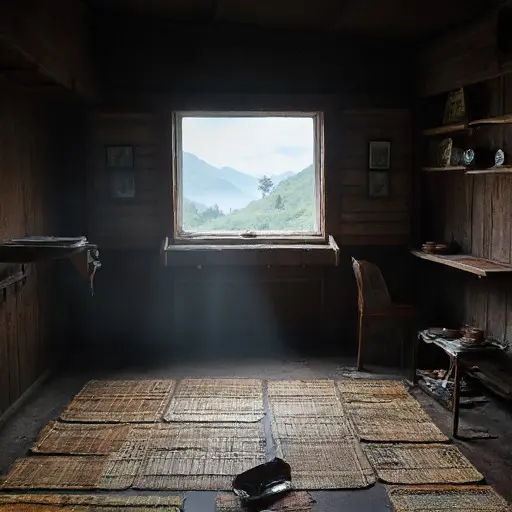
The bottles looked empty.
That was the mistake people made.
They lifted them toward the window and saw nothing except faint residue along the glass.
Harun would have disagreed.
To him, they were full.
The house beneath the tea ridge belonged to Harun Sato.
He lived there alone and worked in a profession that disappeared almost without argument.
Harun was a fog condensation archivist.
His work involved collecting and cataloguing moisture gathered from seasonal fogs, mountain mists, and cloudbanks. Researchers, tea estates, and environmental museums once commissioned him to preserve atmospheric samples linked to particular elevations, weather systems, and local ecosystems.
He did not chase storms.
He preserved their fingerprints.
The upper room still reflects that devotion.
Glass funnels hang from wooden hooks. Moisture ledgers sit stacked beneath shelves. Narrow-necked bottles remain arranged by season and altitude, each carrying labels written in meticulous script.
The Vapor Ledger Alcove
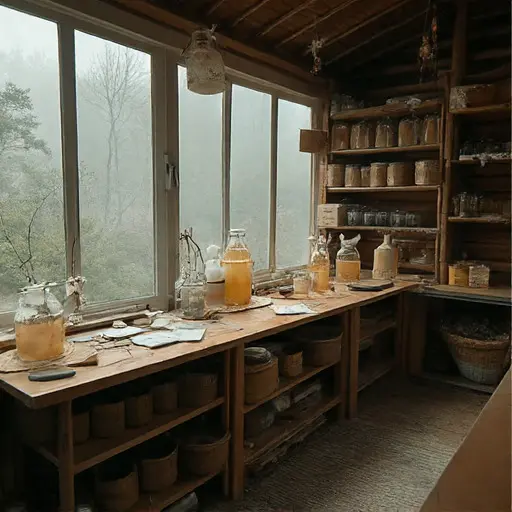
Harun organized his work around the Vapor Ledger Alcove.
The small recessed corner remained coolest throughout the year and protected delicate samples from temperature swings.
One unfinished collection still rests there.
The bottle sealed.
The label blank.
Harun had once taught environmental science but withdrew from public work after his wife died.
He became known instead for walking ridges before dawn carrying nets, funnels, and cloth-wrapped cases.
For years the work attracted institutions and curious visitors.
Then research centralized.
Large climate databases, automated atmospheric stations, and satellite monitoring steadily displaced small-scale environmental archiving. Physical moisture collections came to be viewed as sentimental rather than scientifically necessary.
Harun continued regardless.
He believed weather deserved memory.
Then the mountain roads changed.
Tourism expansion and resort construction altered drainage and vegetation across nearby ridges, disrupting fog behavior and reducing the cloud formations that had defined the region for generations.
Harun documented the loss obsessively.
Already struggling with untreated blood pressure complications and worsening exhaustion, he spent increasingly difficult mornings climbing for samples that grew rarer each season.
One dawn he suffered a fatal cerebral hemorrhage while descending a ridge path with collection cases strapped to his back.
The funeral was brief.
Former students attended quietly.
The house remained afterward.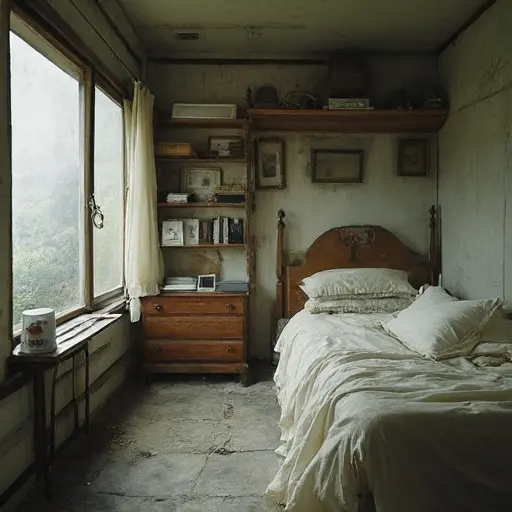
The funnels still hang from their hooks.
The ledgers remain stacked beneath the shelf.
And inside the Vapor Ledger Alcove, Harun’s final fog sample continues resting in silence—holding weather he never returned to name.