The Viremont Super-Mansion Left Frozen in Expressionist Silence
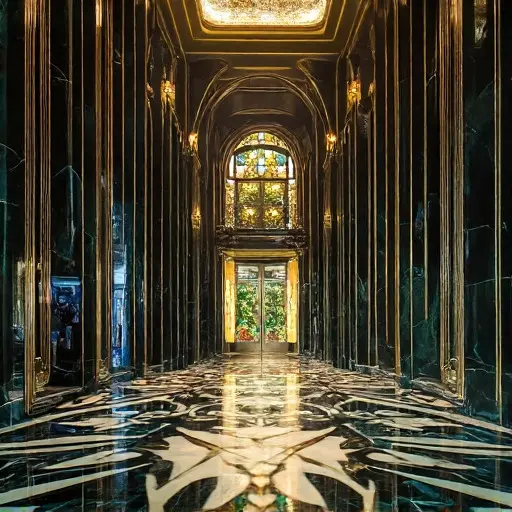
Completed in 1929 at the height of industrial aristocratic wealth, the Viremont Super-Mansion was commissioned by the Viremont industrial family as both private residence and symbolic monument to modern architectural ambition. Unlike traditional estates built on historical imitation, the mansion was conceived as a forward-looking synthesis of Expressionist form and Beaux-Arts discipline, later infused with emerging Art Deco geometry. The result was a residence that functioned less as a house and more as a sculptural environment for controlled luxury, where every corridor, terrace, and hall was designed to express motion, rhythm, and engineered elegance.
At its peak, the estate housed multiple generations of the family along with a large administrative and domestic staff. Private salons hosted diplomatic gatherings, while the winter glass hall was used for exhibitions of industrial design and mechanical innovation. Maintenance crews operated continuously to preserve enamel cladding, chrome inlays, and stained-glass assemblies, ensuring the structure retained its precise geometric clarity despite its vast scale.
Early Decline
The global economic contraction of the early 1930s severely impacted the Viremont industrial holdings. Factories were scaled down, investments failed, and the estate’s operational costs became increasingly unsustainable. Decorative maintenance of enamel façades and structural glazing was reduced, followed by the closure of several residential wings. Staff departures occurred gradually as wages were delayed, and entire sections of the mansion were sealed to limit upkeep demands.
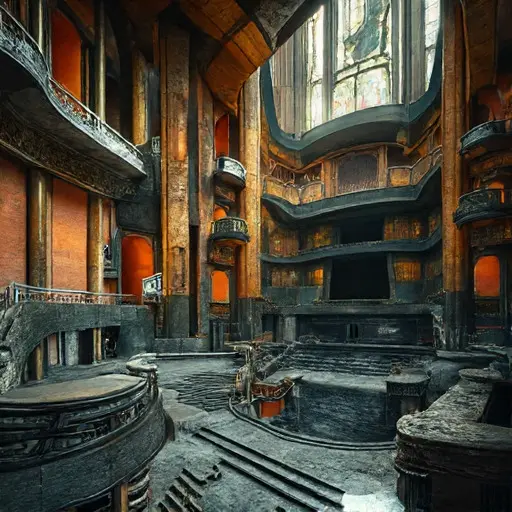
By the late 1930s, legal disputes over inheritance and corporate debt restructuring stalled all restoration efforts. Sections of the winter hall suffered from minor structural stress due to unaddressed thermal expansion in the glass-and-steel system. Repairs were postponed repeatedly, and eventually the entire eastern wing was closed. The family relocated to smaller urban residences, leaving only essential caretakers to manage security and minimal preservation tasks.
Final Abandonment
After the Second World War, ownership disputes remained unresolved while taxation on large private estates increased significantly. With no viable financial plan for restoration, the remaining caretakers vacated the property, locking the primary entrances and leaving furnishings, records, and architectural documentation in place. The mansion was never sold, as no buyer could absorb the cost of maintaining such a complex and materially intensive structure.
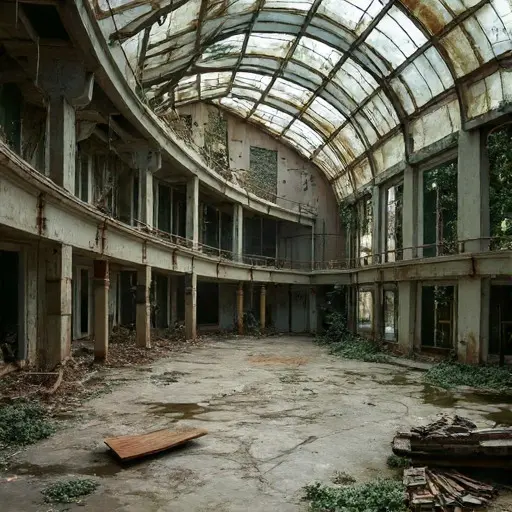
Today, the Viremont Super-Mansion remains abandoned and unrestored, its ownership still unresolved in archival records. Deep within the forest clearing, the monumental structure stands intact but slowly decaying, its bold geometric language softened by time and vegetation. What was once a symbol of industrial ambition and architectural futurism now persists as a silent, monumental relic of a family’s collapse into economic and historical obscurity.