The Viremont Neo-Baroque Estate Left in Radiant Silence
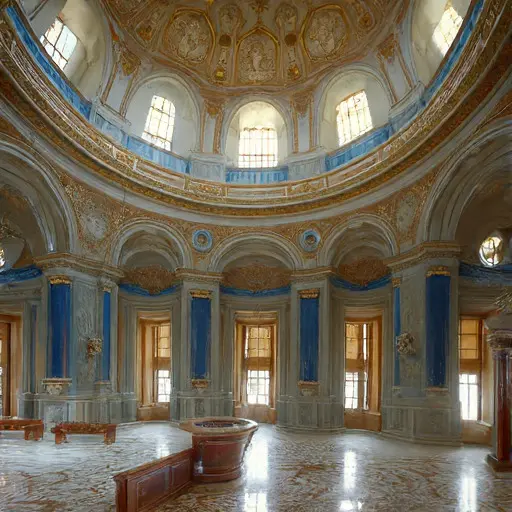
The Viremont Estate was constructed deep within a dense forest clearing in the early 1900s by an aristocratic lineage seeking to express absolute order and influence through Neo-Baroque radial design. The château was planned as a star-shaped complex, with multiple curved wings radiating from a central domed hall that functioned as both ceremonial and administrative core. The household included extended family members and estate clerks responsible for managing agricultural lands, forestry rights, and regional taxation records.
Early operation was defined by strict procedural discipline, with all financial and administrative activity coordinated through the central dome. The surrounding terraced gardens were maintained as geometric extensions of this order, reinforcing the estate’s emphasis on controlled symmetry and hierarchical organization.
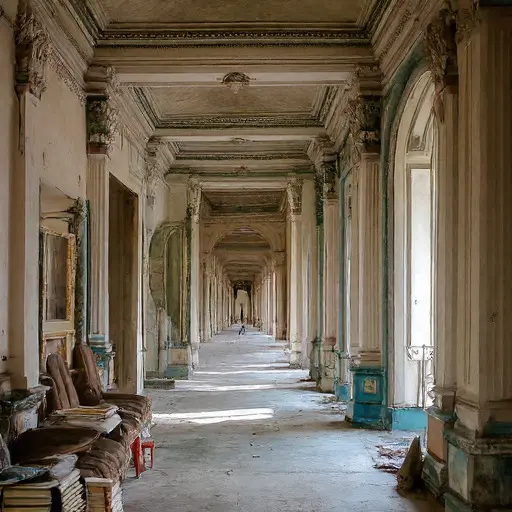
By the late 1920s, the Viremont Estate began to experience financial strain as agricultural output declined and the cost of maintaining its highly complex Neo-Baroque structure increased significantly. The radial layout required continuous upkeep across multiple wings simultaneously, making reductions in staffing particularly impactful. Portions of the estate were gradually closed off to conserve resources, leading to uneven maintenance across the circular plan. Administrative correspondence accumulated in the central dome without timely processing, and estate governance slowed into delayed cycles of oversight. Moisture from the surrounding forest began penetrating stone joints and decorative reliefs, subtly eroding surface clarity and diminishing the sharp contrast of ivory stone, sapphire accents, and emerald roofing that defined the estate’s visual identity.
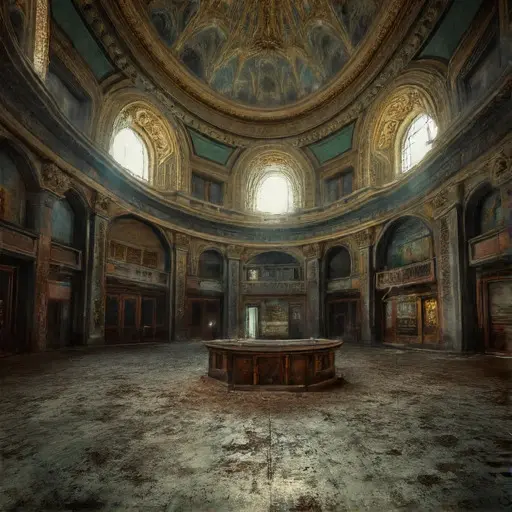
By the early 1940s, following prolonged financial collapse and fragmented inheritance disputes, the Viremont Estate was fully abandoned. No restoration efforts were undertaken, and legal complications prevented any unified intervention or redevelopment. The structure remained intact within the forest but gradually deteriorated under seasonal weathering and vegetation encroachment. Interior spaces were left in their final state of use, preserving documents and furnishings beneath accumulating dust and moisture. Over time, the once perfectly ordered radial system dissolved into silent decay, leaving the estate as an uninhabited architectural star embedded in the forest, slowly reclaimed without resolution or return.