The Verandah House of Kalimara Beneath the Still Green Air
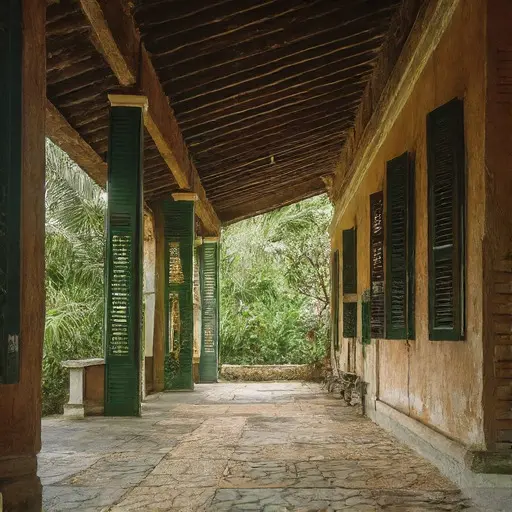
The Kalimara Manor was constructed in the late 19th century during the expansion of European colonial architectural experimentation in tropical regions, where climate-responsive design was fused with formal Victorian planning. Commissioned as a seasonal administrative residence, the structure was intended to balance ceremonial symmetry with environmental adaptability. Its defining feature—the continuous wraparound veranda—was engineered to maintain airflow across all elevations while preserving shaded interior circulation routes.
The raised central pavilion roof acted as a thermal exhaust system, allowing heat to dissipate naturally through vertical convection, while the louvered shutters provided adjustable control over light, wind, and humidity.
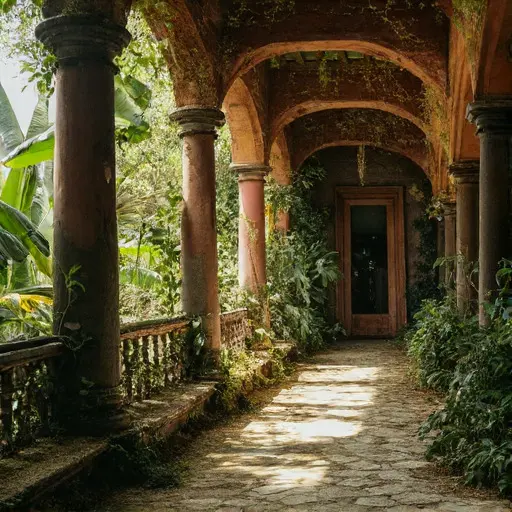
By the early 20th century, the Kalimara Manor entered gradual abandonment following the decline of its administrative function and the relocation of its occupants to coastal urban centers. Without sustained maintenance, the delicate balance between ventilation architecture and material preservation began to deteriorate. Coral plaster surfaces faded unevenly under prolonged humidity exposure, while brass ventilation grilles oxidized into deeper brown tones. The courtyard’s geometric paving, once carefully maintained for drainage and ceremonial movement, fractured into irregular segments as root systems penetrated its structure. Vegetation expanded rapidly into the veranda edges, following the original airflow logic of the building while transforming it into a living ecological framework.
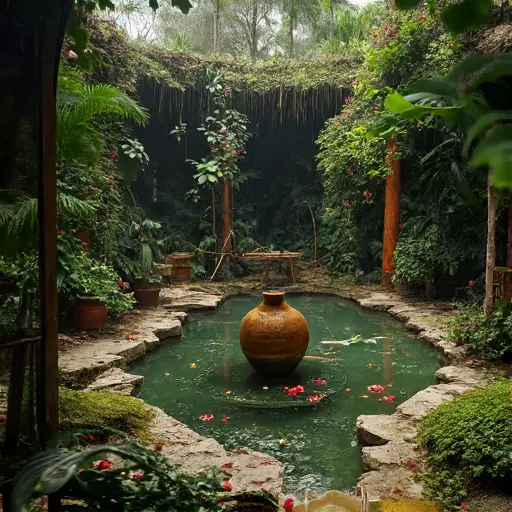
In its present condition, the Kalimara Manor persists as a stabilized tropical ruin where architectural design and ecological processes have reached a continuous state of overlap. The veranda system still defines spatial circulation, but now functions equally as a structural scaffold for vegetation. The original climate-responsive intent of the building remains visible in its openness, shading, and ventilation logic, even as nature has repurposed these systems for its own expansion. Rather than collapsing, the estate has transformed into a hybrid environment where tropical growth and colonial architecture coexist within a single, evolving spatial organism.