The Veiled Truth of Quill-Haven House
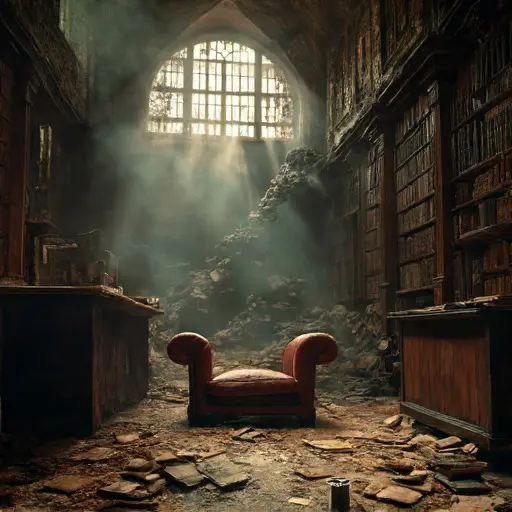
Quill-Haven House, a mansion of severe, dark red brick and numerous leaded-glass windows, sat deep within a forgotten valley, perpetually shrouded in dense, damp air. Its name suggested a sanctuary for the written word, yet the house felt heavy with unspoken truths. Stepping across the threshold, the air was immediately dry, sharp, and intensely fragrant with the distinct, musty odor of old ink and animal glue. The floorboards of the main gallery were strangely slick, coated in a fine, metallic dust. The silence here was not empty, but pressurized, suggesting that the very walls were holding their breath, determined not to reveal what they knew. This abandoned Victorian house was an archive of memory, where every item felt like a sentence in a vast, unfinished narrative.
The Censor’s Buried Story
Quill-Haven House was the fortress and final project of Frederick Vance, a powerful but fanatical government censor during a period of intense political upheaval in the late 19th century. His professional life demanded relentless scrutiny of all published works, the systematic suppression of ‘dangerous’ ideas, and the creation of perfectly sanitized public records. Personally, Frederick was an intensely paranoid man, tormented by the belief that he himself was a subject of scrutiny, constantly watched and judged. He saw the house as the ultimate tool of control: a place to rewrite not just the nation’s narrative, but his own, turning his home into a private, sealed archive of forbidden histories.
The Cryptography Chamber
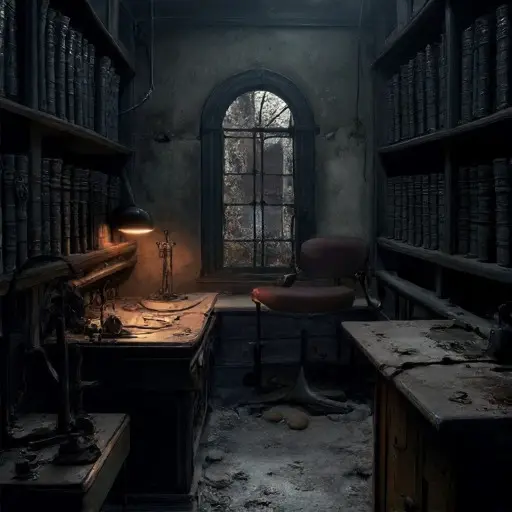
Frederick’s Cryptography Chamber was hidden behind a rotating bookcase. The atmosphere was sterile, dry, and cold. The shelves held his personal, meticulous archive: hundreds of ledgers detailing the books he had censored, cross-referenced with the reasons for their destruction. His final journal, found tucked inside the cipher wheel mechanism, revealed a staggering confession: he was not censoring external works, but his own family’s letters and diaries. He believed his wife, Eliza, was secretly communicating treasonous ideas through their private correspondence. The last ledger entry detailed his final, desperate act: the burning of every single original piece of correspondence, leaving behind only his meticulously edited, sanitized copies.
The Attic of Unspeakable Silence
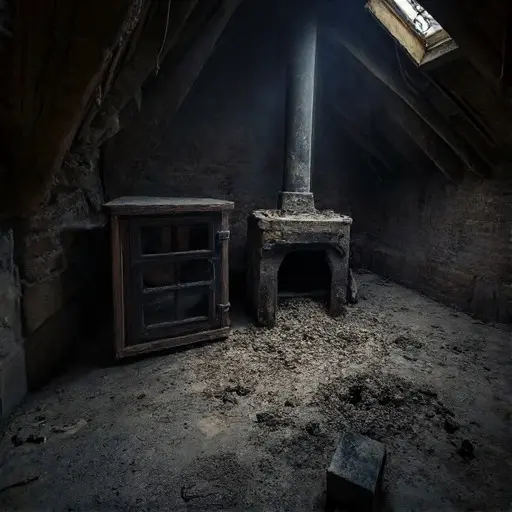
The attic, vast and low-ceilinged, was the final repository of the mansion’s secrets. Here, amidst the skeletal frameworks of old furniture and trunks, we found the remnants of Frederick’s destructive obsession. Near the chimney flue, covered by years of soot, was a large, iron furnace, clearly built not for warmth but for destruction. Strewn around it were countless brittle, blackened fragments of paper—the ashes of the original letters and diaries he had burned. The most significant find was a small, locked, fire-proof box. Inside was a single, pristine, uncensored love letter written by Eliza, dated 1885. It spoke not of treason, but of her intense loneliness and her plan to leave him, detailing her despair over his paranoia. The key was his paranoia, not her guilt. The veiled truth of Quill-Haven House is the silence of an entire family history meticulously burned away by one man’s need for control, leaving behind only the cold, hard evidence of his own terrifying delusion within the abandoned Victorian house.