The Veiled Rasmussen Hearth-Step Pantry Where the Tilt Grew Uneven
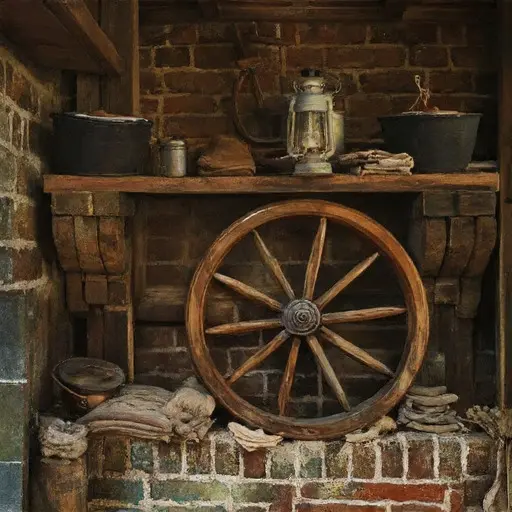
The hearth-step pantry holds a mingled scent of ash, pine shavings, and cooling iron. Lanternlight creeps across tools arranged in a discipline that trembles with doubt, each object carrying the hush of a motion paused too abruptly.
A Wheelwright’s Practice Drawn to Subtle Precision
Niels Torben Rasmussen, born 1874 near Odense, shaped modest wagon wheels for farmers and travelers.
A soft linen scrap from his sister Dagmar cushions his spoke shaves. Niels carved hubs at dawn, trimmed spokes by midday, and fitted rims under a warm lantern glow. His humble upbringing lingers in reused molds, re-wedged handles, and Danish-script slips tucked behind flour tins.
Work Straining Inside the Hearth’s Narrow Heat
A rim molding board rests half-sanded, its curve wavering near the center. A spoke shave lies on a rag stiffened by resin. Wooden spokes sit propped in mismatched angles, their ends roughened by repeated test fits. A basin once used for dough now holds pins and wedges, their surfaces smudged with iron flecks. Even the lantern’s flame dips toward the hearth wall, shadowing faint chalk arcs meant to guide alignment.

Strain Threaded Through Grain and Iron
Behind stacked rim boards lies a returned note—“uneven rotation.” A hoop segment shows faint scorch marks from over-heating. Niels’s stool angles toward the pantry door, as though he stood often, pacing in restless attempts to restore equilibrium. A spoke end bears deepened tool marks where doubt pressed harder than skill. Thin trails of sawdust curve along the floor, marking quiet, looping circuits of uncertainty.
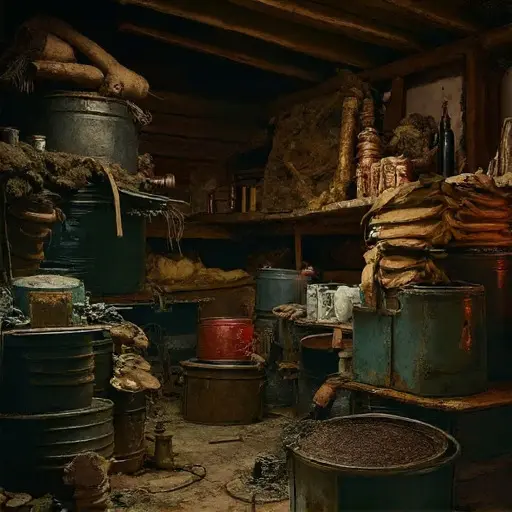
Returning to the hearth-step pantry, one final sign remains: a perfectly trued segment resting beside the tilted one—certainty and doubt sharing the same dim warmth.
The house remains abandoned.
