The Vanished Rinaldi House

The Rinaldi House was constructed in 1901 on the edge of the Venetian lagoon for Giorgio Rinaldi (1866–1912), a customs revenue assessor employed by the maritime republic’s municipal treasury offices to calculate canal tolls, merchant docking fees, and trade duty distributions across lagoon transport routes.
The villa functioned as both residence and administrative tax station, where Rinaldi and his assistants recorded shipping manifests, levy adjustments, and customs reconciliations for goods passing through the lagoon ports. His household included his wife Sofia and his assistant Matteo Bellini, both responsible for maintaining tax registers, seal authentication logs, and merchant compliance records.
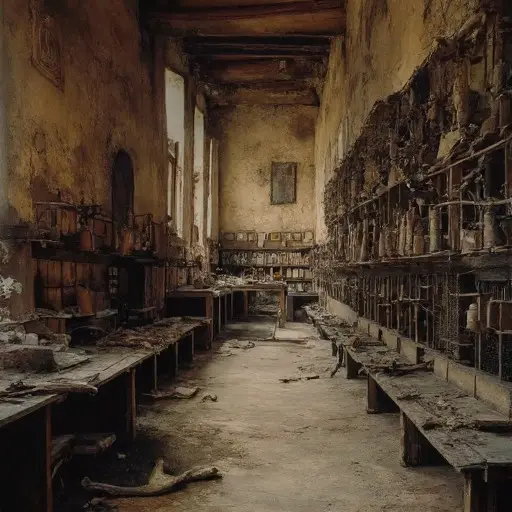
The turning point came in 1908 when international trade reforms redirected customs authority from local municipal offices to centralized state agencies, stripping lagoon-based revenue stations of their jurisdiction over shipping tariffs.
At the same time, mechanized port systems and standardized trade documentation replaced manual tax calculation methods, making local ledger-based customs offices redundant across maritime regions.
Revenue shipments stopped arriving. Merchant declarations were processed elsewhere. The villa’s accounting cycle was never completed again.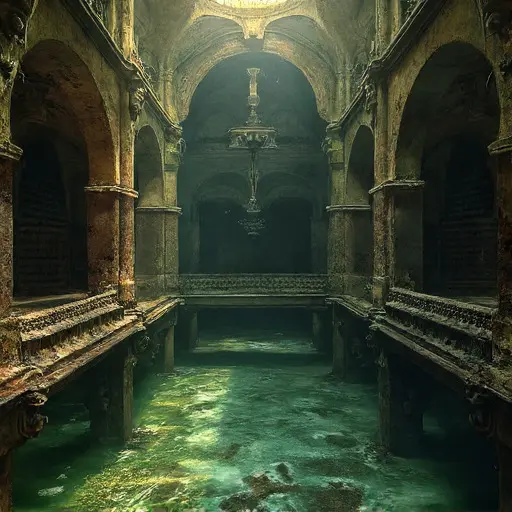
By 1912, Giorgio Rinaldi was formally dismissed from municipal treasury service following the dissolution of lagoon customs offices and the full centralization of maritime taxation systems.
Inside the final ledger press, inspectors found an incomplete customs reconciliation entry that was never stamped before the system was permanently shut down.
The Rinaldi House remains abandoned in the Venetian lagoon, its records drifting in saltwater, its systems dissolved, and its rooms slowly disappearing beneath tide, ink, and silence.