The Valecross House Left Vacant After Glacial Valley Withdrawal
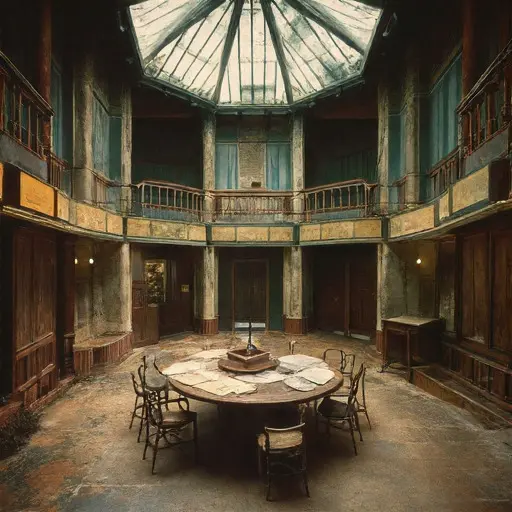
Valecross House was completed in 1905 within a broad glacial valley where braided river channels spread across gravel plains beneath steep forested slopes. Designed by the Halewood family as both residence and observation post, the structure was organized around a central octagonal hall from which multiple wings radiated outward at uneven angles. Rather than adhering to symmetry, the house was oriented according to sightlines toward the river plain, forest edges, and distant valley corridors, creating a star-like footprint that embedded the building within its environment.
Constructed from alternating courses of pale travertine stone and vertically paneled timber, the exterior carried a layered banded appearance that shifted with weather and light. The stone surfaces ranged from ivory and pale peach to cool ash gray depending on moisture levels, while timber sections were painted in saturated yet weather-muted tones of midnight indigo, burnt sienna, and subdued jade green. This interplay between mineral and organic materials reinforced the house’s sense of grounded complexity.
Inside, the Halewood family maintained a structured routine tied to land observation and river monitoring. Edward Halewood documented seasonal changes in river flow and valley ecology, while his wife Clara managed correspondence, records, and household logistics. The octagonal hall functioned as the central organizing space, with each radiating wing dedicated to a specific purpose such as study, storage, lodging, or observation.
Early financial strain
By the late 1920s, regional administrative consolidation reduced the need for localized valley monitoring stations. Government agencies absorbed much of the ecological and hydrological oversight previously managed by private estates like Valecross House. As contracts were withdrawn, the household’s financial foundation weakened. Maintenance of the complex radial structure became increasingly difficult, particularly given its exposure to valley winds and seasonal moisture fluctuations.
Gradual decline in the household
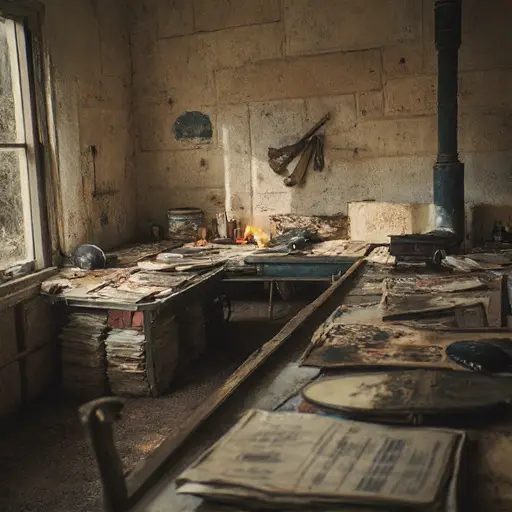
As financial pressure increased, entire wings of the house were gradually closed off. River-facing rooms saw reduced use as ecological monitoring ceased. The glass-walled conservatory, once a key observational space, began to deteriorate as panes clouded and iron ribs corroded in places. Interior circulation shifted inward toward the central hall, compressing daily life into fewer, more manageable spaces.
Younger members of the Halewood family left the valley for urban employment opportunities as institutional oversight replaced private observation work. By the early 1940s, only minimal occupation remained, with the house maintained intermittently by distant relatives and occasional caretakers.
Final abandonment phase
By 1946, Valecross House was no longer fully inhabited. Utility services were reduced and eventually discontinued following sustained arrears. Without maintenance, moisture and wind infiltration increased across all radial wings, accelerating deterioration of timber sections and weakening stone mortar joints. Fog from the valley floor often rose into the structure, softening interior boundaries and obscuring the once-clear directional logic of the architecture.
The house left empty
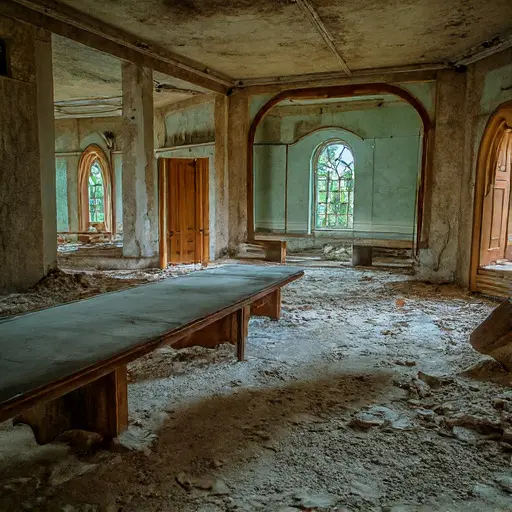
By the late 1940s, no formal ownership or maintenance of Valecross House remained. Legal responsibility for the estate dissolved among multiple heirs who never returned to the valley. No restoration was attempted, and no administrative transfer occurred. The structure remained in place within the glacial valley, slowly degrading under fog, wind, and seasonal runoff, its radial wings gradually dissolving into the surrounding forested slopes and braided river plain.