The Unspoken Rule of Vow-Anchor Keep
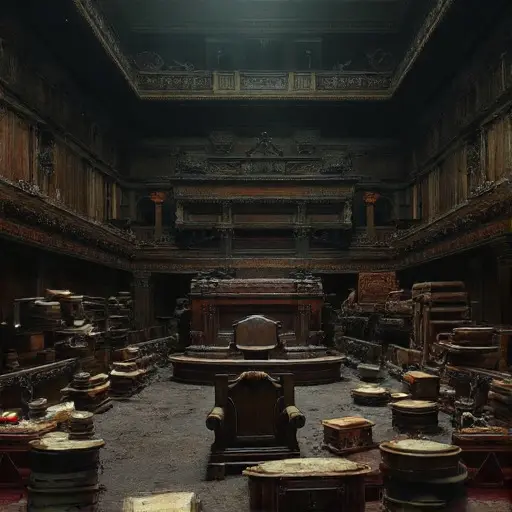
Vow-Anchor Keep was an architectural statement of rigid, moral authority: a massive, symmetrical structure built of cold, light-gray stone, characterized by its numerous, perfectly balanced arches and its forbidding, central tower. Its name suggested a blend of binding promises and unwavering permanence. The house stood on a prominent, isolated hill, giving it an appearance of judgment overlooking the world. Upon entering the main library, which was devoted entirely to law, the air was immediately cold, thin, and carried a potent, almost dusty scent of old parchment, dry ink, and a subtle, metallic odor. The floors were covered in heavy, dust-laden rugs that muffled all footsteps. The silence here was not merely quiet; it was a heavy, judgmental stillness that implied every action, every whispered word, was being weighed against an unbreakable moral code. This abandoned Victorian house was a temple to jurisprudence, designed to enforce one single, ultimate legal principle.
The Jurist’s Absolute Law
Vow-Anchor Keep was the fortified residence and personal court of Lord Alistair Dubois, a brilliant but pathologically obsessive jurist and private legal scholar of the late 19th century. His professional life demanded the exhaustive study of legal precedent, the flawless application of case law, and the pursuit of absolute, unassailable justice. Personally, Lord Dubois was tormented by a crippling fear of moral ambiguity and a profound paranoia that all human law was fatally flawed by exceptions and emotion. He saw the Keep as his ultimate court: a space designed to filter out all human weakness and establish a single, pure, irrefutable law—the “Absolute Statute”—that governed his own life.
The Verdict Chamber
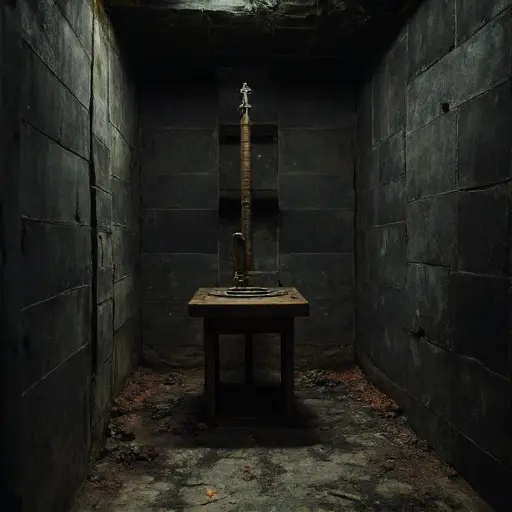
Lord Dubois’s Verdict Chamber was the engine of his moral system. Here, he documented and weighed the “transgressions” of everyone he knew, including his family, reducing complex human behavior to quantifiable data. We found his final, detailed Judgment Ledger, where he assigned numerical “Moral Deficit” values to the actions of his wife, Lady Elara, and his staff. His notes revealed that he believed the only way to achieve the Absolute Statute was to eliminate the need for spoken law entirely, creating a moral rule so obvious and pure that it would be an Unspoken Rule. His final project, detailed meticulously, was the creation of a massive, physical Balance that would perfectly quantify all moral good and evil in the world, proving his statute with irrefutable, physical symmetry.
The Chamber of Final Balance
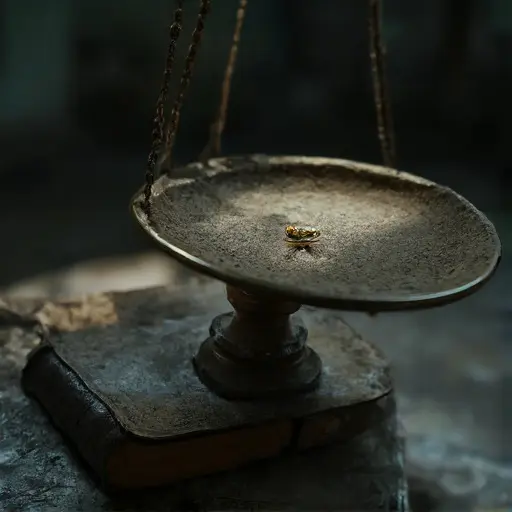
The most chilling discovery was in the main courtroom, where a final, massive exhibit was assembled. In the center of the room stood an immense, hand-crafted brass balance scale, tall as a man. The scale was utterly still, the two large, circular pans perfectly level and covered in a fine layer of dust. One pan was empty. The other pan contained a single, small, tarnished wedding ring. Tucked beneath the scale was Lord Dubois’s final note. It revealed the tragic climax: he had finally realized the only thing of sufficient moral weight to perfectly balance the inherent chaos and evil of the world (represented by the empty pan) was the single, perfect, unexpressed love he felt for his wife, symbolized by her ring. He had taken her ring before she left, using it as his final, pure measure. He had achieved the perfect, static balance, but only by sacrificing the love the ring represented. His final note read: “The Balance is perfect. The Statute is silent. Justice is achieved in the stillness of the sacrifice.” His body was never found. The unspoken rule of Vow-Anchor Keep is the enduring, cold silence of that perfectly balanced scale, a terrifying testament to a jurist who sought absolute, objective justice, only to find the ultimate moral weight was the profound, silent acknowledgment of his own sacrificed heart within the abandoned Victorian house.}