The Tri-Courtyard Estate of Birchlight Parkland
An abandoned Victorian family manor sits within a wide, open forest parkland where gently rolling grass fields transition into scattered groves of birch, cherry, and maple trees under a softly overcast sky. The lighting is evenly diffused and calm—no direct sunlight, no harsh shadows—just a bright, neutral atmosphere that reveals every architectural surface and color with quiet clarity.
The manor is deliberately unconventional in form, designed not as a single unified structure but as a clustered Victorian estate composed of three offset building masses arranged loosely around a triangular courtyard. Instead of symmetry, the architecture embraces variation and gradual evolution, with each mass representing a different interpretation of Victorian design layered over time.
The tallest section resembles a narrow Victorian townhouse stack, rising four stories with vertical sash windows framed in faded ultramarine and soft cream stonework.
Adjacent to it at an angle is a wide, low manor wing with elongated bay windows and pale coral brick softened by age into muted pastel tones. The third structure is a greenhouse-residence hybrid, fully glazed and supported by iron framing painted in muted teal and brushed gold, extending outward like a luminous botanical annex embedded in the landscape.
The central courtyard between these three forms is open and irregular, paved in pale stone tiles now partially reclaimed by grass and scattered wildflowers. Rather than formal landscaping, the space feels gently repurposed by time, with curved, informal paths connecting each wing like softened garden routes shaped by repeated passage rather than design intent.
Inside, each wing maintains a distinct interior identity, reflecting its architectural origin and era of expansion.
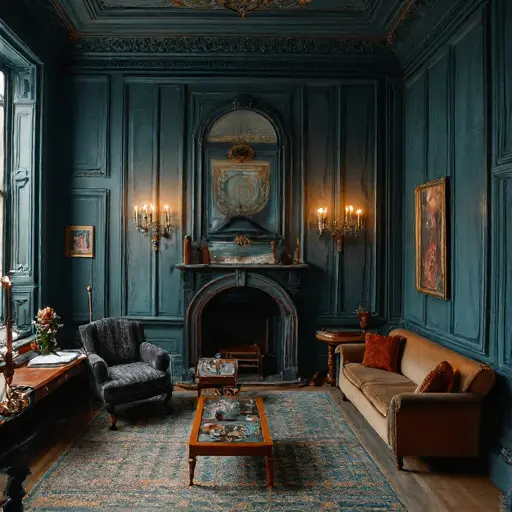
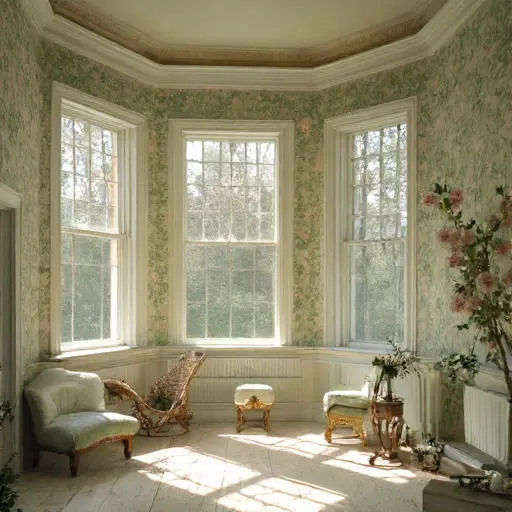
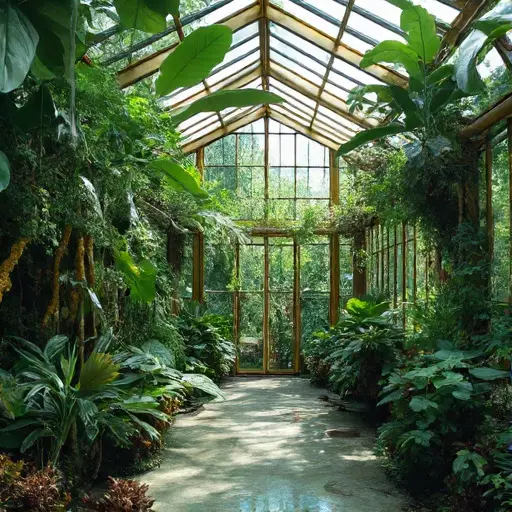
Furniture shifts noticeably between sections: heavy carved walnut dominates the older vertical wing, lighter painted wood defines the wide pastoral wing, and minimal nature-integrated seating appears within the greenhouse annex. Despite stylistic differences, all spaces remain orderly and preserved, as though life paused mid-expansion rather than ending.
The surrounding parkland is open and tranquil, with meadows stretching between tree clusters and shallow streams reflecting the soft gray sky. The forest edge remains bright and breathable, never dense or threatening—only a smooth transition from meadow to woodland.
The atmosphere is quiet, balanced, and grounded in realism—an abandoned Victorian estate that evolved into a multi-form architectural cluster, each section expressing a distinct identity, now slowly being reclaimed by a calm, sunlit forest parkland.