The Thornwycke House Archives and the Abandoned Lithographer’s Bench
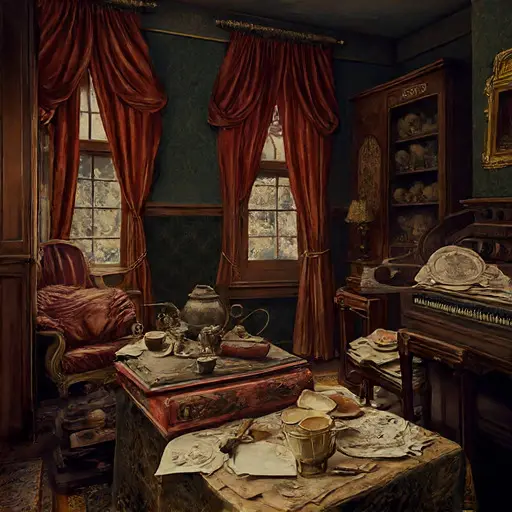
The Steady, Observant Life of Corvan Thale Thornwycke
Corvan Thale Thornwycke, a Victorian lithographer specializing in architectural prints, lived here with his sister, Mirene, and her daughter, Lysa. Corvan carved patiently, his limestone plates decorated with meticulous street scenes, façades, and ornamental window tracings. His notebooks overflowed with perspective studies, shading tests, and alignment guides written in a narrow, disciplined script.
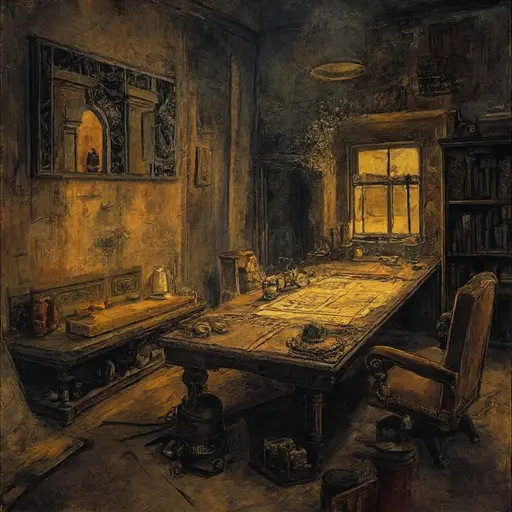
In the Lithography Studio, tools remain arranged in Corvan’s careful order: scrapers sorted by fineness, brayers stacked in angled rows, pigment tins labeled with fading handwriting, and tracing vellum pinned beneath iron weights. Mirene’s steadying influence shaped the home—linens folded in crisp stacks, herbal mixtures placed in orderly bottles, and clothing repairs left in tidy piles. Lysa’s faint footprint remains visible in the soft traces she left behind: a wooden puzzle block carved by Corvan, chalk letters scrawled across a slate, and a paper tower drawing folded beneath proof sheets.
As commissions increased, Corvan’s notes grew tighter, more urgent. Margins filled with perspective corrections. Limestone blocks accumulated, many only half-prepared. When Mirene fell ill, house rhythms slipped. After her passing, Lysa was taken in by relatives. Corvan’s final sketches show trembling lines, unfinished shading, and notations that stop in mid-stroke. One afternoon, he stepped away without completing his final plate. Thornwycke House has remained untouched since.
A Corridor Slackened by Quiet Departure
Upstairs, the corridor’s runner rug has softened into gentle ripples, its once-vivid pattern faded into muted beige. A hall table holds a broken spectacles hinge, a dulled metal scraper, and a personal note ending mid-phrase. Pale outlines trace where architectural sketches once hung before being removed in a final slow gesture.
A Sewing Room Held in Unfinished Stillness
In the Sewing Room, Mirene’s meticulous domestic touch remains suspended. A partially hemmed skirt lies pinned beneath the treadle machine’s presser foot. Thread spools have slipped from their orderly rows, their color softened into chalklike tones. Pincushions hardened with time bristle with rusted needles. Folded muslin stiffened at the edges sits exactly where she last left it.
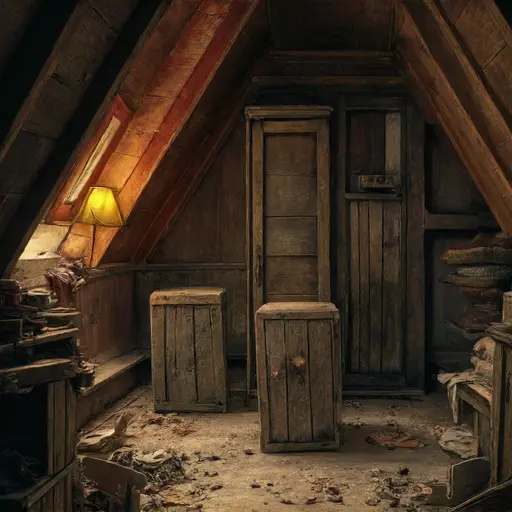
Behind the smallest crate lies a slip in Corvan’s narrowing script: “Etch tower line — tomorrow.” Tomorrow never came to Thornwycke House.
