The Thornwickmere House Diary and the Cindered Quill
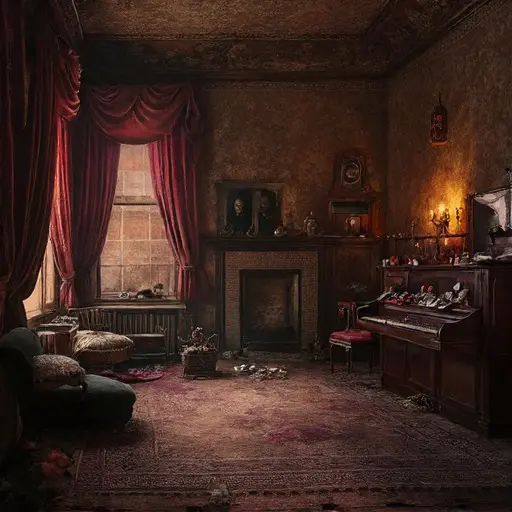
The parlour bears the thick stillness of a room that never witnessed its own ending. The air smells faintly of dried ink, old drapery, and the mineral dullness of long-set plaster. Thornwickmere House feels not evacuated but gently abandoned—its routines simply exhaled, then left to settle into dust without interruption.
The Measured and Reserved Life of Edwin Calder Thornwick
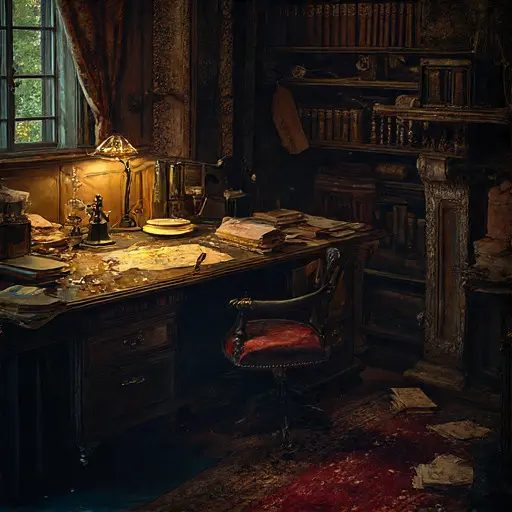
Edwin Calder Thornwick, a modest clerical supervisor for a regional shipping office, lived here with his wife, Lydia, and their daughter, Cora. Edwin’s character—quiet, structured, dutiful—echoes through the remnants he left behind. In the Study, his ledgers are arranged in narrow, meticulously stacked columns, each bound with twill and labeled in fine penmanship. Correspondence lies sorted by month, envelopes slightly parted where he halted mid-review. His journal entries, though private, remain half-tucked beneath blotters—entries that become noticeably cramped and uneven during the later years.
Lydia’s presence lingers in careful gestures: a cupboard lined with neatly folded linens, a basket of mending arranged by severity, and a small notebook of household instructions annotated in her looping hand. Cora’s belongings—chalked slates, a doll missing its right arm, a primer book with softened edges—linger in rooms as though awaiting her return from an afternoon errand.
But Edwin’s professional burdens grew heavier over time. Shipping delays, new regulations, and long hours began to infiltrate his handwriting—first in the form of tighter loops, then blotches, then entire lines rewritten. Meals were skipped. Letters unanswered. When Lydia fell ill, the household’s rhythm fractured completely. After her passing, Cora went to stay with relatives, leaving her toys and books scattered as if mid-play. Edwin attempted to maintain order, but the house quietly surpassed his strength. Rooms gathered dust. Tasks remained half-finished. Eventually he stepped away entirely, leaving Thornwickmere House in a fragile, suspended state.
A Corridor Shaped by Diminishing Footsteps
The upstairs corridor reads like a record of a family withdrawing room by room. The runner rug has collapsed into loose folds, undisturbed for years. A hall table holds collar studs, an undone necktie, and a weekly planner whose entries stop mid-sentence. Pale rectangles mark where family portraits once hung, removed gradually as the household thinned.
Domestic Work Paused in Perpetuity
In the Sewing Room, Lydia’s last efforts remain untouched. A half-mended sleeve is still pinned beneath the presser foot of her treadle machine. Rusted needles protrude from stiffened pincushions. Spools of thread lie scattered across the worktable, their colors faded into powdery hues. Fabric lengths intended for new garments have hardened at their creases, edges lifting like paper.
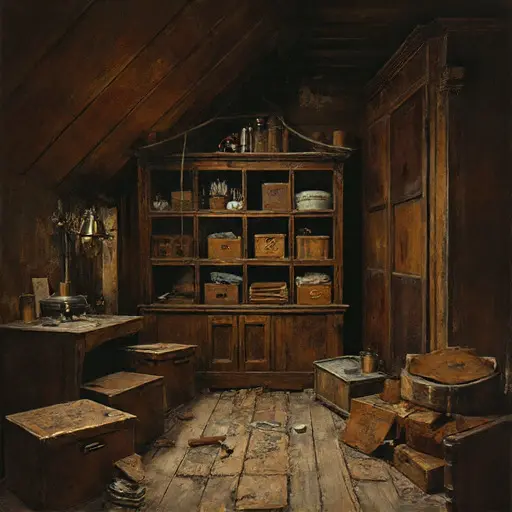
Behind the crates lies a page in Edwin’s unmistakable script: “Review tallies—complete tomorrow.” There is no date. Thornwickmere House remains silent, its rooms still waiting for that tomorrow that never arrived.
