The Terracotta Flow of the Quiet Forest Estate
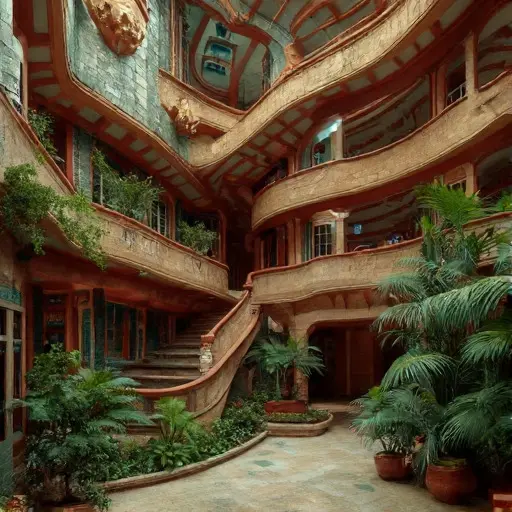
In a quiet forest clearing, an Arts and Crafts Victorian three-story family estate sits with a grounded presence shaped by continuity rather than rigid structure. Its construction of warm terracotta stone is interwoven with muted sea-glass green ceramic panels, arranged in flowing horizontal bands that wrap continuously around the building instead of stacking in conventional layers. The result is a façade that feels encircling and unified, as if the architecture were wrapped rather than built.
The silhouette is organic and low-sweeping. Gently curved exterior walls soften the massing, while a roof of uneven slate tiles and subdued copper seams drifts across the top in irregular but controlled rhythm. A recessed central veranda bends subtly along the façade, reinforcing the sense that the building responds to movement and terrain rather than enforcing strict geometry.
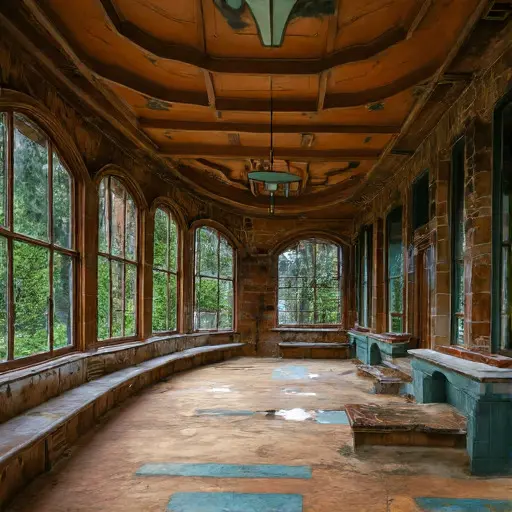
A rounded corner pavilion anchors one side of the estate, slightly offset from the main volume. Rather than appearing as an add-on, it integrates into the flow of the structure, reinforcing a sense of natural asymmetry. The composition feels balanced through distribution of mass rather than mirrored symmetry, allowing the building to settle visually into its forest clearing.
Windows across the estate are diverse but harmonious. Broad arched panes, slender vertical openings, and softly rounded corners are distributed in a non-repetitive rhythm that avoids uniformity without becoming chaotic. Every interior behind these windows remains completely dark and unlit, with no glow or artificial illumination visible anywhere within the structure.
The surrounding forest is calm and estate-like, with widely spaced birch and pine trees standing among a soft moss-and-grass floor. A gently winding gravel path leads through the clearing toward the entrance, guiding approach with subtle curvature that echoes the architecture.
At the threshold, a shallow carved stone basin bears faint mineral staining, its surface weathered but intact. Nearby, a simple wrought-iron gate stands as a restrained boundary marker between forest and structure. The entire scene holds a quiet equilibrium—an estate defined by flow, material continuity, and the absence of interior life.