The Terracline Ridge Residence Left Abandoned Across Monsoon Terraces
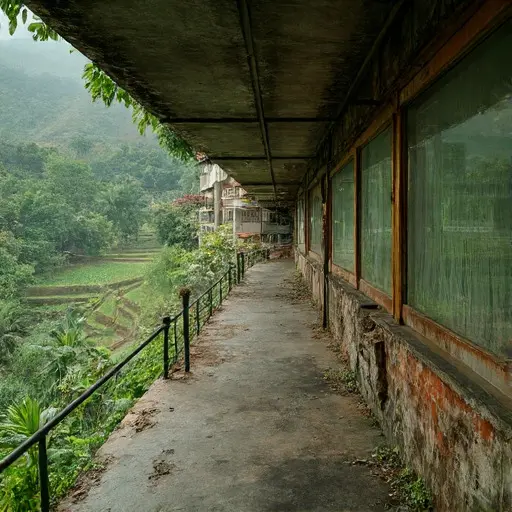
The Terracline Ridge Residence was constructed in 1958 as part of a remote agricultural modernization initiative in a highland monsoon valley where steep rice terraces had been cultivated for centuries The project aimed to integrate long-form residential infrastructure directly into the terraced topography, allowing workers and seasonal residents to inhabit continuous linear housing aligned with irrigation systems and elevation steps rather than conventional clustered settlement patterns The architecture was designed as a zigzagging extrusion of living modules that followed the natural contour lines of the hillside, with each segment slightly offset in height and orientation to match the agricultural geometry of the rice fields Structural systems combined rammed earth retaining walls to stabilize terrace edges, poured concrete slabs for horizontal load distribution, and oxidized steel frames that carried the elongated living volumes across uneven terrain Narrow corridors and open-air walkways connected the segments, allowing movement along the full length of the structure while maintaining visual continuity with the landscape Below and through the building, traditional irrigation channels were integrated into the design, ensuring that water flow for the rice fields also contributed to passive cooling and humidity regulation within the residence
Gradual Monsoon Abandonment and Landscape Encroachment
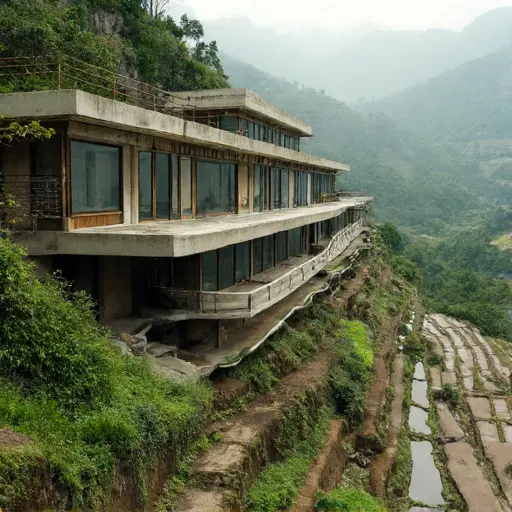
By the late 1970s the Terracline Ridge Residence began to experience sustained decline as agricultural management of the surrounding terraces weakened due to rural depopulation and changing economic priorities Seasonal maintenance of irrigation channels became irregular, causing water flow to divert unpredictably and saturate portions of the foundation retaining systems The rammed earth walls, while structurally robust, began to erode under prolonged exposure to uncontrolled runoff, leading to localized weakening along lower terrace interfaces The steel framing exhibited accelerated oxidation in the persistent monsoon humidity, and concrete slab joints developed hairline fractures that expanded over successive wet seasons Occupancy declined steadily as residents found the continuous linear layout increasingly impractical under reduced agricultural activity, and entire sections of the residence were gradually vacated rather than formally decommissioned By the early 1980s only isolated segments remained intermittently used, primarily near accessible road points, while the majority of the structure stood empty but structurally intact, slowly integrating into the terraced hillside environment
Final Seasonal Departure and Terraced Reclamation
<img src=”https://beyondvisit.
com/wp-content/imagecontent/uploads/abandoned victorian house 10114941.webp” alt=”” />
By 1991 the Terracline Ridge Residence was officially declared uninhabitable following regional infrastructure assessments that documented widespread material degradation, irrigation system failure, and progressive erosion of foundational terrace supports No demolition was undertaken due to the extreme length of the structure and its deep integration into active agricultural topography, and no full restoration was attempted due to the cost and logistical complexity of stabilizing a continuous zigzagging architecture across steep elevation gradients Ownership responsibilities were gradually dissolved as rural depopulation continued and administrative oversight shifted toward broader watershed management policies The structure was left in place as a passive architectural remnant embedded within the rice terraces, with vegetation slowly reclaiming lower walkways and water channels while upper segments remained exposed along the hillside contour
The Terracline Ridge Residence remains stretched across the monsoon valley as a silent linear ruin Its segmented volumes persist in place, partially intact yet fully abandoned, following the contours of the terraced landscape without interruption No return has ever occurred, and no restoration has been attempted The structure endures as a quiet architectural trace embedded within a living agricultural terrain, slowly weathering under monsoon skies while the rice terraces continue to reclaim its lower edges