The Sycamore Hollow Victorian Manor
An abandoned Victorian family manor sits within a secluded forest hollow where tall sycamores and ancient oaks form a natural enclosure around a once-grand estate. The structure is an elongated L-shaped limestone residence with restrained Gothic Revival influences, including pointed arch windows, slender pilaster-like buttresses, and steep slate roofs that have softened over time into layered tones of slate-blue, charcoal, and weathered pewter. The stone façade is dulled into cool gray hues, marked by faint mineral streaks and delicate moss tracing the lower courses of masonry.
A central hall anchors the composition of the building, organizing two asymmetrical wings that extend outward with quiet architectural logic. One wing leads to formal drawing rooms and a modest library, while the other contains private family quarters and service areas.
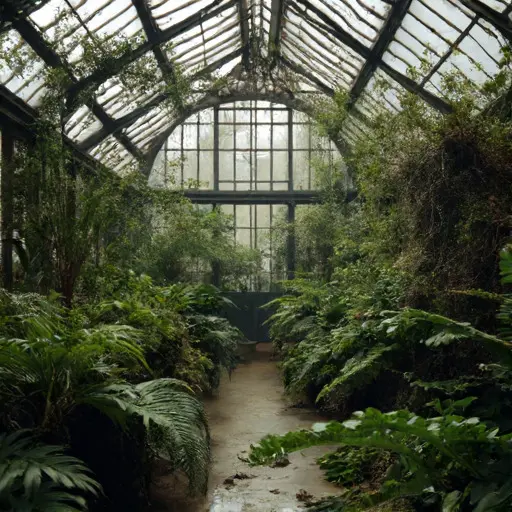
At the rear, a partially enclosed winter garden projects from the main structure, constructed in iron and glass. Its panes remain mostly intact but are clouded by condensation, age, and diffuse forest humidity. Inside, skeletal vines and dormant ferns occupy the beds, contained within the structure yet continuing their slow, persistent presence.
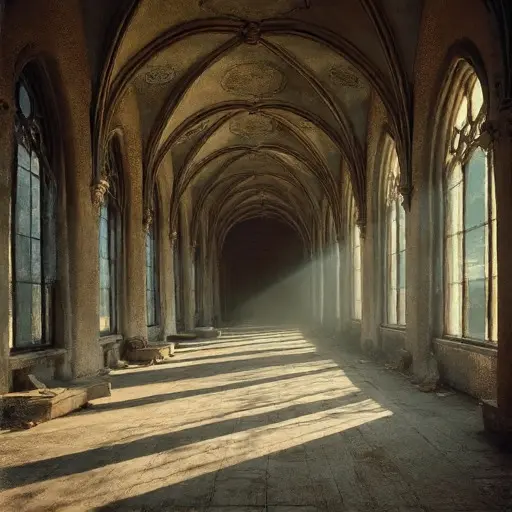
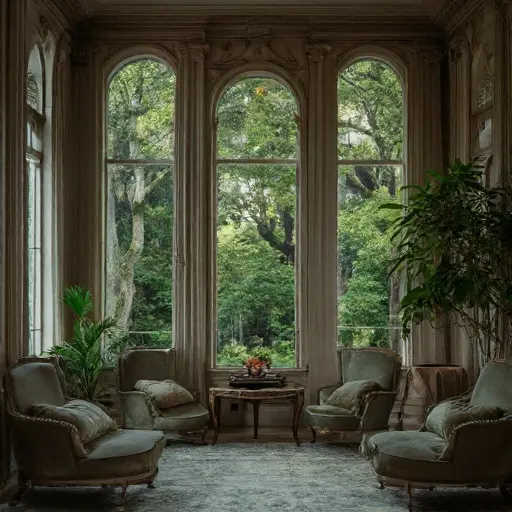
Inside the manor, the spatial order remains strikingly preserved. High ceilings with restrained ornamental plasterwork cast soft, diffused shadows across faded wallpaper in muted sage, dusty blue, and softened cream patterns. Long corridors connect rooms with measured rhythm, reinforcing the manor’s formal logic. Grand yet understated staircases rise between levels, their wooden surfaces worn smooth but structurally sound. Furniture—wooden settees, writing desks, and upholstered chairs in desaturated green-gray fabrics—remains carefully positioned, suggesting absence without disruption.
The surrounding estate has transitioned into a quiet woodland garden. Former gravel paths are now softened by moss and leaf litter, while traces of a circular carriage drive remain faintly visible beneath creeping vegetation. Ivy climbs selectively across portions of stonework, following architectural lines rather than overwhelming them, preserving the integrity of the original design.
The atmosphere is overcast and still, with diffuse forest light filtering evenly through dense canopy layers. The scene carries no sense of collapse or urgency—only the slow, continuous presence of time acting upon Victorian craftsmanship and a manor gently absorbed into the surrounding forest.