The Stone-Base Victorian House Resting in a Mountain Valley
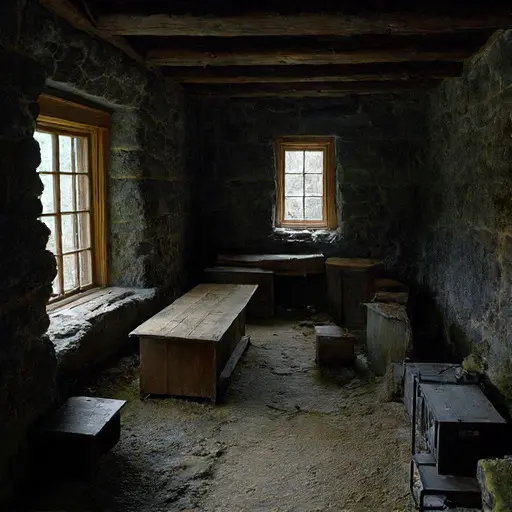
The house sits in the valley with a sense of structural certainty, as though it was placed to belong specifically to this enclosed mountain space. Inside the stone base level, the air is cool and still, shaped by the thickness of the walls rather than the openness of the environment. Light enters in controlled, narrow planes through deep-set windows, revealing textures in the stone that feel geological rather than decorative.
There is no sense of fragility here. The lower level reads as permanence—an extension of the mountain itself—where human construction and natural formation are nearly indistinguishable. Even in abandonment, the structure does not feel diminished; it simply continues existing in its most fundamental state.
The timber upper floors and vertical structure
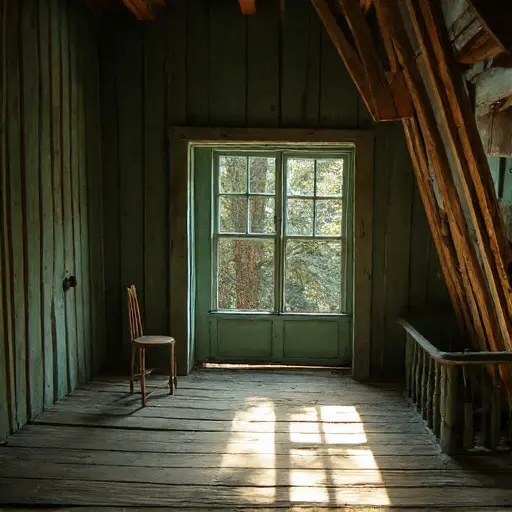
Above the stone foundation, the house transitions into lighter timber construction that responds more directly to the mountain climate. The verticality becomes more pronounced, with beams and siding emphasizing height and slope rather than expansion. Inside these upper rooms, the forest feels closer—not intrusive, but present in every window frame.
The arrangement of interior spaces remains simple and functional. Furniture is sparse, aligned with the narrow proportions of the rooms, suggesting a life adapted to constraint and seasonal conditions. Nothing appears displaced; instead, everything feels as though it has simply stopped being used.
The windows reflect the surrounding trees in muted tones, blending interior stillness with exterior continuity. The house does not separate itself from the valley so much as participate in it at different elevations.
The upper rooms under the pitched roof
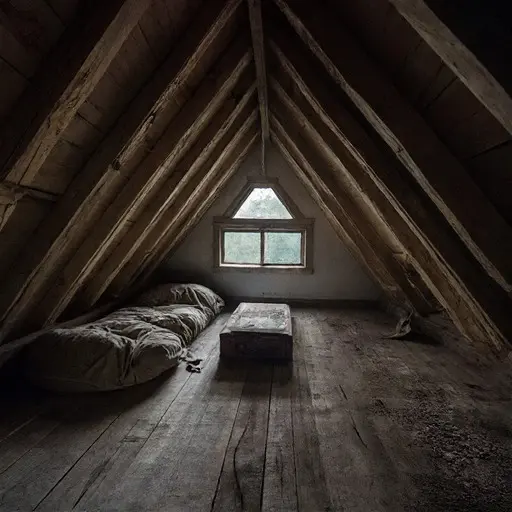
At the highest level, the house becomes more compressed and intimate beneath the steep roofline. The attic space follows the angle of the structure closely, creating a room that feels shaped by weather and necessity rather than comfort. Light enters in narrow, angled beams that move slowly across the wooden surfaces throughout the day.
Despite its confinement, the space remains orderly and intact. Objects are positioned carefully, and nothing suggests disruption or sudden departure. The sense here is not of loss, but of completion—a household that reached its natural end point and simply stopped adding new motion to its existing form.
Outside, the valley continues in steady quiet, with water flowing over stone and wind passing through the treetops. Inside, the house remains exactly as it was last used, preserved in a state of calm architectural endurance within the mountain landscape.