The Stillness of Alderwick Forest Lodge
Alderwick Forest Lodge sits in a wide, flat clearing where evenly spaced trees form a natural perimeter around a quiet architectural presence. The forest feels deliberate in its order, almost landscaped by nature itself, with soft overcast daylight filtering evenly through the canopy and flattening all shadows into a calm, neutral atmosphere. Nothing about the environment suggests neglect or collapse—only long stillness.
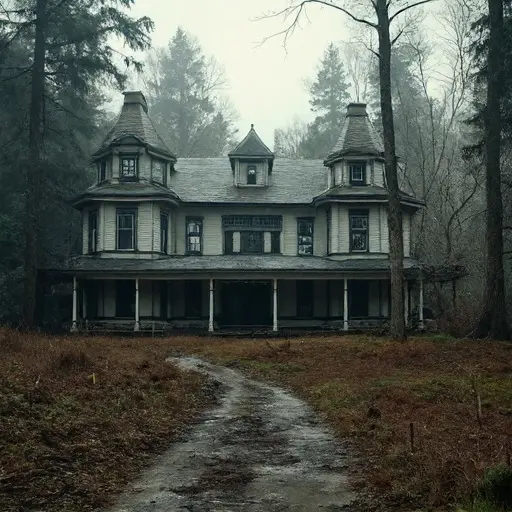
The lodge is a two-story Victorian residence constructed from light painted wood siding and pale stone accents. Its overall form is symmetrical and restrained, with a centered entrance and balanced rows of tall sash windows.
The structure appears carefully maintained even in abandonment, its materials softened by time rather than broken by it. The paint has faded into muted off-whites and desaturated creams, giving the house a quiet, weathered dignity.
Subtle irregularities emerge only upon closer inspection. The right wing extends fractionally farther than the left, and the spacing between windows on that side stretches almost imperceptibly, as if the building was gently expanded during construction and then unified under a single architectural intent. These deviations remain within plausible structural logic, never disrupting the lodge’s overall stability or harmony.
The roof is a shallow, cool gray slate expanse, cleanly laid and uninterrupted by damage. Two chimneys rise in perfect vertical alignment, evenly spaced and uncracked, reinforcing the sense of structural confidence. The roofline carries a quiet discipline, its simplicity contrasting with the slight asymmetry below.
The front porch is modest and well-preserved, framed by white wooden posts and a lightly weathered railing. The stone steps leading up to it show soft rounding at the edges from age and use long past, yet remain solid and intact. The front door is closed, its surface unbroken, with a glass panel reflecting the pale gray sky like a dull mirror.
Inside, the lodge remains visible through its windows in subdued detail.
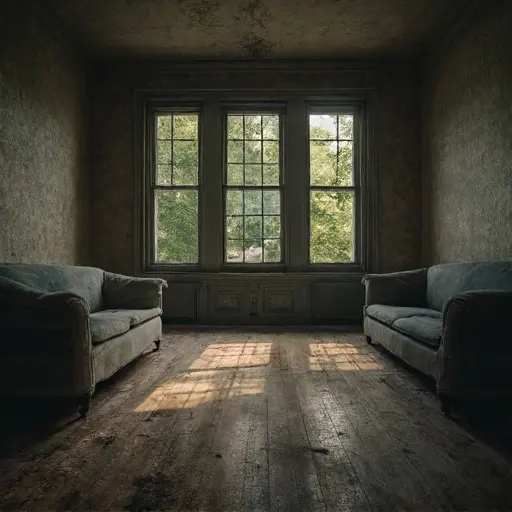
Curtains hang unevenly in several rooms, suggesting a slow and unintentional abandonment rather than abrupt departure. Some are drawn fully closed, others partially open, and one upper window is slightly ajar, introducing a small but noticeable deviation in the otherwise ordered façade. Dust lightly coats interior glass, softening visibility without obscuring form.
The surrounding clearing remains respectful in its distance. Thin grass grows around the foundation stones, and a few small wild plants cluster near the steps, but no aggressive vegetation has claimed the structure. The forest edge holds back naturally, forming a quiet boundary rather than encroachment.
Inside deeper rooms, the lodge maintains its preserved state. Furniture remains arranged as if awaiting return—chairs aligned near tables, rugs flat against polished wood floors, and framed wall patterns still intact beneath layers of time. The interior feels paused rather than abandoned, as though the moment of departure never fully completed itself.
The entire structure exists in a state of quiet suspension. There is no rot, no collapse, no dramatic decay—only the slow passage of time across a well-built Victorian home left undisturbed in a forest clearing that never rushed to reclaim it.