The Stair That Never Reached Tomorrow
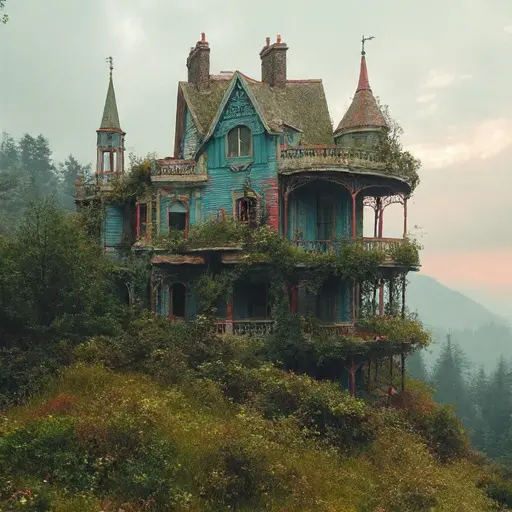
There are buildings that stand on land, and then there are buildings that seem to be still becoming land. On a wide meadow basin where grass grows in layered terraces and wildflowers cling to every change in elevation, an abandoned Victorian mansion rises in the form of a colossal spiral staircase.
It does not simply occupy the landscape.
It performs a motion that never finishes.
Its solar-azure structure winds upward in a slow architectural helix, each step widened into a livable terrace. Ember-chartreuse trim traces the edges of every rise and turn, while a violet-ivory roof softens the uppermost curves where the spiral begins to dissolve into open sky. Beneath a horizon washed from muted seafoam into soft apricot, the entire form is held in a calm, matte light that reveals depth without spectacle.
The feeling is not of grandeur.
It is of interrupted ascent.
Architecture Suspended in Climb
From a ground-level perspective, the spiral is unmistakable. It dominates the meadow not by height alone, but by implication—by suggesting movement that no longer continues.
Arched window cutouts appear along each step-face like entrances paused mid-use. Some are broad enough to imply rooms carved into the climb itself. Others are narrow, almost hesitant, as if designed for transitions rather than dwelling.
Thin brushed-iron rail tracery follows the curvature of the staircase, marking ascent like a forgotten guide system. Alongside it, faded enamel height markers remain faintly visible, spaced at intervals that hint at progress once measured with intention.
But no one measures anything here anymore.
The structure keeps the marks anyway.
Terraces That Remember Motion
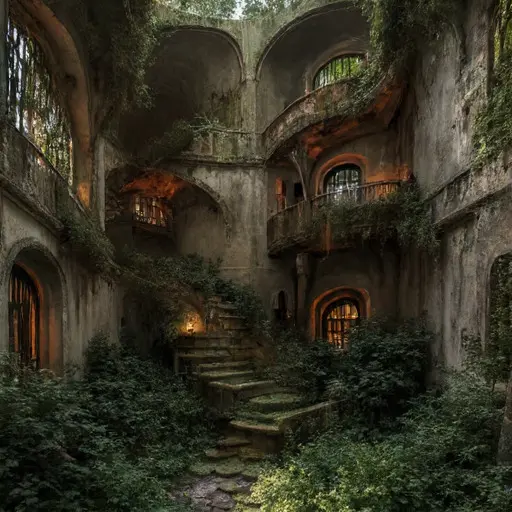
Inside the spiral, the mansion reveals its most unusual truth: every step is a room, and every room is part of a climb.
Corridors curve upward along the helix, sometimes widening into small terraces where wind enters freely from the meadow. Floors are uneven not from decay alone, but from design—each level slightly offset from the last, preserving the sensation of movement even in stillness.
Windows remain dark and open, aligned with the spiral’s outward face. Through them, the meadow appears in shifting fragments: grass at one level, wildflowers at another, sky at the highest points.
There is no interior lighting.
Only the ambient illumination of the world outside, diffused and indifferent.
The air itself seems to move vertically through the structure, sliding along the curvature like memory refusing to settle.
The Base of Forgotten Progress
At the foot of the spiral lies a fractured stone elevation dial, partially buried in grass. Its colored fragments are scattered unevenly, as though the concept of measurement itself broke apart and fell into the soil.
Around it, meadow growth has advanced without hesitation. Tall grass leans against the lowest steps. Wildflowers bloom between cracks in the stone foundation. The boundary between architecture and field has softened into continuity.
A narrow footpath once followed the base of the spiral upward, suggesting the possibility of ascent. It climbs only a short distance now before dissolving into overgrowth, as if the idea of continuing was gently abandoned mid-thought.
Beyond that point, the structure simply becomes landscape again.
A Staircase That Refused Arrival
The most unsettling quality of the mansion is not its scale, nor its surreal geometry, but its refusal of destination.
A staircase implies direction. It implies progress. It assumes arrival.
This one does none of those things.
It rises, but does not resolve. It curves, but does not conclude. It offers ascent without summit, motion without completion.
And yet, nothing about it feels broken.
It feels accepted.
The meadow has adjusted to it the way grass adjusts to stone—without resistance, without urgency.
Wildflowers trace its edges like annotations in a forgotten diagram. Wind moves through its vertical corridors like breath through an open instrument.
The Helix in Evening Light
As the sky shifts toward evening, the spiral becomes more subdued, its solar-azure surfaces cooling under the soft gradient of seafoam and apricot light. Shadows lengthen along the terraces, emphasizing the structure’s impossible continuity.
There is no summit to silhouette against the sky.
Only continuation.
The mansion does not rise into a final point. It dissolves into atmosphere, step by step, until architecture and horizon begin to share the same quiet language.
And there, in the settling wind of the meadow basin, the great spiral staircase rests without conclusion—still ascending in memory, still unfolding in silence, exhaling softly like a dethroned emperor remembering the garden.