The Spiral Stack Villa Manor Left Vacant in the Inland Basin
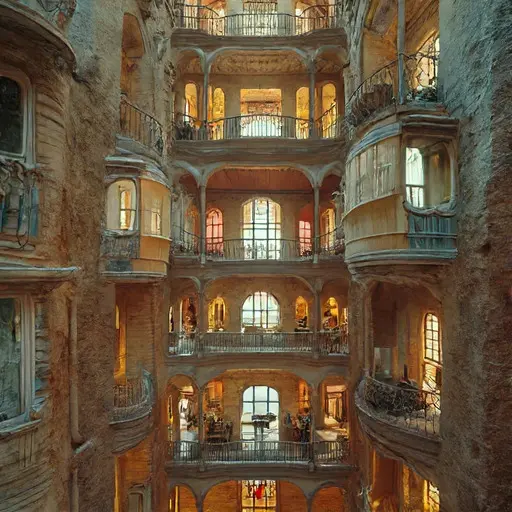
The Spiral Stack Villa Manor was constructed in the late Victorian period within a broad inland basin where open fields, scattered fruit trees, and long golden grasses form a quiet, sunlit landscape. Unlike conventional manor design that spreads horizontally, this residence was conceived as a vertical sequence of interlocking “stacked villas,” each forming a complete residential level arranged around a central stone spine. The result is a tall, compact structure that appears stable yet subtly twisting, as if the building itself has been gently rotated over time.
Each level of the manor operates as an independent Victorian residence, complete with its own façade, windows, and balconies. However, each tier is offset by a few degrees relative to the one below, creating a slow spiraling progression upward. This rotational logic produces constantly shifting alignments: arched windows briefly coincide before slipping out of view, balconies overlap in staggered rhythm, and structural edges appear to orbit the central axis. Despite this movement in form, the structure remains fully stable and coherently engineered.
Material expression varies subtly across the ascending tiers. The exterior is constructed from alternating bands of pale limestone and glazed terracotta brick in soft jade and muted sapphire tones. Wrought iron railings in softened bronze line the balconies, while window frames shift in alternating colors of pale aquamarine and dusty coral. Carved stone lintels also evolve across levels, transitioning from floral motifs at the base to more geometric patterns in the upper tiers, reinforcing the sense of gradual transformation through vertical ascent.
The roof system is composed of stacked circular terraces rather than a single unified cap. Each terrace is slightly smaller than the one below it, forming a stepped crown that follows the spiral logic of the building. Small ornamental skylights and slender chimneys rise from these terraces, maintaining vertical alignment despite the rotational offset beneath them. This creates a subtle tension between rotational movement and vertical stability.
At ground level, a modest Victorian entrance hall anchors the entire structure. A simple stone portico and short flight of steps lead into the lowest residential tier, which is the most grounded and solid in appearance. Surrounding the manor is a remnant orchard, with evenly spaced trees casting soft, diffuse shadows across the grass. Faint stone pathways remain partially visible beneath regrowth, suggesting former circulation routes that once connected garden and residence.
Gradual decline within the spiraling villa system
By the 1930s, the Spiral Stack Villa Manor began to experience structural and logistical challenges due to its unusual rotational stacking system. While architecturally stable, the complexity of maintaining offset residential tiers made repairs increasingly difficult, particularly in upper levels where exposure to wind and weather was more severe. Over time, occupancy gradually shifted downward as upper villas were vacated first.
Fragmentation of vertical spiral habitation
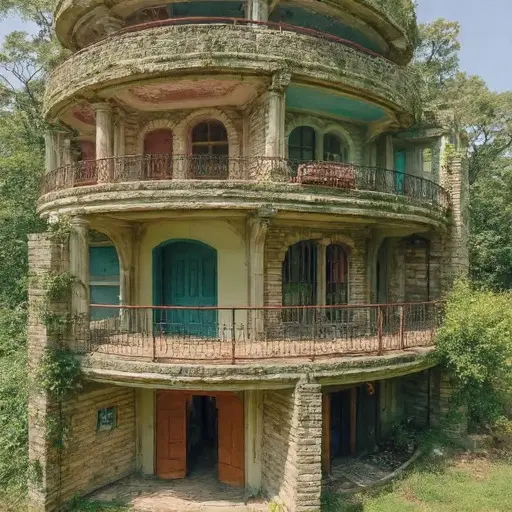
As economic and demographic shifts reduced the need for large multi-tier family estates, the manor’s upper levels were gradually decommissioned. The rotational misalignment, once an aesthetic innovation, became increasingly impractical for full-time habitation. Maintenance efforts concentrated on the lower tiers, while upper villas were progressively sealed and left unoccupied.
Eventually, the manor ceased functioning as a unified residence. Remaining occupants departed in stages, leaving behind a structurally sound but partially hollowed vertical system of stacked and rotated Victorian villas suspended within the inland basin.
Final abandonment of the spiral manor
By the early 1940s, the Spiral Stack Villa Manor was fully vacated. No redevelopment occurred due to the complexity of its rotational vertical architecture, which resisted conventional subdivision or adaptation. The structure remained stable, anchored by its central stone spine and balanced tiered foundation.
Final rotational stillness
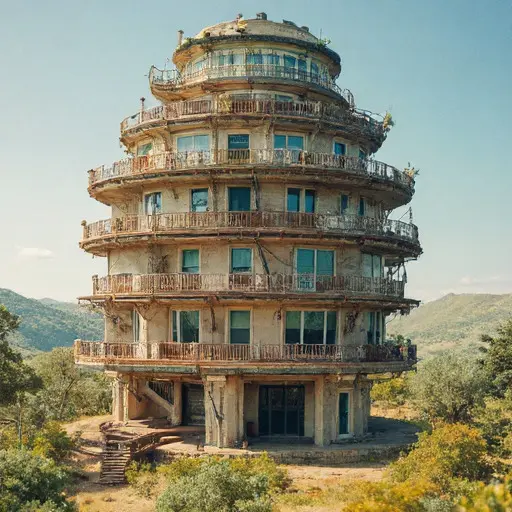
By the mid-1940s, no active ownership or functional use remained for the Spiral Stack Villa Manor. The surrounding orchard basin remained open and undisturbed, with no redevelopment due to the unconventional rotational stacking system. The structure persists today as a stable but uninhabited vertical spiral, its layered villas preserved in quiet equilibrium within a sunlit rural landscape.