The Spiral House in the Coastal Basin Rainforest
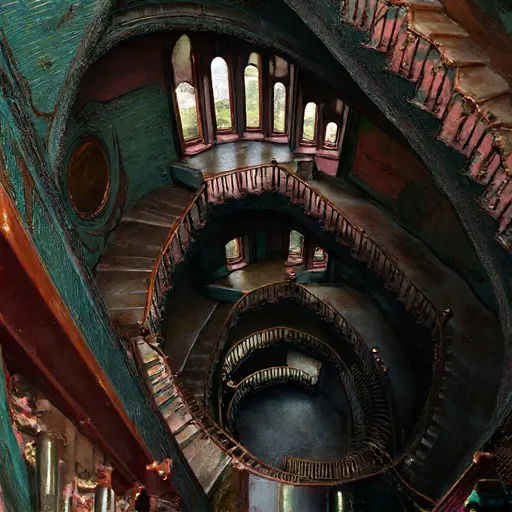
The house did not rise so much as it turned into itself. Built within a coastal rainforest basin where mist moves like a second tide through the canopy, its form was never intended to be read in a single glance. Each level shifts slightly off-axis from the one below, producing a restrained helical drift that reveals itself only through movement—walking, climbing, pausing at landings where the geometry briefly misaligns and then corrects again.
This rotational logic extends into every surface. The glazed brickwork, arranged in vertical fields of indigo, ruby, and jade, behaves less like ornament and more like a coordinate system for orientation within the structure. Even in abandonment, the colors remain saturated, as if the humid air has preserved their intensity rather than eroded it.
The rotating gallery corridor
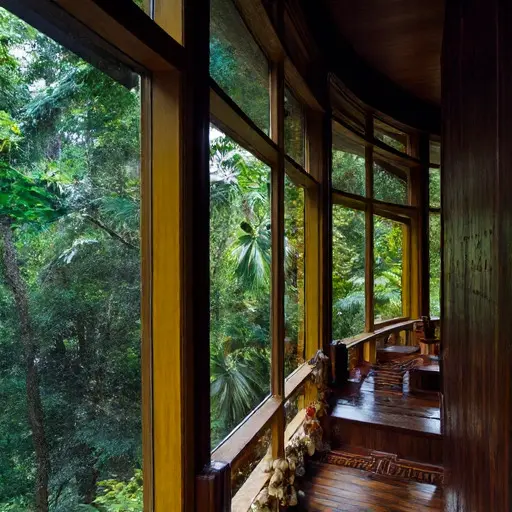
This corridor functioned as a transitional loop between floors rather than a destination. Its curvature is not purely horizontal; it subtly climbs and rotates, mirroring the external stair that coils around the building. Movement here is always directional but never linear—progress feels like it is being translated through a slow spatial turn.
Light behaves unpredictably in this space. Because of the slight rotation of each structural segment, sunlight enters at shifting angles, producing moving gradients that never repeat exactly from one circuit to the next.
The upper rotational chambers
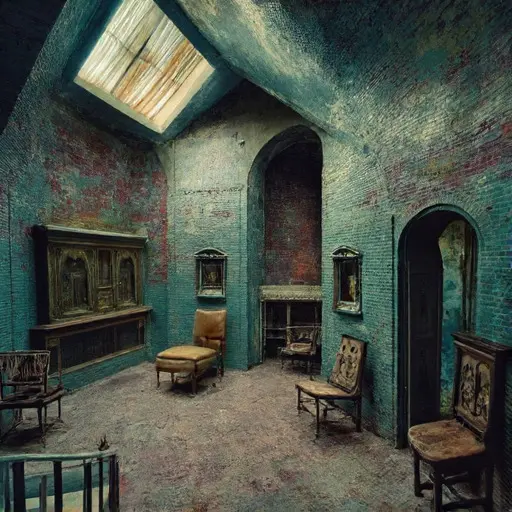
At the upper levels, the rotational design becomes most legible. Rooms do not align in traditional Victorian symmetry; instead, they appear as successive calibrations of angle and position. Doors open into spaces that are never quite centered, reinforcing the sensation that the entire house is gently turning even when completely still.
The skylights above intensify this effect. As mist moves through the rainforest canopy, light filters in as fragmented shafts that shift across walls like slow rotational markers, reinforcing the building’s underlying geometry.
The house remains structurally intact, yet perceptually unstable in the most deliberate way. In the basin forest, where everything else grows vertically and predictably, it continues its silent inward twist—an abandoned Victorian residence preserved not as a ruin, but as a slow architectural rotation suspended in humid air.