The Slate-Pink House at the End of the Lane
An abandoned Victorian family house stands at the end of a quiet suburban lane bordered by old chestnut trees, its presence grounded in a restrained late-Victorian domestic language rather than ornament or display. The structure reads immediately as familiar and functional: a compact two-and-a-half story residence composed of a central rectangular mass, a shallow front gable, and a modest rear extension that suggests incremental family growth over time rather than a single unified design intention. It is a house shaped by continuity of use, where form follows accumulation rather than architectural ideal.
The exterior is clad in horizontal weatherboard siding painted in a softened slate-pink tone that has aged unevenly across its surfaces. Layers of weathering have broken the color into dusty rose, pale clay, and faint traces of underlying cream primer, producing a muted stratification that feels gentle rather than eroded.
The siding reveals subtle inconsistencies in plank width and alignment, evidence of long-term repairs and small domestic adjustments that accumulated without disrupting the house’s overall coherence. The result is a surface that feels lived-in rather than designed—quietly responsive to time rather than resistant to it.
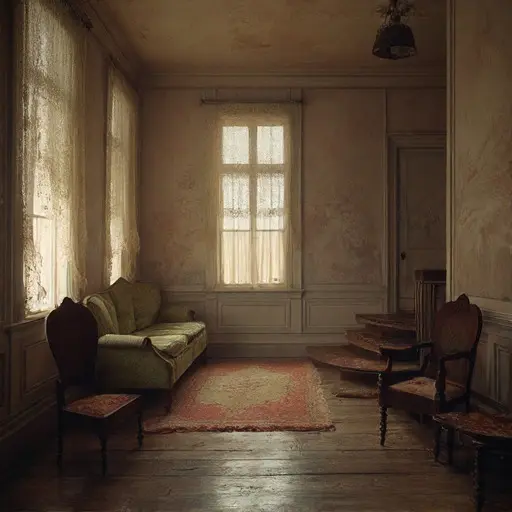
The front entrance sits slightly off-center, framed by a simple timber surround with minimal Victorian detailing: a narrow cornice trim and a modest transom window above the door. The door itself is painted a desaturated bottle green, its edges softened by years of repeated handling that have worn the finish into a smoother, darker gradient. A single concrete step leads up to it, its surface gently curved from long use, marking the threshold with understated clarity rather than ornament.
Windows are evenly spaced and proportioned for practicality rather than display. Each is set within slightly recessed frames painted a faded off-white that contrasts gently with the weathered siding. The glass remains mostly intact but softened by age, introducing faint distortions that blur interior darkness into ambiguous depth. In a few openings, remnants of lace curtains still hang loosely, barely visible through the glass, suggesting domestic life that once followed regular, unremarkable rhythms.
The roof is a straightforward pitched form covered in aged cedar shingles, now shifted into a soft gradient of weathered silver, pale taupe, and muted brown-gray. A single brick chimney rises near the centerline of the structure, functional and unadorned, with mortar slightly darkened but structurally sound. There is no ornamental excess—only the quiet logic of a house built to shelter rather than impress.
A small front garden defines the boundary between house and lane. A low wooden fence, missing a few slats, encloses an overgrown yard where grass, clover, and wildflowers reclaim space in an unforced, gradual manner. A narrow gravel path still leads from the gate to the front door, though its edges have softened as vegetation encroaches, blurring the intended geometry of arrival.
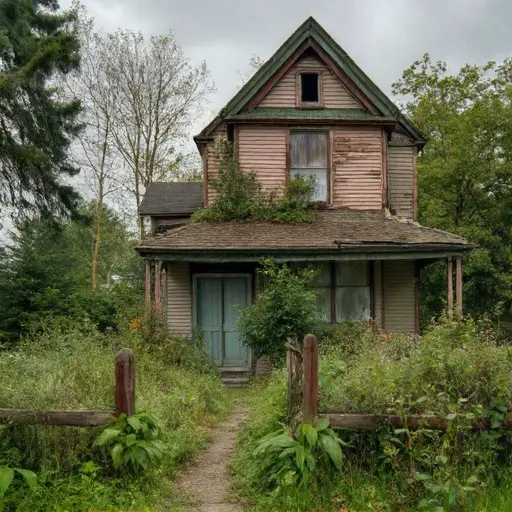
The surrounding lane remains quiet and enclosed by mature chestnut trees whose branches arch gently overhead, filtering light into a diffuse, even pattern across the house’s façade. The atmosphere is calm, subdued, and spatially familiar, emphasizing proportion, repetition, and the understated dignity of ordinary domestic architecture paused in time.
The result is a grounded Victorian suburban house that feels neither monumental nor romanticized, but gently continuous with everyday life—an architecture of modest permanence shaped by use, weather, and gradual, almost imperceptible change.