The Silted Canal Basin Warehouse Residence
Abandoned Victorian house, pale kiln-fired sandbrick with subtle horizontal banding from original brick layering and long-term sediment staining, deep oxblood-stained timber accents faded into muted brown-red tones with uneven exposure-driven bleaching, and wrought ironwork in dark gunmetal with irregular oxidation patterns formed by decades of canal moisture, wind exposure, and mineral runoff. A compact Victorian inland harbor warehouse-residence hybrid sits along a forgotten canal basin that has partially silted over, where domestic life and small-scale trade once coexisted within a single long, functional structure aligned to waterborne logistics.
The building is long, low, and strongly horizontal in composition, emphasizing utility over ornament. The ground level façade is organized into repeating arched bays originally used for goods storage and canal loading access, now sealed with aged timber shutters reinforced by iron fastenings. Above this, a continuous residential floor spans the length of the structure, articulated by evenly spaced tall sash windows that once overlooked canal activity and loading movement.
The roof is shallow-pitched slate with pronounced weathering variation—tiles shifting between charcoal gray, ash-blue, and softened stone tones—showing subtle sagging between older structural beams due to long-term load distribution and settlement.
The façade is fully exterior and materially accurate in its aging behavior. Sandbrick surfaces exhibit edge softening from erosion and faint discoloration bands aligned with historic water exposure near the canal-facing side. Timber components are not uniformly treated; remnants of oxblood stain persist in irregular patches, revealing layered maintenance cycles and exposed grain beneath worn coatings. Iron fixtures—hinges, pulley mounts, bracket supports, and rail anchors—retain functional geometry but display realistic oxidation gradients, heavier in sheltered recesses and lighter on exposed planes washed by rain over time.
The adjacent canal basin is partially reclaimed by sediment and vegetation. Water exists in discontinuous pools rather than a continuous channel, forming shallow reflective sections separated by silted ground and moss-covered stone edges. The water is still, slightly opaque, and reflects fragmented impressions of architecture, sky, and surrounding structures. Original canal stonework remains visible in sections, though unevenly submerged or fractured due to long-term ground shifting and silt accumulation.
Vegetation follows hydrological and structural moisture patterns rather than ornamental design. Dense moss carpets canal edges where water once flowed consistently. Reeds and tall grasses grow in irregular clusters, bending in wind corridors between structures. Small wild plants occupy nutrient-rich pockets—white-flowering weeds near stone joints, pale green creeping vines along damp timber, and occasional muted yellow blossoms near drainage outlets where runoff once concentrated.
A rusted iron loading crane remains partially intact near the rear canal façade, its arm fixed in a lowered position, with cables long since removed and mechanical joints frozen by corrosion. Adjacent wooden dock planks are warped and uneven, some submerged, others tilted due to subsurface ground displacement. A narrow exterior stair runs along the side elevation, connecting ground-level storage bays to upper living quarters, with tread wear concentrated along central paths from historical repeated use.
Window glass varies in condition and composition—some panes retain original waviness and mineral inclusions, subtly distorting reflections of canal water and sky; others are missing or replaced with mismatched glass types, creating irregular transparency across the façade. Interior spaces are only partially visible, revealing faint structural silhouettes of beams, doorframes, and empty rooms without readable detail.
Lighting is overcast industrial daylight filtered through canal mist and low cloud cover. Illumination is soft and diffuse but directionally coherent, allowing realistic material definition across brick, timber, and iron without exaggerated contrast or atmospheric stylization. Reflections on wet stone and water remain subdued and physically consistent with real-world optical behavior.
Interior Image Descriptions (for flux dev generation):
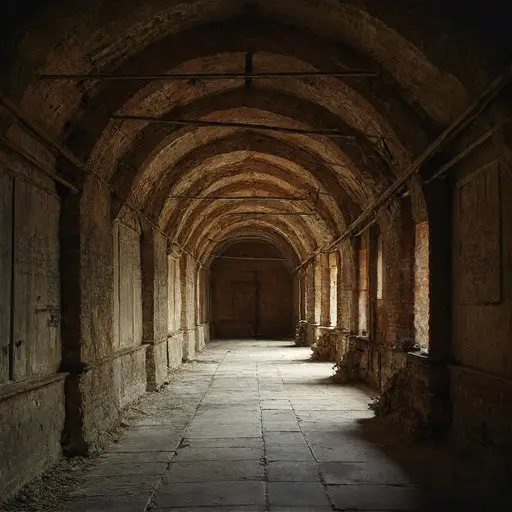
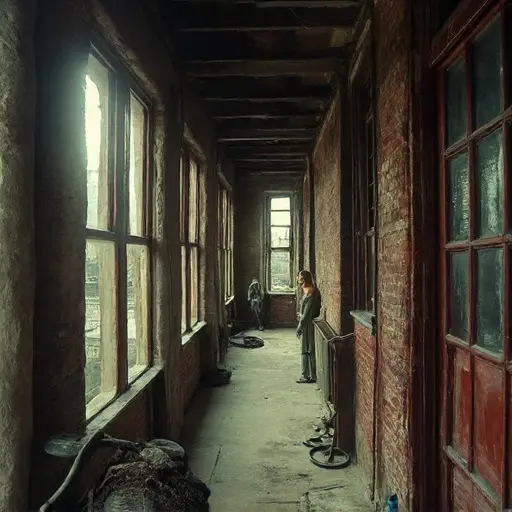
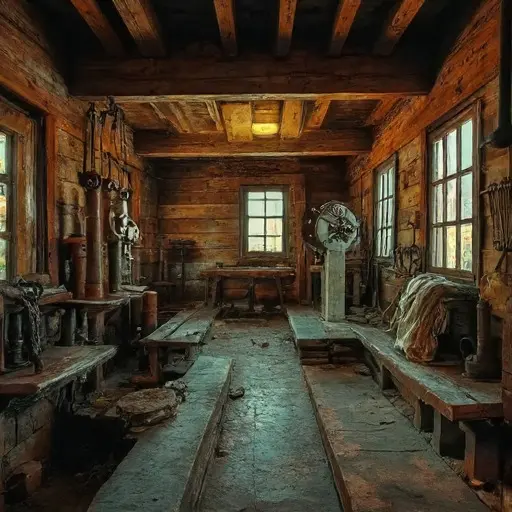
The entire scene reads like a precise architectural documentation photograph of a Victorian canal warehouse residence—material-driven, physically grounded, and shaped entirely by trade history, water behavior, and long-term environmental interaction rather than ornament or romanticized decay.