The Silent Watch of Aethelred House
The Aethelred House stands on a low hill, its asymmetrical red brick and stone bulk shrouded by thick, unpruned stands of yew and cedar. Built in the high Gothic Revival style in 1883, it has always possessed a stern, almost unforgiving presence. To enter is to meet a pervasive, mineral coldness, the kind that settles into bone.
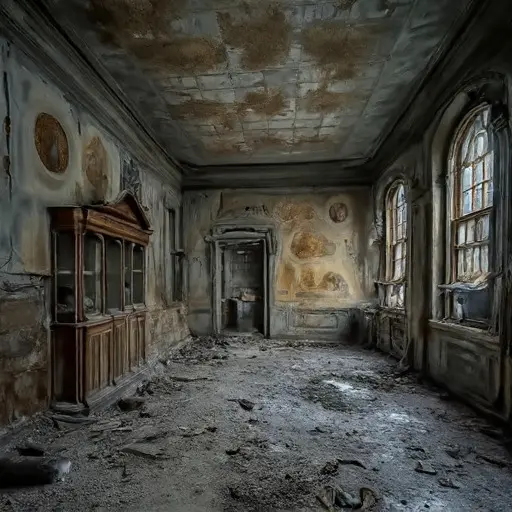
The main drawing-room, a cavernous space meant for formal entertaining, is the epicenter of this chilling silence. The room is in an advanced state of deterioration—dust covers everything, but the underlying structure holds fast, a resolute tomb of memory. The atmosphere is heavy with the truth: this house has been keeping a silent vigil over the remains of a single, devastating internal conflict for nearly a century.
The Weight of George Atherton
The manor was commissioned by George Atherton (1835–1905), a man whose identity was inextricably linked to the law. He was a distinguished High Court Judge, a figure whose profession demanded meticulous adherence to rules and absolute moral rectitude. Socially, he was respected but feared—a man of unyielding, often brutal, discipline.
George married Lydia Vance in 1860, and they had one daughter, Catherine. George’s personality was rigid, formal, and deeply conservative. His daily life was dictated by schedules, order, and the expectation of unwavering obedience from his family. His ambition was not wealth, but legacy: to be remembered as a pillar of judicial and moral authority.
The house was built to reflect this authority. The addition of a private, two-story Muniment Room—a space designed for storing legal documents, historical family papers, and the Judge’s private docket notes—was his obsession. He viewed the house as a fortress against the moral laxity of the outside world, a place where his own exacting standards could be enforced.
A Broken Engagement in the Music Alcove
The family’s central tragedy was the suppression of their only child. Catherine Atherton was an artistic, vibrant woman stifled by her father’s severe regime. Her only refuge was the small Music Alcove off the drawing-room, where she kept a small, elegant harpsichord and painted watercolors.
In 1898, Catherine became secretly engaged to a young journalist, a move her father deemed utterly unacceptable—a threat to his social standing and the family’s “sacred” reputation. In a devastating confrontation that took place in the Music Alcove, Judge Atherton gave Catherine an ultimatum: break the engagement or be permanently disinherited and disowned. Catherine refused. He used his immense legal knowledge and influence to destroy the young man’s career, forcing him to flee the city.
The broken engagement shattered Catherine. She did not rail or flee; she simply retreated entirely, adopting a monastic existence within the house. She developed an intense, self-imposed isolation, retreating from all social functions, communicating only through notes, and refusing to leave her third-floor sewing room. She became the silent, living ghost of the house, a direct consequence of her father’s unforgiving nature.
The Final Document in the Muniment Room
Judge Atherton died suddenly of a cerebral hemorrhage in 1905, the victim of his own unrelenting stress. His wife, Lydia, equally broken by years of living between two irreconcilable forces, died just six months later.
Catherine, the sole heir, was now free, but the house had become her cage. She did not change anything; she left the drawing-room as it was, the dinner table unset, and her father’s private study exactly as he had left it. She lived in the house alone for another 25 years, a wealthy recluse. She paid the taxes, hired a minimal caretaker to bring coal and groceries, and saw no one. She was the mansion’s dedicated, living jailer, ensuring its continued isolation.
In 1930, Catherine died quietly in her sleep in the sewing room. Her will was simple and stark: the house was to be placed in an obscure legal trust, stipulating that it could never be sold, occupied, or significantly altered for a period of one hundred years. She created an elaborate, unassailable legal mechanism to ensure the house remained precisely as it was—a silent monument to her father’s tyranny and her own loss.
The legal trust expired in 2030, but by then, the Aethelred House was utterly valueless—structurally sound, but filled with a hundred years of filth and legally too complicated to untangle without a monumental effort. It was simply forgotten by the inheritors who had no personal connection to the tragedy. The house still stands, a monument to the power of a single will and the devastation of emotional control, its heavy structure keeping a cold, silent watch over the consequences of a life not lived.
