The Silent Testament of Skerryfell Hall
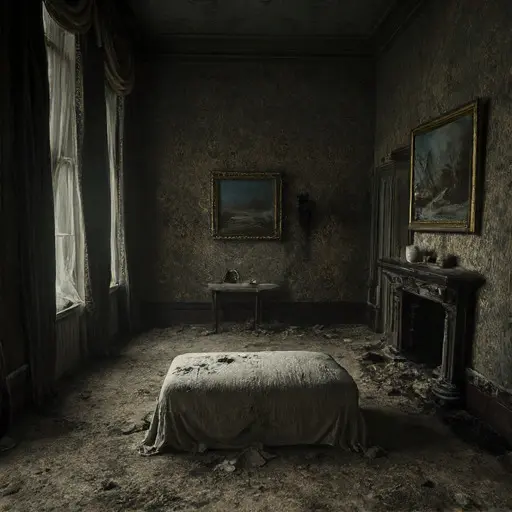
The atmosphere inside Skerryfell Hall was a study in cold, dry silence, a space that had perfectly preserved the moment of its abandonment. Stepping through the shattered remains of the Main Entrance Doors, one was immediately struck by the sheer volume of dust—a thick, gray blanket that rendered all surfaces soft and muted. The scent was a mixture of dry paper, moth-eaten wool, and the faint, mineral odor of coastal stone.
This mansion’s story was one of forgotten love and duty, its interiors holding the exact inventory of a family that simply ceased to exist.
Doctor Theron Price: The Collector of Sins
The central figure of Skerryfell Hall was Doctor Theron Price, a highly respected physician in the late 1880s whose practice focused on the study and treatment of pulmonary diseases common among mill workers. His wealth was substantial, rooted in his medical reputation. His temperament was outwardly empathetic and meticulous, but secretly, he was driven by a deep, puritanical guilt over his own life’s comforts, fearing that prosperity was earned through the suffering of others. He married Clara, a woman who devoted herself entirely to his medical career, and they had one son, Jonas.
Theron’s guilt is materialized in his Private Consulting Room, a severe, dark space adjacent to the main study. This room, while professionally equipped with an examination couch and medical instruments—now heavily oxidized—holds a secret. Hidden in a locked Apothecary Cabinet, behind rows of dried herbs and labeled vials, is his Sin Ledger. This small, leather-bound book contains no financial accounts, but daily, meticulous records of every perceived moral failing or indulgence: a glass of wine, a new suit, a half-hour of leisure. He believed that by meticulously documenting his “sins,” he could somehow atone for his wealth.
Clara’s Final Act of Love in the Conservatory
Clara Price’s life was defined by the relentless support of her husband’s career and the management of his profound anxieties. Her only place of personal expression, and the scene of her turning point, was the Glass Conservatory.
The room, though now severely damaged by decades of frost and broken glass, holds her final, poignant message. On a small, wooden work table, beneath a scattering of dead leaves and grit, lies a small, Children’s Storybook she had made for Jonas. The pages are filled with her delicate, handwritten stories and charming watercolor illustrations of local birds. Tucked into the book’s center is a carefully preserved, folded newspaper clipping, dated 1899. It details the success of a new, experimental tuberculosis sanatorium opening overseas, which offered radical, effective treatments. This was the final turning point for Clara: she realized Theron’s obsessive guilt had prevented him from adopting effective, modern treatments, leading to the avoidable death of their son, Jonas, from consumption earlier that year. The Conservatory was where she resolved to confront her husband with his fatal flaw.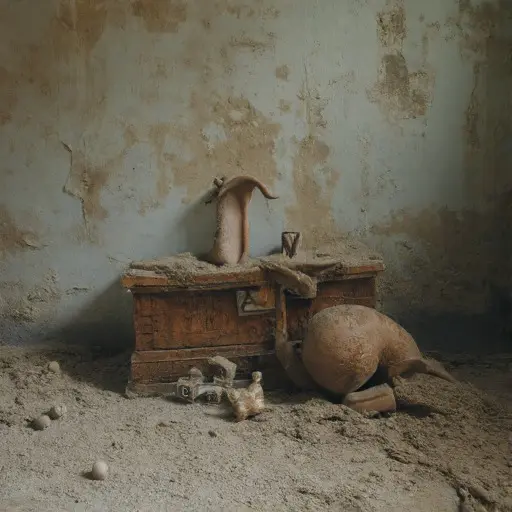
The Ledger’s Last Page in the Master Suite
Clara left Skerryfell Hall in the spring of 1900, taking only a single valise and the Children’s Storybook. She left behind a letter for Theron on his desk, not of anger, but of cold, clinical diagnosis: “Your guilt has always been your most fatal disease, and you chose it over us.”
Theron Price, faced with the exposure of his flawed morality and the complete abandonment by his family, broke entirely. The final, fatal turning point is preserved in the Master Dressing Room, a small, cold space adjacent to the bedroom. Here, on a severe, low wooden bench, lies his Sin Ledger. The final entry is scrawled across the last two pages, dated the day Clara left, and reads only: “The true sin was the comfort of the lock. Unpaid.” The entries end there.
Theron Price was found dead in the Master Bedroom a week later, having meticulously prepared a lethal dose from his own medicinal supplies. He did not sell the house or liquidate his assets; he simply left everything in place, a monument to his failed atonement. Skerryfell Hall was seized by the state for lack of heirs, its contents deemed worthless to creditors, and it was quietly sealed. It remains today, utterly full, its interiors a forgotten archive of a life ruined not by poverty, but by the paralyzing burden of self-inflicted guilt.
