The Silent Seal of Haptic-Void Hall
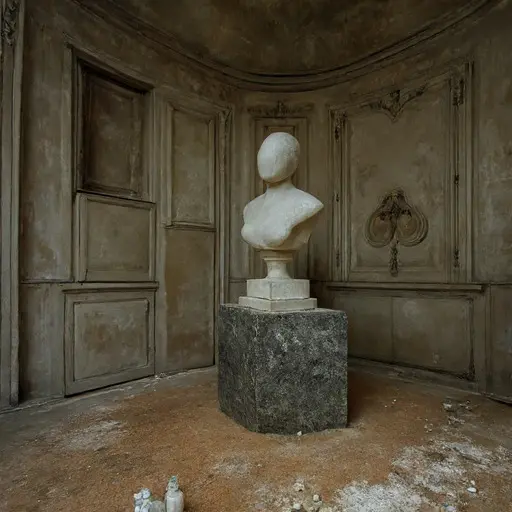
Haptic-Void Hall was an architectural statement of non-perception: a massive, dome-like structure built of pale, smooth stone with almost no external windows, characterized by numerous heavily insulated, internal chambers. Its name suggested a blend of the sense of touch and absolute emptiness. The house sat low in a remote valley, surrounded by dense, high foliage, which naturally muted all external stimuli. Upon entering the main sensory chamber, the air was immediately thick, cool, and carried a potent, almost dusty scent of aged felt, dry plaster, and a subtle, sterile aroma. The floors were covered in thick, sound-dampening cork tiles that muffled all footsteps. The silence here was not merely quiet; it was an intense, perceptual stillness, the profound hush that enforces the memory of complete isolation from all input. This abandoned Victorian house was a giant, sealed bubble, designed to achieve and hold a state of absolute, unchangeable, sensory deprivation.
The Physiologist’s Perfect Blank
Haptic-Void Hall was the fortified residence and elaborate laboratory of Dr. Elias Vane, a brilliant but pathologically obsessive physiologist and sensory researcher of the late 19th century. His professional life demanded the relentless study of human perception, the flawless control of environmental stimuli, and the pursuit of absolute non-perception—a state where the mind was free of all external input. Personally, Dr. Vane was tormented by a crippling fear of overwhelming stimuli and a profound desire to make the chaotic, unpredictable nature of consciousness conform to a state of pure, silent awareness. He saw the Hall as his ultimate experiment: a space where he could finally engineer and preserve a single, perfect, unfeeling body that contained a perfectly silent mind.
The Stimulus Elimination Room
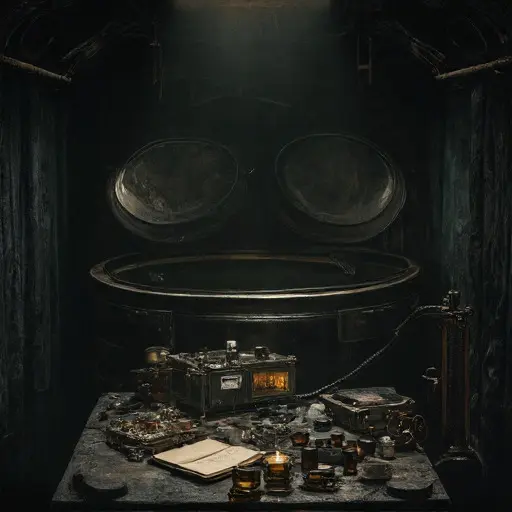
Dr. Vane’s Stimulus Elimination Room was the engine of his obsession. Here, he worked to isolate and stabilize the human sensorium. We found his final, detailed Perception Compendium, bound in thick, featureless black leather. His entries chronicled his escalating desperation to find the “Zero-Input State”—a conscious mind free of all sensation. His notes revealed that he had begun to believe the most chaotic element was the sense of touch—the constantly changing contact with the world. His final project, detailed meticulously, was the creation of a massive, unique, internal “Master Body”—a final, massive, perfectly preserved clay cast of a human form, designed to be permanently covered in a thick, insulating layer of non-conductive, self-healing resin, ensuring no physical sensation could ever penetrate it.
The Final Cast
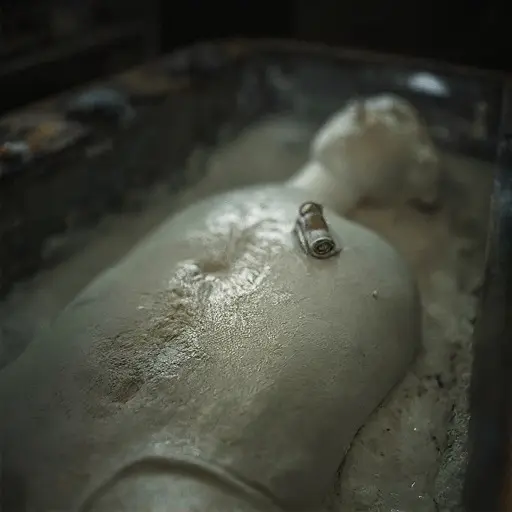
The most chilling discovery was made back in the main chamber. Tucked directly beneath the large marble pedestal was a massive, custom-machined wooden sarcophagus, its lid heavy and sealed. When opened, it contained a life-sized plaster cast of a human body. The figure was utterly smooth, featureless, and covered entirely in a thick, glass-like layer of clear resin, which had hardened into a dense, non-conductive shell. Tucked into the resin near the hand of the cast, sitting perfectly on the surface, was a single, small, tarnished finger thimble, used to press and shape clay. Tucked beneath the sarcophagus was Dr. Vane’s final note. It revealed the tragic climax: he had successfully created his “Master Body,” achieving the absolute, unfeeling stasis he craved. However, upon completing the final resin coat, he realized that in perfectly isolating the body from sensation, he had isolated the consciousness inside the resin with no means of communication or escape—an eternal, silent prison. His final note read: “The seal is absolute. The silence is perfect. But the truth of being is the desire to touch.” His body was never found. The silent seal of Haptic-Void Hall is the enduring, cold, and massive resin-coated figure, a terrifying testament to a physiologist who achieved sensory perfection only to find the ultimate, necessary flaw was the removal of the very desire to feel, forever preserved within the silent, unfeeling stasis of the abandoned Victorian house.}