The Silent Script of Caligo-Rune House
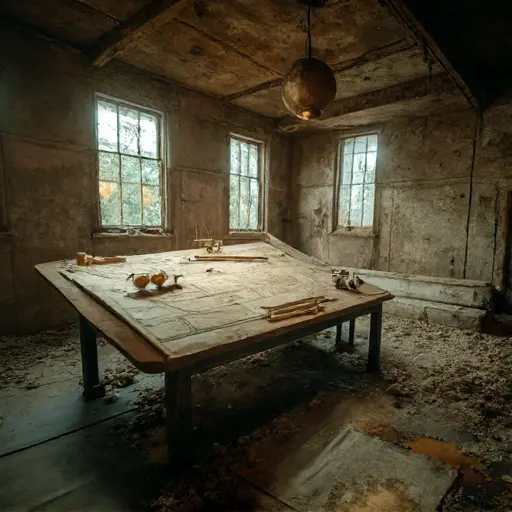
Caligo-Rune House was an architectural anomaly: a sprawling, single-story mansion built of pale, smooth sandstone, characterized by a complex, asymmetrical floor plan that made navigating the interior nearly impossible. Its name suggested a blend of deep fog and mysterious script. The house sat low in a vast, featureless coastal marsh, often shrouded in a thick, disorienting mist. Upon entering the main charting room, the air was immediately cold, thin, and carried a potent, mineral scent of aged parchment, oxidized lead, and a faint, acrid trace of salt air. The floors were rough, uneven stone, amplifying every faint sound into an unsettling echo. The silence here was profoundly disorienting, the kind of quiet that suggests one is utterly lost and without bearings. This abandoned Victorian house was a machine built for orientation, now the ultimate symbol of lost direction.
The Cartographer’s Perfect Blank
Caligo-Rune House was the fortified residence and elaborate charting facility of Professor Elias Thorne, a brilliant but pathologically obsessive cartographer and topographer of the late 19th century. His professional life demanded the relentless surveying of terrain, the meticulous plotting of coordinates, and the pursuit of absolute, irrefutable geographical truth. Personally, Professor Thorne was tormented by a crippling fear of error and a profound paranoia that all maps were fundamentally flawed, leading to fatal mistakes. He saw the House as his ultimate, final map: a space designed to represent a terrain so perfectly defined that it could never lead anyone astray.
The Scale Model Chamber
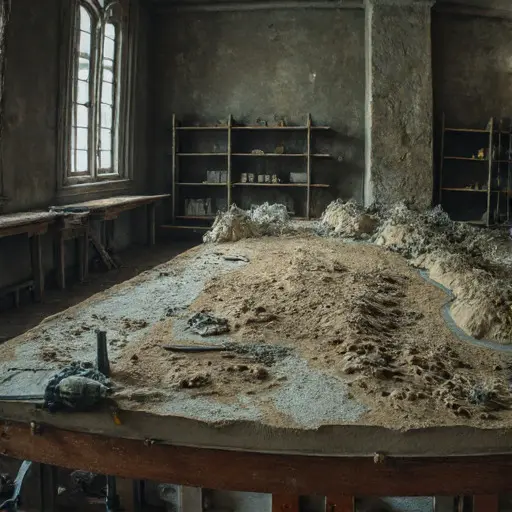
Professor Thorne’s Scale Model Chamber was where he attempted to bring his abstract data into physical reality. Here, amidst the plaster and clay, we found his final, detailed Coordinate Log, bound in stiff canvas. His entries chronicled his escalating desperation to achieve a “Zero Error” map—one where every single point was perfectly verifiable. His notes revealed that he had begun to believe the errors were inherent not in his data, but in the terrain itself, which he saw as a malicious, changing entity. His final project, detailed meticulously, was the creation of a massive, single, master map designed not to chart geographical features, but to chart the entire internal space of Caligo-Rune House itself, turning his home into the subject of his final, perfect map.
The Final Coordinates
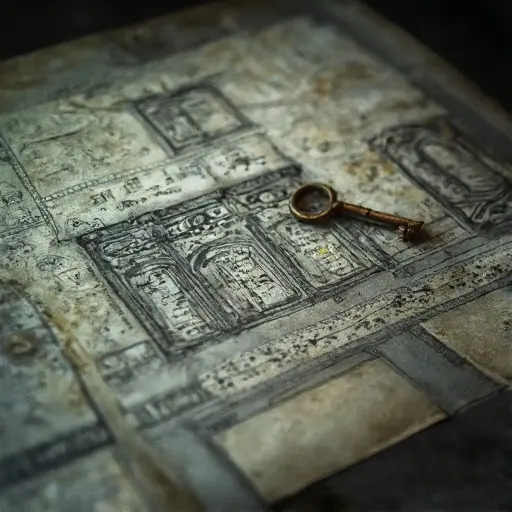
The most chilling discovery was made in the very center of the main charting room. The large drafting table was covered by the final Master Internal Map. The map was incredibly detailed, charting every wall, door, and floorboard of the house in precise, microscopic detail. Tucked beneath the map was a single, sealed wooden box. Inside, we found the only object the Professor had charted but could not locate: a simple, tarnished brass house key. Tucked beneath the key was Professor Thorne’s final note. It revealed the tragic climax: he had perfectly charted the entire house, proving its absolute spatial integrity, but realized that the one thing he could not map was himself—his own shifting presence within the structure. He had deliberately lost the final key to lock himself out of his own perfect map. His final note read: “The map is finished. The terrain is stable. The only lost coordinate is the cartographer.” His body was never found. The silent script of Caligo-Rune House is the enduring, cold stillness of that perfect, hyper-detailed internal map, a terrifying testament to a cartographer who sought absolute certainty in geography, only to find the ultimate, unchartable truth of his own profound disappearance preserved within the silent, abandoned Victorian house.