The Silent Rotation of Halewick Observatory House
Halewick Observatory House sits in a quiet forest clearing under a uniform layer of overcast sky, where light spreads evenly across every surface without shadow or contrast. The surrounding trees are evenly spaced, forming a natural ring around the structure, as if the forest itself had agreed to maintain distance. The atmosphere is still, neutral, and scientifically calm—more like a paused experiment than an abandoned home.
The building is a compact Victorian residence constructed from pale stone and white-painted timber, carefully preserved and structurally intact. Its most defining feature is a central observatory dome that rises seamlessly from the middle of the house.
The combination of domestic architecture and scientific structure feels intentional and harmonious, as though the house was designed to bridge private living and systematic observation.
The observatory dome is circular, made of segmented glass panels fitted into a precise iron frame. The glass remains intact but carries a faint haze of age, softening the view of the interior. An iron ring mechanism encircles the base of the dome, frozen in place—once capable of rotation, now locked without visible damage or corrosion. The stillness of this mechanism gives the impression that motion was simply paused rather than discontinued.
The main house beneath the dome is orderly and symmetrical. Tall sash windows are evenly spaced across both floors, their proportions consistent and carefully aligned. The only deviation appears where the rectangular structure transitions into the circular base of the observatory. Here, interior walls subtly curve to accommodate geometry that does not conform to standard right angles, yet nothing appears forced or structurally compromised.
The roof is composed of clean, dark gray slate, tightly fitted and well maintained. It wraps neatly around the base of the dome, forming a stable boundary between traditional Victorian architecture and the scientific structure above. Chimneys rise in simple vertical lines, evenly spaced and undisturbed by time or weather. There is no sagging, no collapse—only long-term stillness.
The entrance is centered beneath a modest stone archway, its proportions calm and balanced. The wooden door remains closed, slightly faded but completely intact. The stone steps leading up to it are evenly cut and gently worn, their edges softened by years of subtle use rather than decay or erosion.
Inside the observatory dome, the circular room is visible through the glass. It is empty, but carefully constructed, with faint concentric floor markings that suggest measurement or tracking systems once in use.
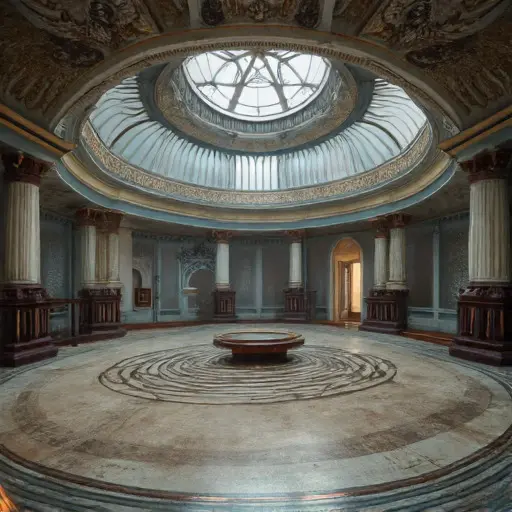
No instruments remain, but fixed mounting points and metal brackets are embedded at regular radial intervals along the floor and inner frame, reinforcing the sense of precise but abandoned functionality. The space feels designed for observation rather than occupation, a room meant to align with movement that is no longer occurring.
Windows across the rest of the house remain mostly clear, with only a thin film of dust softening their transparency. Curtains are absent or carefully drawn aside and left undisturbed. One upper window is slightly ajar, introducing the only visible disruption in an otherwise perfectly controlled exterior.
The surrounding forest maintains a respectful boundary around the clearing. Grass remains short and evenly distributed, with only sparse wild growth near the foundation stones. The trees do not press inward; instead, they form a consistent perimeter that frames the structure without encroaching upon it.
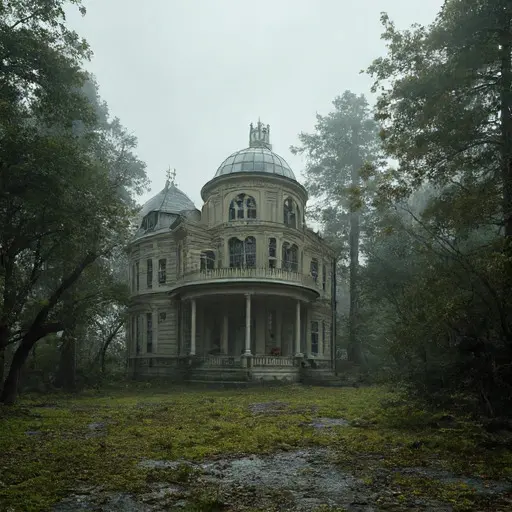
Halewick Observatory House does not feel ruined or forgotten. It feels paused mid-function, as if its systems were intentionally halted at a precise moment of observation. The geometry remains exact, the materials remain intact, and the silence suggests not abandonment in the traditional sense, but suspension—an unfinished cycle of watching that never resumed.