The Silent Petrescu Lamp Alcove Where the Tension Wouldn’t Hold
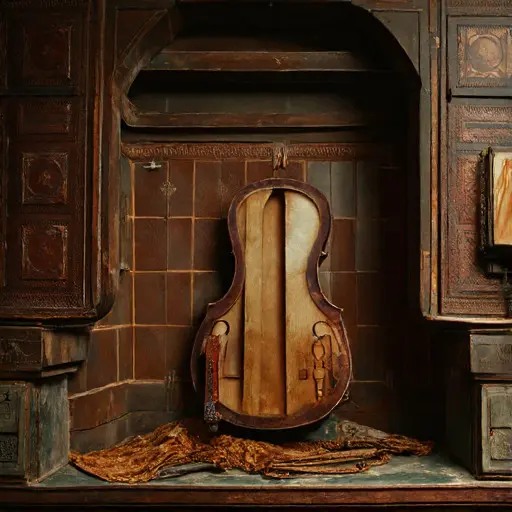
The lamp alcove holds a low amber glow, as though the lamps themselves cannot decide whether to keep breathing light. Each tool appears touched by recent testing, a steadiness halted at the edge of sound.
A Luthier Guided by Quiet Precision
Constantin Radu Petrescu, born 1875 in Cluj, built modest violins for school ensembles and traveling trios.
A cotton kerchief from his sister Ana cushions thin scrapers. Constantin shaped plates at dawn, carved scrolls by midday, and tuned thicknesses at dusk under lamp warmth. His humble background shows in re-ground varnish pigments and reused clamps whose screws shine from overuse.
Wood and Light Gathered in Frail Harmony
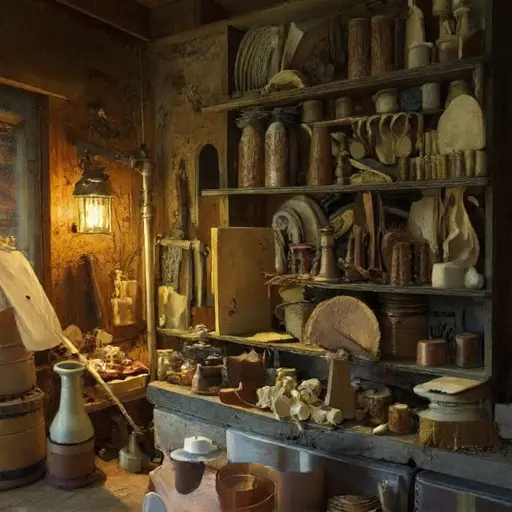
A spruce wedge lies split along an uncertain grain. The workbench holds a half-fitted bass bar, chalk dust still clinging to its underside. A folded knife cloth bears faint streaks of red varnish, brushed once and blotted twice. On the lamp shelf, a tonewood billet leans toward a neck blank whose scroll outline falters at the third turn. Even the lamp wicks seem trimmed with distracted care, their flames drawn thin.
Strain Lingering Behind Thin Plates
Behind stacked tonewood rests a returned note—“uneven response.” One rib strip lies warped where moisture touched it too long. The stool stands angled toward the alcove entrance, as though Constantin rose repeatedly to gauge the room’s meager light. A caliper, usually exact, shows a faint misreading where the screw drags. Chalk marks on the tiles form soft arcs from slow pacing, each curve uncertain.
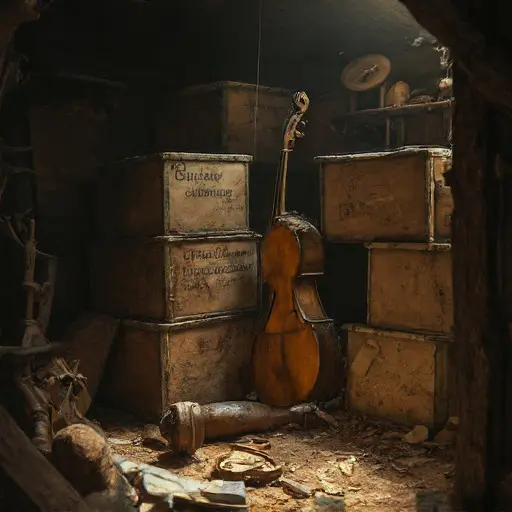
Returning to the lamp alcove, one quiet trace remains: a flawless scroll blank placed beside its wavering counterpart—certainty and doubt resting in mute resonance.
The house remains abandoned.
