The Silent Novák Marionette Loft and the Strings That Loosened
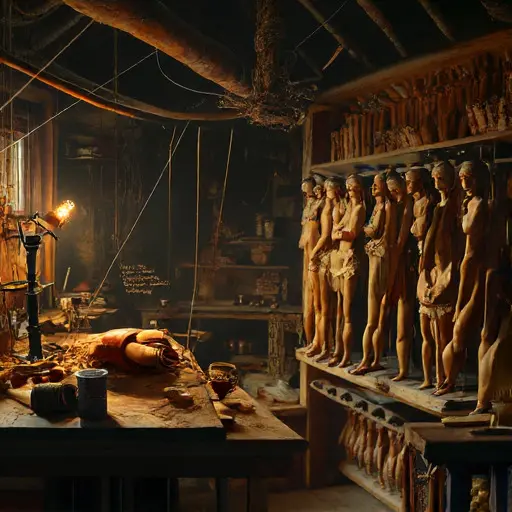
The Marionette Loft holds a hush textured by dust and faint wood shavings. A carved hand lies on the floor, its wrist cord trailing across a warped board. On the central workbench, a torso waits beneath taut lines that never found their matching limbs.
A shallow tray of brushes sits untouched, varnish hardened at the tips. Along a wall beam, the practice pulley and its guide cord sag by a few inches, the droop slight yet troubling—an angle of doubt left in midair. Nothing in the room signals haste, yet everything feels paused, caught just before craft met its next breath.
Workmanship of Matěj Ludvík Novák, Marionette Artisan
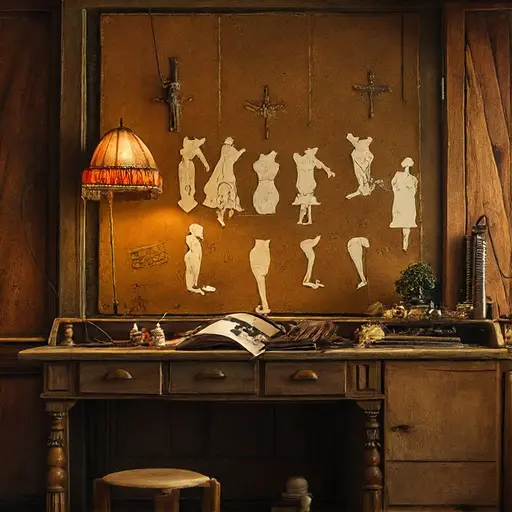
Small, deliberate clues unveil Matěj Ludvík Novák, born 1872 in Prague, raised within a family of modest woodcarvers. In the Pattern Nook, paper silhouettes of puppets—stamped with Czech annotations—hang in even rows. His chisels bear Prague makers’ marks, handles polished by steady hands. A jar of garnet-tinted varnish hints at an old Bohemian preference for warm finishes. His temperament emerges in the tidy coil of strings, carefully waxed, resting beside the bench: a man who shaped motion from stillness, whose patience accumulated through thousands of tiny cuts.
He likely began mornings trimming joints, settled into afternoons carving faces with precise strokes, and closed each evening by testing balance along the practice frame. In the Parlor Corner, two finished marionettes hang near the mantel—one a jester mid-bow, the other serene, almost prayerful. Their balance is flawless, each suspended by strings of equal tension, the kind only a patient artisan would trust himself to perfect.
Wavering Lines That Gathered in Quiet Corners
Subtle unrest threads through the house. In the Upper Washstand Room, a cracked water basin smells faintly of oil soap—where he may have cleaned brushes too late at night. A folded notice from a traveling theatre troupe, edges softened by moisture, lies beneath a rag: perhaps an invitation rescinded, or a commission delayed past solvency. On the Guest Cot, a travel coat remains spread open, pockets filled only with carving chalk and a wrapped awl—not the full kit for touring performances.
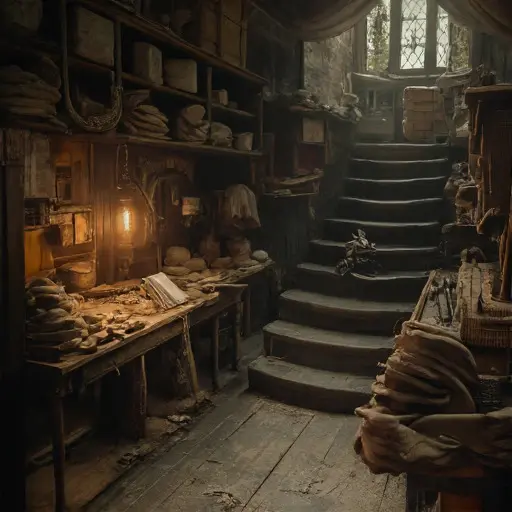
In the Side Storage Closet, a puppet head rests upside down among linen bundles. Its eye sockets remain unpainted, uncarved details trembling in their incompletion. A spool of cord lies uncoiled on the floor, its end knotted tightly as though wrestled with unease. Something—illness, debt, waning confidence—pressed on him quietly, where the house refuses to say more.
A Pulley That Tilted Out of True
Back in the Marionette Loft, unease centers on the listed pulley suspended from the rafter. Its wooden wheel bears a fresh nick along the rim, as if a cord jerked or slipped unexpectedly. Beneath it, the unfinished torso holds a row of pilot holes drilled unevenly—an anomaly for a craftsman of his steady hand. A carving knife rests off-balance atop a block of beechwood, its blade smeared with thin, hurried strokes of varnish.
On the bench’s edge, waxed strings tangle into a confused loop, unlike his usual parallel lines. A measuring rod leans at an unfamiliar angle in the corner, faint chalk residue marking where he once calculated limb ratios with unwavering care. The tension of his work—literal and figurative—seems to have wavered all at once.
Behind the workbench, tucked between stacked wood blanks, rests his final attempt: a painted puppet face whose left cheek shows a wavering contour. The curvature falters just enough for doubt to bloom. No note clarifies the slip—only the soft outline of where his thumb hesitated, smudging a final stroke.
The house offers no further answer, and it remains abandoned still.
