The Silent Morand Cutting Table and the Pattern Left Ajar
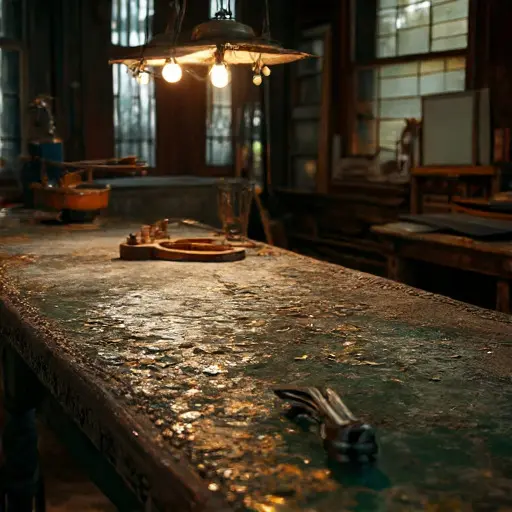
The Glazier’s Workshop carries the hush of a breath held too long. On the cutting table, a half-shaped panel lies beneath chalked borders, its central motif paused in uncertain symmetry. A narrow bench nearby holds flux-stained cloths, still faintly sweet with tin-lead scent.
A penciled note curls at the corner of the table—no words visible, only impressions pressed into the paper. Even the lamplight, dim and amber, seems reluctant to disturb the quiet geometry abandoned mid-creation.
Footprints of Émile Auguste Morand, Stained-Glass Artisan
The furnished rooms suggest the late presence of Émile Auguste Morand, born 1876 in Rennes, trained under local cathedral glaziers who prized patience above all. In the Pattern Alcove, elaborate tracings of Breton knotwork hang in measure-perfect rows. Boxes labeled in French contain pigments for cold enamel touch-ups: iron red, sea green, cathedral blue. His temperament appears in the disciplined order of his cames, sorted by gauge, and the careful stacking of cutoffs used for patching fractures invisible to the untrained eye.
His days once unfolded in steady increments: mornings spent scoring rough shapes; afternoons trimming curves by hand; evenings soldering joins until each line shone true. The Side Parlour displays small finished panels mounted in dark walnut frames—stylized herons, a rising sun, a flowering branch. None boast signature; his pride lived quietly within accuracy, not acclaim.
Strain Rising Through His Careful Routine
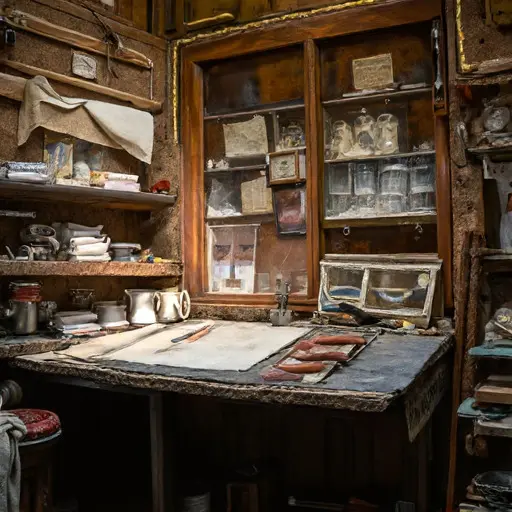
A thread of unease winds quietly through other rooms. In the Upper Washstand Chamber, a cracked glass blank sits atop a towel, its break fresh enough to glint sharply. A folded note from a distant client—edges water-warped—lies beneath a tin of solder; the blurred seal hints at a commission delayed or cancelled. By the stenciled window, a travel robe hangs over a chair, pockets filled only with a handful of chalk stubs and a brass compass for circle cuts.
Down in the Finished Works Closet, two panels wrapped in muslin show minor flaws along their borders: joins slightly uneven, edges subtly warped—faults he would never normally release. The irregularity suggests faltering concentration, perhaps an illness creeping into his hands or eyesight. The house offers no confession, only faint signals of precision misaligned.
The Bevel That Would Not Settle Into Place
Returning to the Glazier’s Workshop, everything bends toward the misplaced bevel strip resting near the scoring wheel. It gleams with an unfinished grind, its edge wavering as though he doubted the line mid-stroke. The half-shaped panel on the table shows a central void where that bevel was meant to sit. Around it, chalk marks cluster in hesitant layers—sketched, rubbed away, drawn again. A soldering iron cools on the trivet, its handle shifted slightly off its usual parallel.
Dust rings trace the absence of tools once arranged with unwavering order. A spool of copper foil slumps across a corner, its end trailing onto the floorboards as if tugged by a moment of indecision. The workshop’s quiet has grown thick, settling on every contour.
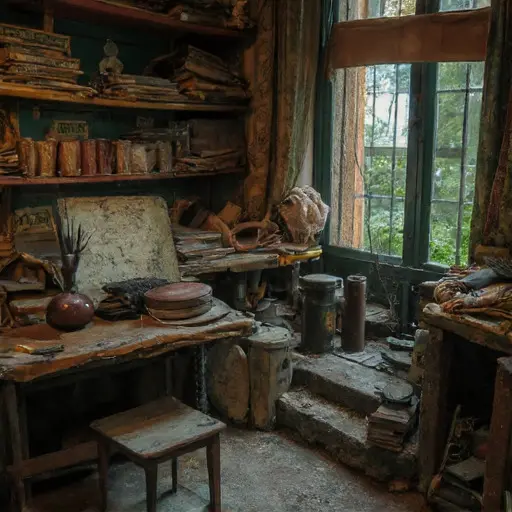
Beneath the cutting table, partly hidden behind stacked glass blanks, rests his final attempt: a narrow panel with a single curve set askew, the solder seam wavering where precision once thrived. No note accompanies it—only a brief indentation in the chalk border, as if his thumb had lingered there before he stepped away.
The house speaks no further, and it remains abandoned still.
