The Silent Liang Porcelain-Firing Chamber Where the Glaze Shifted Loose
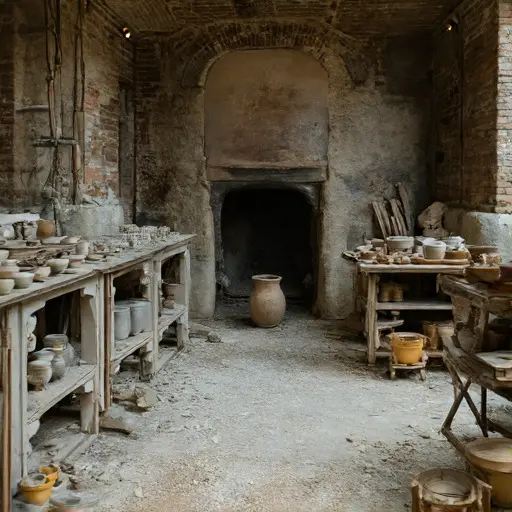
The chamber’s hush feels strangely weighty. A vase sits on the central wheel-stand, its cobalt outline forming a perfect arc until—suddenly—an aberrant stroke veers off. A bamboo brush lies splayed, as though placed down quickly before stiffening.
A slip bowl crusts at the rim where a hand hesitated too long. No violence lingers, only the heavy pause that mirrors an artist’s breath caught between confidence and collapse.
A Life Built from Kiln Heat and Fine Precision
This porcelain-firing chamber belonged to Liang Wenhao, porcelain painter and kiln finisher, born 1878 in a small district near Jingdezhen. Raised by modest clay merchants, he trained under a traveling painter who taught him disciplined brushwork, the patience of layering slip, and the subtle dance between pigment and heat. His younger sister, Liang Meisu, lingers in a red-thread charm tied around a kiln rack.
Wenhao shaped his days a careful way: dawn sketching of motifs on unfired blanks, midday slip layering, dusk adjusting kiln temperature under dim lantern glow. His tools remain in orderly rows—brushes grouped by softness, pigments labeled with delicate characters, glaze ladles rinsed to a quiet sheen. Merchants admired his ability to coax luminous depth from celadon and precise poetry from cobalt strokes.
Work Once Smooth, Then Quietly Troubled
During strong seasons, the chamber thrummed with even purpose. Cobalt shipments from coastal traders filled glazed jars. Clay blanks dried along the shelves in tidy progressions of hue. Finished bowls glimmered as though reflecting distant sky.
Yet small shifts betrayed strain. On one tile, a mountain motif wavers at its peak. On another, a lotus petal smears where Wenhao once painted with unerring grace. A celadon jar shows faint blotching, a glaze pulled unevenly. His commission ledger bears a high-ranking buyer’s name written, rewritten, then struck out in sharp lines. A brief Chinese note reads: “They say my glaze lies.”
Rumor drifted: a prestigious patron accused Wenhao of misrepresenting the intended color tone—claiming his brushwork distorted a family’s ceremonial emblem. Others whispered that the buyer demanded an imported style Wenhao refused to imitate.
The TURNING POINT Held in Clay and Uncertainty
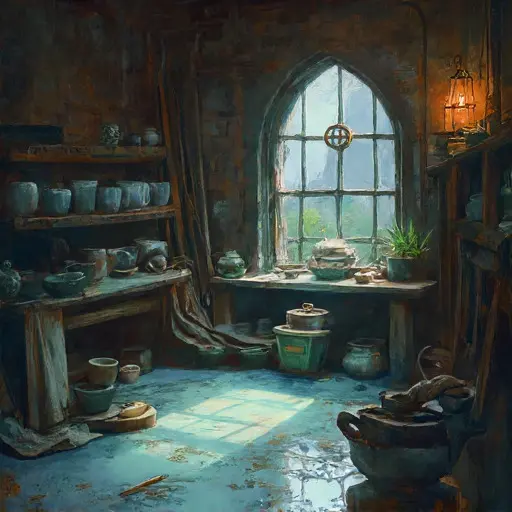
One late firing night left quiet evidence. A ceremonial plate rests on the kiln stones, its central emblem forming cleanly until the outer ring—where trailing petals buckle out of symmetry. A firing log shows repeated temperature corrections, some overwritten, some smudged. A cobalt brush bears cracked bristles, pigment clotted at the tip.
Pinned beneath a glaze test tile lies a torn slip: “They insist I falsified the emblem.” Another scrap, blurred at the edges, reads: “Reparation impossible… I cannot match their demands.” The strokes falter near the end, ink pooling as if his hand lingered too long.
Even the kiln’s damper rod sits misaligned, not fully engaged—a rare oversight for someone who once controlled heat as precisely as breath.
A Small Pocket Behind the Drying Shelves
Behind stacked porcelain blanks, a thin board slides aside. Inside rests a small vase—beautifully formed, its celadon base soft as mist—but its final motif fades halfway through, cobalt dissolving into pale wash. Beside it, a folded note in Wenhao’s delicate script: “For Meisu—when clarity steadies again.” The last word trails into faint ink, the brushstroke thinning like cooling glaze.
A pristine porcelain blank lies next to it, untouched, its surface chalky and waiting for the first decisive line he never laid.
The Last Faint Stroke
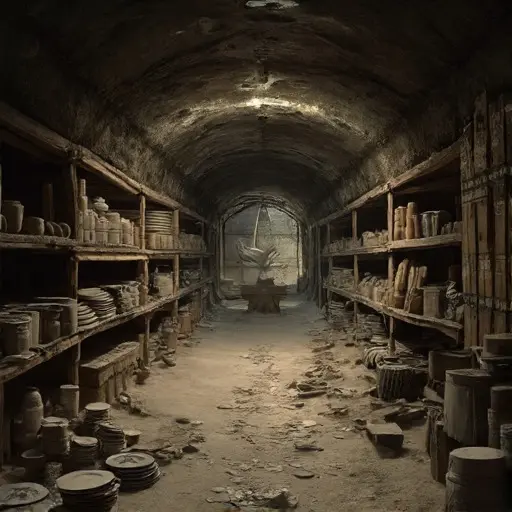
Inside a drawer beneath the turning wheel rests a test shard: one perfect cobalt line that abruptly dissolves into a pale, uneven wash. Under it Wenhao wrote: “Tone fractures when trust erodes.”
The porcelain chamber drifts back into quiet resinous air, pigments drying into a silence without resolution.
And the house, holding its abandoned kiln painter’s room, remains abandoned.
