The Silent Kowalski Brining Cellar Where the Measure Went Strange
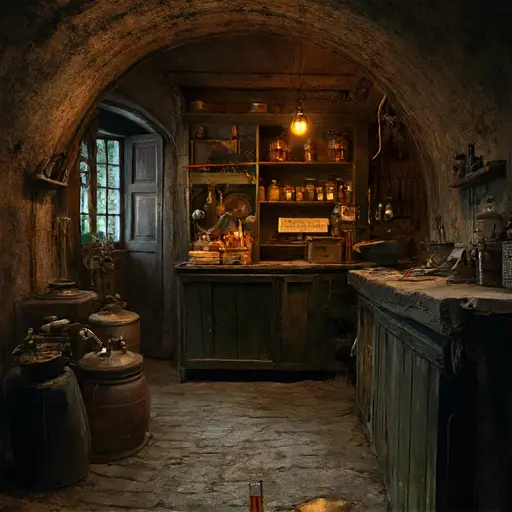
The brining cellar smells faintly of salt, iron, and herbs long left to settle. Lanternlight hovers over instruments arranged with deliberate calm, though each shadow hints at a steadiness that slipped without warning.
A Life Bound to Quiet Preparations
Wiktor Jan Kowalski, born 1875 in Kraków, mixed modest remedies for travelers and neighbors.
A linen scrap from his sister Irena cushions his finer glassware. Wiktor prepared tinctures at dawn, blended powders by midday, and calibrated measures by lanternlight. His humble background appears in reused corks and Polish-script notes tucked behind brine jars.
Calculations Paused in a Room Meant for Salt
A mortar sits beside a tin of dried valerian, pestle dusted from interrupted grinding. A narrow funnel leans against a jar whose liquid has separated at the rim. The brass scale bears a faint tilt, one pan slightly heavier with residue. On the stone counter, a folded cloth holds vials whose markings fade near the top, as though traced and retraced. Even the lantern flame trembles toward the barrels, echoing an unsettled balance.

Strain Whispered Through Glass and Salt
Behind stacked barrels lies a returned note—“incorrect proportion.” A rejected tincture darkens a shallow dish, its surface clouded. Wiktor’s stool angles toward the steps, suggesting restless pacing. A small scoop rests on its side, handle warmed by recent use. A ring of spilled brine curves across the floor, marking each turn of indecision. Even the stone counter shows faint scratches from repeated adjustments.
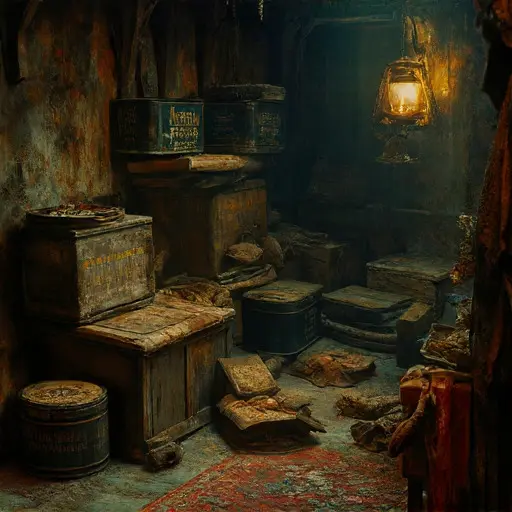
Returning to the brining cellar, one last sign remains: a perfectly balanced vial set beside the uneven one—certainty and doubt settling in shared, quiet air.
The house remains abandoned.
