The Silent Ishikawa Scriptorium Desk and the Stroke That Shivered
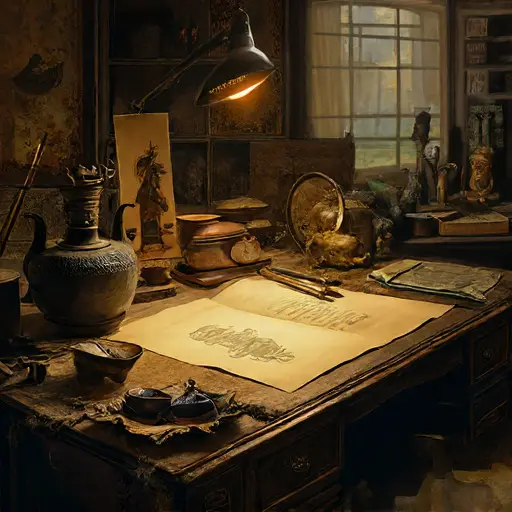
The Calligraphy Room holds a soot-sweet hush, steeped in sumi and paper fibers. Brush cords sway faintly, disturbed by no breeze. The scriptorium desk sits in expectant calm, its blotting cloth stiffened by ink that dried before a final stroke could be set.
A jade paperweight has been nudged a few inches from true center. Nothing is disordered, yet the arrangement feels tenderly off balance—as though a single lapse had rippled through the quiet and left every object wondering where the next gesture went.
The Delicate Discipline of Atsuko Haru Ishikawa, Calligrapher
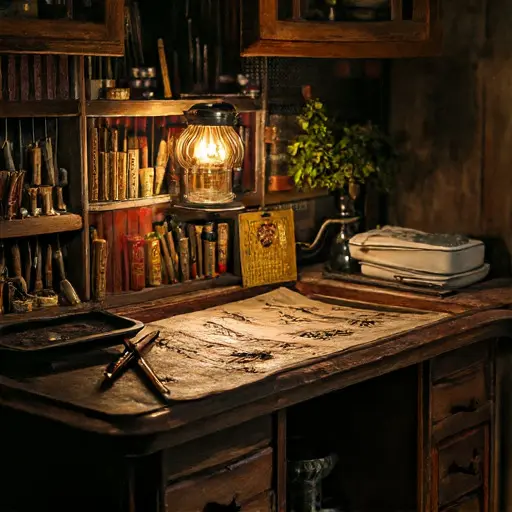
Evidence across the furnished rooms reveals Atsuko Haru Ishikawa, born 1878 in Kyoto, trained under modest brush masters who prized restraint and clarity. In the Brush Alcove, racks hold tools sorted by hair type—wolf, goat, sable—each handle lacquered with Japanese motifs. Inkcakes embossed with kanji line a cedar tray, their ends worn by years of patient grinding. Her temperament emerges in this measured exactness: a calm practitioner of form, attentive to the space between each curve of ink.
Her daily rhythm likely began with warming water over a small brazier, then grinding ink to the desired viscosity. Afternoons devoted to copying poems onto cream parchment, evenings to mounting finished pieces onto hanging scrolls. In the Side Parlour, framed verses in Japanese script share space with English lettering samples—hinting at commissions from abroad and a quiet pride in bridging traditions. The room’s stillness suggests careful devotion, the kind that finds solace in practiced lines.
Subtle Fractures in a Steady Hand
Moments of unease appear in adjacent rooms. In the Upper Washstand Chamber, a porcelain basin shows diluted sumi swirling in an uneven ring, as if rinsed in haste. A letter from London, its seal broken and edges softened by steam, lies unfolded near the mirror—perhaps a cancellation or critique. On the Guest Cot, a travel shawl encloses only two brushes and an empty inkstick box, insufficient for departure yet too intentional for casual storage.
A mounting scroll in the Side Cabinet hangs crooked on its rod, the paste beneath it puckered. Atsuko would never have allowed such misalignment. A cracked water dropper rests atop a blotter stained in irregular arcs, the sort of mark made by trembling or deep distraction. These signs trace a quiet struggle—financial strain, waning commissions, or unspoken grief pressing gently but persistently on her craft.
A Stroke That Faltered Beyond Correction
Returning to the Calligraphy Room, the scriptorium desk reveals the heart of hesitation. The half-written poem shows one stroke thinning into a wavering line, its tail nearly broken. A sable brush lies bristle-down—an error so unlike her fastidious care. The inkstone beside it contains a shallow pool, its sheen dulled by overgrinding, a sign of restless repetition rather than focused preparation.
On the desk’s corner, a parchment sheet for Western lettering bears faint guidelines drawn too heavily, then scrubbed out, the fibers frayed. Even the bronze crane paperweight leans slightly askew, as though nudged by an uncertain hand retreating from the page. The tension in the room feels delicate, almost apologetic.
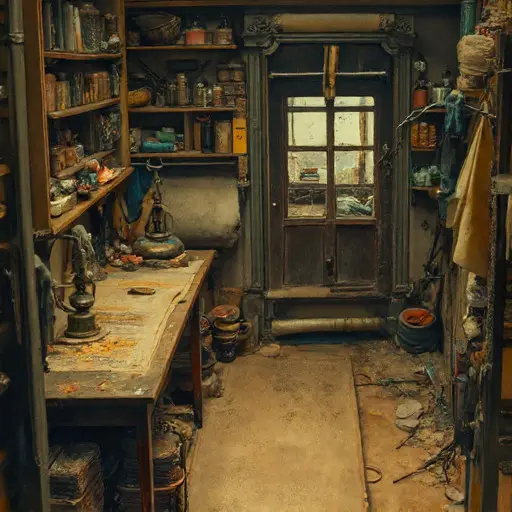
Behind the scriptorium desk, tucked beneath a cabinet of mounting tools, lies her final attempt: a scroll whose final vertical line stalls midway, the ink paling into nothing. No annotation accompanies it; no correction follows. Only the quiet arc of a gesture that lost its certainty at the moment it mattered most.
The house preserves its silence, and it remains abandoned still.
